Showing posts with label women. Show all posts

Friday, August 15, 2014

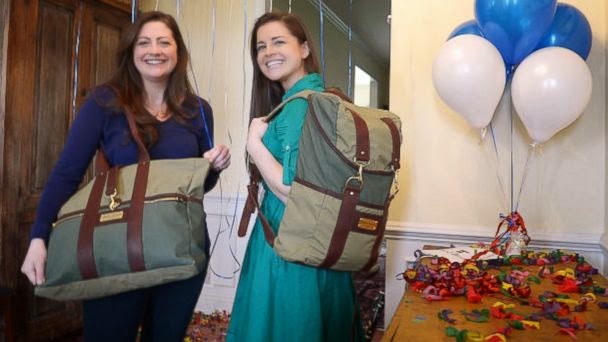
Army Officer Recycles Military Surplus & Creates Fashionable Bags

By Angel Canales. Published by ABC News on 14 August 2014.

DENVER–Serving in the military while also being the CEO of a fashion company can be an intimidating but also a rewarding experience. It’s also a perfect match for U.S. Army 1st Lt. Emily Núñez, 24, who saw a need and filled it, helping her fellow veterans along the way.

“It has been challenging at times but the two roles complement each other. As an officer in the US Army your job is to lead soldiers and to motivate them to accomplish a task. As the CEO, my job is to ensure that we’re accomplishing our social mission while keeping the team excited about what we’re doing,” she says.

Núñez is the CEO and co-founder of Sword and Plough. Sword and Plough creates bags and other accessories out of repurposed military surplus, like shelter halves tents, laundry bags and sleeping bag covers.

Although Núñez was committed to a career in the military, she and her sister Betsy Núñez, 26, co- founded Sword & Plough in 2012.  Growing up in a military family Emily followed in her father’s footsteps and joined the Army. She currently serves as an Intelligence Officer with the Group Support Battalion in the 10th Special Forces Group (Airborne) at Fort Carson, Colorado. Prior to joining the military, Núñez enrolled in the Army ROTC at the University of Vermont and and Middlebury College in Vermont in 2008. It was there during her senior year that the idea to launch her entrepreneurial venture was born.

The idea to create her fashion company came to Núñez after a talk at the Middlebury’s Center for Social Entrepreneurship. During the Social Entrepreneurship Symposium at Middlebury Jacqueline Novogratz, founder and CEO of Acumen Fund talked about businesses that had incorporated recycling into their business model. Núñez took note and put her social entrepreneur spirit to work. She began to think about what around her was routinely wasted and could be recycled and turned into something powerful. ”I was aware that there was a lot of military surplus that was wasted, thrown away or burned,” Núñez says.

Emily told her sister Betsy about her idea to turn a military shelter halves tent into tote bags.  ”When she first told me about her idea I was so surprised and happy that she shared that with me. I knew this was something that could be very special and could become something really unique,” Betsy says. From that conversation the sisters continue to build on the idea and business model.

Sword & Plough’s name comes from the biblical phrase to “turn swords into ploughshares” from the Book of Isaiah.  For Emily and Betsy it means re-adapting military technology for a peaceful civilian purpose. The sisters are giving these fabrics and materials another purpose as stylish designs. “Some of the materials we use have been used by the Army and military since the Civil War,” Betsy says.

Emily and Betsy never went to school for business and they didn’t have any experience in fashion either but that didn’t stop them. “It was a challenge to start the business but at the same time it was a huge opportunity,” she says. The sisters thank the Middlebury Center for Social Entrepreneurship for helping them every step of the way.

To build the company, they sought out support and mentorship from other groups. They attended the Dell Summer Social Innovation Lab in July 2012. During the three-week program, they were able to build their business plan, supply chain, brand name and a prototype bag.

The idea caught on and last year Sword and Plough participated in Mass Challenge, the largest startup accelerator and competition in the world.  Some 1,200 young companies from all over the world applied for 120 spots.  Sword and Plough was selected and they were awarded $50,000 to grow their business. Preparing for that pitch was nerve-racking, Betsy says. At the time, Emily was serving in Afghanistan and they practiced over Skype how they were going to prepare their pitch.

The company’s social mission is to empower and promote veteran employment, strengthen military civil relations and reduce waste. All items are made in the US and the company works with veteran owned, operated and staffed manufactures. “I really wanted to create a product that would physically touch civilians in a beautiful way and to remind them of veterans and the sacrifice that they made but also the challenges that they encounter as they transition into civilian life,” Emily says.

For Emily, veteran employment was their main company goal. During her time at the Army Airborne School at Fort Benning, Georgia, she heard about veterans having difficulties finding meaningful employment. “I spent a lot of time with soldiers of all different ranks and services and many of them told me about friends of their who were getting out of the military and faced challenges as they tried to find employment and that experience always stuck with me,”  she says.

The company’s launched started on Kickstarter in 2013 with a goal to raise $20,000.   Their campaign exceeded their goal and raised over $312,000 and so far have provided jobs to 35 veterans and recycled over 15,000 pounds of military surplus.

Sword and Plough items are on sale on their website and they are being sold in Toms Marketplace.

Emily and Betsy are  happy to be accomplishing a social mission with their company. “I want Sword & Plough to be a leader in the field of social entrepreneurship that is able to communicate effectively the awesome skill that veterans bring to communities. As a fashion brand over the course of the next five to 10 years we want Sword & Plough to be known as a strong American heritage brand,” Emily says.

Thursday, December 20, 2012

Season of goodwill


By The Sultanah of Johor RAJA ZARITH IDRIS. Published by The StarOnline on 9 January 2011.

DURING the days before Christmas last year, I wished my friends who were celebrating it “Merry Christmas” in much the same way they would wish me “Selamat Hari Raya” or “Happy Eid”.

I find it rather sad that such a simple greeting – one which I grew up with and which I have never regarded as something that would compromise or de-value my own faith – is now regarded as something so religiously incorrect for us Malaysian Muslims.

When I was at boarding school in England, I had to go to church every Sunday because it was part of the rules. My father advised me to consider it as part of my “education” and he had no doubt that the experience would strengthen rather than weaken my own faith.

I was able to see the similarities and differences between Christianity and Islam. I learned more than the average Malaysian Muslim would about Christianity. I learnt that just as we Muslims categorise ourselves according to the four different schools of thoughts of the four Imams (Imam Malik, Imam Al Shafi, Imam Abu Hanifa and Imam Ahmad Abn Hambal) and are either Sunnis or Shias, so Christians too are divided into different sects or churches.

Going to church did not make me less of a Muslim when I was a young girl, and neither does saying “Merry Christmas” make me less of a Muslim now. My faith has not been shaken just because I wished some friends a time of joy with their families. Neither will I suddenly suffer from amnesia and forget what my religion is.

What I do not wish to forget, however, is that there are good, kind people who are not of the same faith as me.

As Harun Yahya, the Turkish writer (he was selected last year as one of the 500 most influential Muslims in the world by the Royal Islamic Strategic Studies Centre of Jordan) noted: “Islam is a religion of peace, love and tolerance.

Today, however, some circles have been presenting a false image of Islam, as if there were conflict between Islam and the adherents of the two other monotheistic religions. Yet Islam’s view of Jews and Christians, who are named ‘the People of the Book’ in the Quran, is very friendly and tolerant.

“This attitude towards the People of the Book developed during the years of the birth of Islam. At that time, Muslims were a minority, struggling to protect their faith and suffering oppression and torture from the pagans of the city of Mecca. Due to this persecution, some Muslims decided to flee Mecca and shelter in a safe country with a just ruler. The Prophet Muhammad told them to take refuge with King Negus, the Christian king of Ethiopia. The Muslims who followed this advice found a very fair administration that embraced them with love and respect when they went to Ethiopia. King Negus refused the demands of the pagan messengers who asked him to surrender the Muslims to them, and announced that Muslims could live freely in his country.

“Such attitudes of Christian people that are based on the concepts of compassion, mercy, modesty and justice, constitute a fact that God has pointed out in the Quran.”

I do not wish to be a self-centred Muslim who expects friends of other faiths to wish me Selamat Hari Raya or, for those who are not Malaysians and therefore do not know about Hari Raya, a Happy Eid and yet do not return their goodwill when it is Christmas, Chinese New Year, Deepavali or Vesak Day.

Every year, friends who are Christians, Buddhists, Hindus, Sikhs or those without any faith come to our home to celebrate Hari Raya with us. They do so with sincerity and as a mark of respect for one of the most important days in the Muslim calendar. Why should we not reciprocate their kindness, show them the same mark of respect for their religion and wish them the same joy on their holy days of celebration?

An Islamic scholar and lecturer also reminded me that as Muslims we must remember the importance of both the five Pillars of Islam and in the six Pillars of Iman (Faith), which are:

> Belief in Allah;

> Belief in the angels;

> Belief in the revealed Books (which include the Bible, the Torah and the Holy Quran);

> Belief in the Prophets (May Peace be Upon Them);

> Belief in the Resurrection and the events of Kiamah, the Day of Judgement; and

> Belief in the predestination (Qada’ and Qadar) by Allah in all things.

The prophets include not just Muhammad (May Peace Be Upon Him) as the last prophet and as the Messenger of Islam, but also in the 24 earlier ones who are mentioned in both the Bible and the Quran. Four of them are Ibrahim (Abraham), Musa (Moses), Daud (David), and Isa (Jesus).

So, if Christmas is the celebration of the birth of Isa (Jesus), a prophet respected and revered in Islam, is it so wrong to wish a blessed day for those who celebrate it?

We are now in the second decade of the 21st century. Surely, we should, now more than ever, be far more enlightened at a time when information of any sort and of all kinds are so readily available to us.

What is most important is that we regard one another as fellow citizens and treat each other with respect, regardless of our race or religion.

> The writer is Royal Fellow, School of Language Studies and Linguistics, Universiti Kebangsaan Malaysia (UKM), and holds a BA (Honours) degree in Chinese Studies, University of Oxford.

Link: 

Tuesday, December 4, 2012

Love Scam Syndicates


Published by The StarOnline on 4 December 2012.

Love scam syndicate members are trained in the art of sweet-talking potential victims into parting with their cash in the name of love. They select their targets, especially lonely women, and flirt with them online for several months before conning them.

Federal CyberSecurity and Multimedia Investigation Division director Asst Comm Mohd Kamaruddin Din said these syndicates would train new recruits on how to ensure victims fall in love with them. “These syndicates comprise mostly African students who recruit members from their homeland to enter Malaysia with the promise of easy money. These recruits speak fluent English and are trained for about a week or two on how to make their victims fall in love with them in just a few months,” he said.


She had not met him in person but she was willing to give him RM1mil after he told her sob stories about being in financial difficulties. Sarah (not her real name) met John Smith, who claimed to be an offshore engineer in Terengganu, online. Both hit it off right from the start.

Months later, John claimed he was in financial difficulties. His family's construction business in Texas was not doing well due to the global economic slowdown and his company in Malaysia was downsizing. Being “in love”, Sarah, 40, agreed to help him by wiring more than RM400,000 to an account which he claimed was in his mother's name.

Monday, December 3, 2012

No money and nothing to eat at times


Published by The StarOnline on 3 December 2012.

Manizel Mazano, from the Philippines, has only one wish – she just wants to be in a place where she can put her miserable experience at a maid agency behind her. “It was terrible. I had no money and nothing to eat at times as the bosses ordered me to work for the past six months. I have not seen any of my salary as well. The worst part is when they (maid agency owners) locked me in a room with other maids after work. I don’t have much to ask now. I just hope we are placed in a much better place after this,” the 22-year-old woman said yesterday at the district immigration office."

Mazano said she paid for her own travel expenses when she came to the country several months ago.

Adinda Tanas, 20, an Indonesian helper, said the agency owner was indifferent to their health. “I once complained of a swollen leg because I was standing too long but they did not care,” she said.

Adinda, who entered Malaysia on a social visit pass in May, also claimed she had not been paid her wages. When she questioned the agency about this, Adinda said she never got a proper answer.

Another Indonesian woman, Yusnida, who arrived here six months ago, said the agency had been bringing her and other women to different homes to work as maids from 5am to 8pm daily. “My hands and legs were swollen from the long hours of work every day. The agent only provided us with two meals a day. There was not enough food and the workload was heavy,” she said.

Yusnida had once asked to go home but was told by the agency that she could only leave once she could settle the cost in agency fees to bring her here.


The Port Klang Immigration rescued 105 foreign women confined in a four-storey building of a maid agency in Bandar Baru Klang near here after raiding the premises yesterday. Selangor Immigration director, Amran Ahmad said the raid at about 7.45am found the women aged between 18 and 25 years, locked on three floors of the four-storey building, occupied by the maid agency.

"The women comprised 95 Indonesians, Filipinos (six) and Cambodians (four) who only had social visit passes and were believed to have entered the country between one and six months earlier," he said in a media conference here today.

He said 12 people were arrested, three of them were local men believed to be the agency employees, as well as nine foreign women supervisors, comprising five Indonesians, three Cambodians and one Filipino.

"Based on investigations, all women rescued were believed to be tricked into becoming maids on monthly and daily basis and were not paid wages after working for the past six months. All the women were sent by van every morning to houses around Klang to work as maids and would be confined in the building after work," he said.

Amran said the women were promised a salary of RM700 per month but have not received any money as the agency had claimed that their seven months salary would be charged as payment for working in the country. He said the licensed agency, believed to have been operating for the last five years, would be committing an offence for recruiting the women who have only social visit passes.

He said rescued women alleged they were roughed up and had their food rationed by the agency. Amran said the department was looking for a local man who is the owner of the maid agency to assist in the investigation. The operation was led by Immigration deputy director M. Chandran with 20 Port Klang immigration officers.

– Bernama

Sunday, October 21, 2012

Isu Lagu Harapan Bangsa: Hanya Nyanyi Untuk Penganut Kristian - Jac


Diterbitkan oleh malaysiandigest.com pada 20 Oktober 2012.

Penyanyi Jaclyn Victor menganggap lagu Harapan Bangsa yang dinyanyikannya adalah salah satu bentuk sumbangan dan tanggungjawab untuk agamanya iaitu Kristian.

Memetik kenyataan di mStar Online, jelas juara Malaysian Idol ini, dia menyanyikan lagu itu dalam Bahasa Malaysia bukan bertujuan untuk menyebarkan agama berkenaan tetapi dikhususkan kepada penganut Kristian di Sabah dan Sarawak. Tambahan kebanyakan mereka di dua negeri itu lebih faham Bahasa Malaysia.

"Saya hanya menjalankan tanggungjawab sebagai seorang penganut Kristian dengan menyanyikan lagu berkenaan kepada orang Kristian di Sabah dan Sarawak. Kebanyakan mereka di dua negeri itu lebih faham Bahasa Malaysia.

"Dan sebagai sebuah negara yang mengamalkan kebebasan beragama, isu tersebut tidak seharusnya dipertikaikan," katanya.

Beberapa hari lalu timbulnya kontroversi penyanyi berusia 33 tahun ni dipertikaikan kerana menyanyikan lagu yang mengandungi konotasi agama yang berkaitan dengan agama Kristian. Lantaran itu Pertubuhan Pribumi Perkasa Malaysia (Perkasa) turut mendakwa Jac telah menghina Islam dan mahu memboikot penyanyi itu.

Selain dalam laporan Utusan Malaysia semalam menyebut, Ahli Timbalan Menteri Pelajaran yang juga Ahli Majlis Tertinggi Umno, Datuk Dr Mohd Puad Zarkashi meminta Jabatan Kemajuan Islam Malaysia (Jakim) serta kementerian berkaitan menyiasat lagu Harapan Bangsa yang mungkin telah menyentuh sensitiviti penganut agama lain di negara ini.

Lagu tersebut pernah dinyanyikan Jac di gereja di Sabah dan Sarawak kira-kira lima tahun lalu. Bagaimanapun ianya mencetuskan kontroversi selepas ia dimuat naik menerusi YouTube bermula Januari lalu.

Tambah penyanyi kelahiran Kuala Lumpur ini, dia tidak melakukan sebarang kesalahan kerana lagu berkenaan bukan dihasilkan untuk tujuan komersial.

Saturday, October 13, 2012

Canadian Archbishop warns U.S. of dire consequences of gay ‘marriage’

BY JOHN-HENRY WESTEN.

Link: http://www.lifesitenews.com/news/canadian-archbishop-warns-u.s.-of-dire-consequences-of-gay-marriage

MINNEAPOLIS, October 12, 2012, (LifeSiteNews.com) – “You are summoned to a tribunal where you cannot have a defense lawyer and you cannot record the proceedings nor have a witness present. The people judging and prosecuting you have no legal qualifications. The accusation is ambiguous, having to do with ideas the state does not like. The penalties could include fines equal to several thousands of dollars, public recanting, and rehabilitation classes. You are a bishop. This is not China. This is Canada. The offense: explaining why homosexual relations are a sin.”

Abp. Terrence Prendergast has seen the American church's fut
Abp. Terrence Prendergast has seen the American church's future.
So began the address of Ottawa Archbishop Terrence Prendergast to St. Thomas University Law School Monday, October 8, where he laid out the alarming consequences of same-sex “marriage” from the Canadian experience. 

The archbishop was describing the true experiences of Calgary Bishop Fred Henry, who in 2005 was hit with a human rights complaint for proclaiming the Church’s teachings on homosexuality. The complaint was subsequently dropped by the plaintiff, who admitted that he only filed the complaint to get media attention.

Others, however, have not been so lucky. Alberta pastor Stephen Boissoin, for instance, was dragged through a several year process in a human rights commission, at the end of which he was found “guilty.” His crime? Writing a letter to the editor of a local newspaper expressing his concern about the gay agenda in schools. Boissoin was hit with a fine and ordered never again to publicly speak about his views on homosexuality.

Archbishop Prendergast also expressed his concern for those who, thanks to the legalization of gay “marriage,” are deceived into destructive lifestyles, approved of and funded by Canadian governments. "The Bible is being called hate literature,” he said. “Clearly, the Church is in the crosshairs. There will be growing pressure for the Church to comply or to be shut down.”

Enumerating the “consequences of same-sex marriages and related sexual license are already manifesting themselves,” the Archbishop noted:
- restrictions on freedoms; 
- forced sex education; 
- sexually confused children; 
- sexual experimentation among children; 
- muzzling and debilitating the Church; 
- more births out of wedlock; 
- more in vitro fertilizations;
- more abortions; 
- more poverty; 
- more misery; 
- more disease; 
- more addictions; and 
- higher health care costs.

Click “like” if you want to defend true marriage. 


By reassigning financial benefits to same-sex marriage, what was once an incentive to fruitful, traditional families has become an incentive to sterile, destructive social arrangements,” he said.

Archbishop Prendergast ended his address on a positive note. “Every challenge to the Church’s teaching is an opportunity to clarify it,” he said. “Media attention is putting the Church on the front page, and we must see that as a good thing.

“Just the same,” he warned, “the playbook of our opponents is unrelenting attempts to change or destroy the Church.” The state of Minnesota is set to vote on a referendum to protect traditional marriage on November 6.

Monday, October 1, 2012

Legalising prostitution hasn't prevented organised crime


By Julie Bindel. Published by STANDPOINT magazine on 1 October 2012.

Amsterdam, often hailed as the sex mecca of Europe, is to have a major facelift. After 12 years of legalised window brothels, attracting hordes of customers from all over Europe, politicians, police, citizens and even many of the prostitutes themselves are admitting that state-sanctioned prostitution is a failed social experiment

Given almost ten years of evidence that criminal gangs control the red-light area of De Wallen, the local council has announced plans to clean it up in an attempt to transform the reputation of the city. Out will go at least half of the window brothels, sex shops and cannabis cafés and in will come more museums, restaurants and art galleries

Many of those controlling the window scene and facilitating the trafficking of thousands of women into Amsterdam are so-called "loverboys", young Dutchmen of Moroccan, Turkish or Surinamese descent, most of them Muslims, who look for vulnerable young Dutch women, pose as lovers, and after a few months, force their "girlfriends" into prostitution, keeping them under close control both by force and psychological means.

Loverboys have the same modus operandi as another group of sex exploiters — the Asian grooming gangs, first exposed in Standpoint (December 2010) — that operated with impunity in the northern towns of England. They single out insecure, under-age girls in schools and coffee shops, and outside care homes, and woo them as "boyfriends", promising love, clothes, status and excitement. Then they start to run them as prostitutes. The girls, now emotionally and financially dependent on their loverboys, find themselves locked into a cycle of abuse, sometimes made to work in windows in official red-light districts or being handed from flat to flat.

They put their victims to work in a window so that they can keep an eye on them day and night. Because it is not an offence under the legalised regime to profit from this form of prostitution the loverboys appear invincible, and the young women feel they have little chance of proving the abuse.

The sex industry in Amsterdam, often hailed as an exploitation-free zone, has also been  shaped by the huge influx of desperate, vulnerable women coming to the EU from Eastern Europe, Africa and southeast Asia to work in the legal zones. Most will have been trafficked by criminal gangs or individual entrepreneurs promising them a better life and the chance to earn a lot of money. Trafficking, and a sharp rise in heroin and crack cocaine abuse among prostitutes, means the women are increasingly desperate, resulting in customers getting what they want.

"I was told I needed someone to protect me when I started working here five years ago," Ingrid, a 24-year-old Slovakian prostitute, tells me, having agreed to speak to me because at 10am it is still a quiet time for her, when customers sleep off their hangovers.  "But all that means is that I pay a pimp to stop me being beaten up, and that is on top of my rent. I can barely make a living."

Since legalisation there are no "pimps" in Amsterdam's red-light area. Men who own the windows and brothels, and live off the earnings of prostitution, are now "managers" or "facilitators". A few feet from the windows, men resembling bouncers stand chatting and checking their merchandise. A customer comes out of a brothel, zipping up his trousers. "The Englishmen drink a lot and can be difficult to handle," says Lena, a quietly-spoken woman from Estonia. "But they spend money. They tell me that back home it is seen as dirty to pay for sex, but here it is just like going to the toilet."

Jan is a beat police officer assigned to the red-light district. I meet him at 1am as he is checking the window brothels by tapping on them and asking the women if there are "any problems". He is nervous about giving me his full name; he tells me that his chiefs have become increasingly sensitive to criticism. "People are starting to hear that our system has a lot of crime and a lot of violence against the working girls linked to it," he says. "The trafficking problem, and the Turkish loverboys, they are all coming to the surface now. Really we have allowed it by being too adventurous with allowing prostitution to be such an attraction to our city."

Legalisation has resulted in a significant increase in sex tourists, in particular from the UK, who travel to Amsterdam primarily to visit the legal brothels. Legal prostitution, including sex shops and live sex performances, attracts as many visitors to Amsterdam as its art galleries and canals.

In 1995, a tippelzone, or pick-up area, was set up for street prostitutes in central Amsterdam. The zone was a strip of road behind which were several parking spaces separated by 6ft-high wooden partitions, as well as one for cyclists, or those who wished to stand up to have sex. 

The tippelzone was promoted as a way of controlling the problems associated with prostitution, such as drug dealing, trafficking and violence. In 2004 the local council closed it down. The mayor, Job Cohen, admitted it had become a haven for traffickers and drug dealers, and had not achieved its aim — to break the links between prostitution and organised crime.

That same year deputy mayor Rob Oudkerk, leader of the Socialist Party, the city's biggest political party, lost his position when it became known that he frequented prostitutes, including streetwalkers, whom he would have known to be illegal or drug addicts.  His successor, Lodewijk Asscher, has very different views on prostitution, and has challenged the pro-legalisation propaganda that has enabled Amsterdam's sex industry to flourish.

In 2006 the city council refused to renew the licences of 37 prostitution entrepreneurs in the red-light area.  Using the Public Administration Probity Act, which enabled municipalities to close illegal venues, the council concluded that many brothels were run by organised crime. Among the charges were human and drug trafficking, and money laundering.

Since 2006 Asscher has implemented radical new prostitution policies. It is not just in Amsterdam where change is taking place. Tippelzones in Rotterdam and The Hague have been closed, as well as one-third of the 450 window brothels in Amsterdam. 

"I was very worried about what had been happening in the old city. When I came into office, six years after legalisation, the signs were not good," Asscher told me. "There is lots of crime in this part of the city."

The Prostitution Framework Act, expected to come into force next January, reads like a last-ditch attempt to address some of the worst consequences of legalisation. It includes a requirement that prostitutes register with the government — an unlikely scenario for those in a stigmatised and clandestine sector. It will also raise the minimum age of involvement from 18 to 21 years. Customers of illegal prostitutes will also be  punishable and owners of premises where abuses recur repeatedly will be dealt with. A national register will be introduced for prostitution businesses whose licence application was rejected or licence revoked. But it is almost certainly too little, too late for a city awash with under-age, trafficked and otherwise coerced prostitutes.

"Legalisation was naive," admits Asscher. "We thought we had dealt with it better than anywhere else in the world. There are arguments that further criminalisation would push it underground but it takes it out of the hands of criminals." 

One research study on men who pay for sex found that 19 out of 103 interviewees, including some who had never previously had a sexual encounter, had travelled to Amsterdam in order to visit the window brothels.

"Amsterdam was like going through a turnstile into a fairground ride: two minutes and you're out," said one the men. "The idea that the women had been with five men in the last hour or 20 men in a day was a big turn-off." Martine and Louise Fokken, 70-year-old identical twins who worked in the red-light area for almost 50 years, give me a tour.  They tell me that the influx of loverboys and young foreign women has "ruined" the trade for Dutch women. "Legalisation has never worked. It is better for the pimps and the foreigners," says Martine. "The vultures came in 2000 — organised criminals. They thought, ‘Aha, it's legalised, now we're OK.'"

The sisters appear to have a rose-tinted view of a region that has always had problems with the sex trade. In the mid-19th century the Netherlands was a hotbed of prostitution, with sailors being the most prolific buyers and impoverished Dutch women the streetwalkers. 

The women were forced to register as prostitutes and submit to weekly medical exams for syphilis. When certified as "clean", they received cards that effectively licensed them to practise and without which they could be imprisoned. In Britain Josephine Butler condemned this system of enforced medical exams, inspiring a coalition of feminists, socialists and Protestants to abolish them in Britain and to campaign in Europe against the regulation and acceptance of prostitution because it was degrading to women

Amsterdam's brothels were closed by 1897, and in 1911 the abolitionists won the day throughout the country: the government outlawed brothels and criminalised pimping and profiting from prostitution. 

But gradually the brothels returned; though still illegal, they were tolerated. In the 1930s, Amsterdam saw its first window brothels. In the 1950s the red-light district became a tourist attraction. Prostitution, sex clubs, pornography shops and drugs were openly tolerated. The 1980s saw an influx of foreign women trafficked into Dutch prostitution, a trend that continues today. 

Pressure slowly grew for prostitution to be legalised. In 1985 the Rode Draad (Red Thread), the sex industry workers' union based in Amsterdam, declared that sex workers' rights could only be achieved if pimps and brothels were decriminalised. (Only 100 of Holland's 25,000 prostitutes are union members, most of them "erotic dancers".) The Mr. A. de Graaf Foundation, originally a Christian research institute that promoted the view of prostitution as harmful, changed its focus during the government's consideration of the new law, and began to lobby in favour of legalisation. It was the recipient of generous state subsidies during this period. The legalisation was passed in 2000.

The Prostitution Information Centre (PIC) is run by Mariska Majoor, a former prostitute and advocate of total legalisation of pimping and brothel-owning. She is on the record as saying that trafficking is rare in Amsterdam. PIC conducts excursions through the prostitution area. In 2005 Thomas Cook, the worldwide tour and travel agency founded to promote ethical and educational tourism, launched a night walking tour through the red-light district. Building on tours organised by the PIC, it offered the outings, advertising them as "free to children under three".

"It is a well-oiled propaganda machine," says Chrissie Bennet, a British-born former escort who spent a month in the window brothels in Amsterdam. "The girls all knew we were under the cosh of the pimps, out of debt and desperation. No one would be there if there was any other choice."

But Lodewijk Asscher is sceptical about the propaganda machine which has long claimed that the Dutch way is best when it comes to regulating the sex industry. "The pro-sex-work lobby does not represent the women but the pimps," he says. "They are financed by the [prostitution] sector and so paint a picture that is too good to be true."

His latest scheme is called Project 1012, named after the district's postal code, and aims to bring new and non-prostitution related business and tourism into the red-light area. It is a collaboration between banks, developers, corporations, investors and entrepreneurs. Under the scheme, licences of coffee shops, gambling houses and brothels will be revoked if they are discovered to be involved in criminal behaviour.  

One of the city's most talked-about restaurants, Anna, opened last year in a refurbished brothel building. Next door to the window brothels is online music station Red Light Radio. When I walk round the red- light district with the Fokken twins they take me to what was the first window brothel they worked in together, and squeal with delight at seeing not naked women in the window but naked mannequins: the building is now a haute couture dress shop. The Red Thread sex workers' union went into receivership in August as a result of losing its government grant.

Asscher hopes to attract more than £600 million of investment from businesses moving to the area, but he also has a plan B if his project fails: he will consider bringing in new legislation to criminalise the buying of sexual services, as countries such as Sweden and Norway have done. 
Thursday, September 20, 2012

Call for ban on disability abortions after Paralympics


By John Bingham. Published by The Telegraph on 19 September 2012.

The success of the Paralympics should trigger a rethink of Britain’s abortion laws to make it illegal to terminate a pregnancy because a child will be born disabled, a coalition of campaigners and charities argues today. An alliance of pro-life campaigners and religious groups is launching a new push to restrict the 1967 Abortion Act, to prevent doctors terminating pregnancies on the grounds of physical abnormality.


In a letter to The Daily Telegraph, they describe the practice of aborting foetuses on physical grounds as a form of “eugenics”. The letter, signed by leading figures from groups such as Life and the Pro-Life Alliance, as well as the Catholic Bishops Conference of Scotland and a number of evangelical Christian groups, argues that the current law enshrines a form of disability discrimination.

Also among the nine signatories is Peter Elliott, a businessman who founded the Down Syndrome Research Foundation UK, after the birth of his son, David, in 1985. The signatories say that while pregnancies can be terminated even up to 40 weeks on physical grounds in certain circumstances, the moment the child is born a “moral volte-face” is performed and the official approach is “full of compassion”.

“The recent Paralympics made this contradiction yet more glaring,” the letter says. “The athletes produced such astonishing examples of courage and triumphs over disability that we now have to rethink what we mean by ‘disabled’ and ‘able’.”

The 1967 abortion act, as it is currently applied, allows terminations up to 24 weeks if two doctors agree that the physical or mental health of a pregnant woman is in jeopardy. After that, however, abortion is possible in cases in which there is a “substantial risk” that the child will suffer from a “serious handicap”. It is also permitted in cases where the life of the mother is judged to be at risk from the continuation of the pregnancy.

The most recent figures available show that there were 146 abortions after the 24-week limit in 2011 in England and Wales out of a total of almost 190,000. But overall there were more than 500 abortions after screening for Down’s Syndrome. The campaigners argue that this amounts to a form of eugenics – the belief that a society can be “improved” through controlled breeding to increase the occurrences of desirable characteristics.

But supporters of abortion reacted with anger saying that the term – with its Nazi connotations – was an “insult” to women who had faced agonising choices.

“Eugenic abortion is bad medicine,” the letter states. “Killing people with disabilities, rather than striving to support and care for them, is contrary to the high principles of medicine.” They insist that the “positive and civilised” approach is exemplified by the work of baby hospices and greater research into fetal conditions rather than allowing terminations.

Prof Jack Scarisbrick, founder of the anti-abortion group Life, said that the group is hoping to mobilise pro-life MPs to bring forward a private members bill in the Commons to amend the act. A simple two-clause bill could make it illegal to terminate a pregnancy after screening for conditions such as Down’s syndrome, he said. “We are very hopeful that now we can make a move from a new direction, that rather than focusing on weeks and grounds for abortion we can tackle this particular aspect which we believe we can win.

“That would send a wonderful signal across the world.”

But Darinka Aleksic, campaigns coordinator at the Abortion Rights group, said: “Every year about one per cent of abortions are carried out on the grounds of fetal abnormality. “A diagnosis of this sort places families in an extremely painful and difficult situation, which requires privacy and support as they decide whether to continue with the pregnancy.

“We believe that the decision is a matter for the parents and their doctors alone. It should not be used as a political football. “Using terms like 'eugenic abortion' is an insult to people who are faced with this difficult choice. “Pro-choice supporters respect the rights of all women, including those with disabilities, to make their own reproductive choices. We believe women are best placed to make the right decision for themselves and their families."

A Department of Health spokesman said: "There are some circumstances where the law permits an abortion beyond 24 weeks - for example where there is a substantial risk of serious physical or mental handicap. "This decision is not taken lightly. Two doctors must agree on the seriousness of the handicap, while also taking into account the facts and circumstances of each individual case.

"The Royal College of Obstetricians and Gynaecologists' guideline on abortion and foetal abnormality is clear that a woman needs sufficient information and time to help her understand the nature of the foetal abnormality and the probable outcome of the pregnancy so that she is able to make an informed decision about the options available to her."

Read more:

In the same week that a  Judge handed down a sentence of eight years to a woman who killed her unborn baby at 39 weeks gestation, calls have been made to end eugenic abortions in Britain. There is a link between these two stories because if the convicted mother had been able to claim that her baby had a disability – such as cleft palate or Down’s Syndrome – she would legally have been able to kill the baby right up and even during its birth.

There is also a link, as the article below points out, between our celebration of the achievements of people with disabilities and our discriminatory abortion laws which single out babies with disabilities for “special” treatment – that is, their death. This is cold blooded eugenics – for which no sentence of years in jail is handed down to those who legislated to make it legal or those who end these babies lives.

Wednesday, September 12, 2012

When did it become 'okay' to bag Christianity?


By STEPHANIE BROWN. Published by www.mamamia.com.au on 11 September 2012.

The mother in my radius this week was discussing her reasons for wanting to move out of the area in which we live. Top of her list, the thing she dislikes most about our leafy suburbia, is that everyone is religious; she perceives we live in a bible belt.

She went on to talk about the large percentage of parents and children in her son’s class who were involved with a church. She vented about feeling in the minority, saying that although people didn’t talk to her about their faith, she felt they were ‘preachy’.

All in all, it seemed that there was little evidence of actual problems or encounters, quite simply she didn’t like it, she didn’t like them. People weren’t like her and this made her uncomfortable.

The reactions were mixed. Some nodded politely, and some had confused looks on their faces. Some went as far as to point out that their experience was quite different, but no one directly challenged her, and I believe she would have walked away thinking people were in agreement with her.

I sat there pondering. I couldn’t help but feel I was caught up in a moment that could be somewhat farcical. If she had said she wanted to leave an area because she didn’t like that there were a group of Asian or Middle Eastern people, it would have been met with shock.

If she had said she was miserable because there were so many homosexual people she would have been heatedly challenged. If she had singled out any other group, even any other religious group, I think it would be seen as being narrow minded and intolerant, and she would have been put in her place.

In contrast, it seemed it was socially acceptable to isolate and attach negative stigma to people involved in the Christian faith. In essence, it was stereotyping and placing prejudice on a group of people without knowing or experiencing them as individuals.

Without getting into the nuts and bolts of whether the area is in fact a bible belt, I have felt uncomfortable about that conversation. It seemed to reinforce a trend, where people with a Christian faith in Australia are free game to be joked about or spoken of negatively in the paper, on the radio and in comic sketches.

You only have to look at regular columns in mainstream papers to find numerous examples of this kind of treatment. The jokes and criticism are often entertaining, and in some cases valid, but I have some level of concern. If the mainstream media took this approach to any other group it would be inappropriate and unacceptable. So why is it tolerated in this case?

Is it because Christianity is perceived to be the institution so many have experienced and are rebelling against? Is it acceptable to generalise and stereotype because most Australians have had some personal contact and experience so, as they see it, they are insulting their own and not a vulnerable minority group? Or do people really have such horrid experiences relating to Christians that their treatment seems valid? I really don’t know the answer, but I have some hopes that things will change.

Surely we should be aiming to remove stereotyping, generalising, pulling down, slandering and discriminating against any one group completely, not just selectively. I want my children to grow up in a world where these things are never acceptable, without exceptions.

I hope this mother can learn a few things. I hope she can learn to put aside her own experiences and prejudices and treat these people like individuals without projecting a uniform typecast on them. I hope she can teach her son that although he may be in the minority in his class, he will still have many things in common with his peers and to look for those commonalities rather than the differences.

I hope she can stop publicly making negative statements about a broad group of people based solely on their belief system. I hope she can extend the courtesy and respect to others that she demands for herself.

And more than anything, at ballet this week, I hope I can find the words to challenge her, because although it sounds more politically correct when couched in an atheistic viewpoint, to be that prejudiced and generalising towards one group is still pretty ugly.

Wednesday, August 29, 2012

Statutory Rape: One more escapes jail sentence

Published by The Staronline on 29 August 2012.
By Simren Kaur.

Another person has been bound over on a good behaviour bond for statutory rape. This time, it is an electrician found guilty of raping his 12-year-old girlfriend on two occasions last year.

Sessions judge Sitarun Nisa Abdul Aziz ordered Chuah Guan Jiu, now 22, to be bound over for three years on a RM25,000 good behaviour bond. She said the court took into consideration that Chuah was a young, first time offender. “We also considered the fact that the sexual act was consensual and that he is a school dropout,” she said when handing down the sentence.

Sitarun Nisa said that another consideration was Chuah’s future. Chuah, who was wearing a shirt and blue jeans, showed no emotion when the sentence was passed.

The court had on July 20 found him guilty of raping the girl, then aged 12 years and 10 months, at his flat in Air Itam between 7am and 1pm on July 18 last year, and between 2.25pm and 2.45pm the next day.

The offence under Section 376(1) of the Penal Code carries a maximum jail sentence of 20 years and whipping. On Monday, DPP Lim Cheah Yit said Chuah had coaxed the girl into skipping school and following him back to his flat on the pretext of him being sick.

They were dating and the accused should have protected her but he took advantage of her instead."

She asked him many times to take her to school but he said he felt unwell and took her to his home,” Lim had said when pressing for a deterrent sentence. In mitigation, counsel Yusuf Idris said his client earned RM30 a day and was staying with his parents and a younger sibling. “This is his first offence. He has a fixed job now and many years ahead of him,” he said. Yusuf said his client had repented and urged the court not to impose a custodial sentence in view of Chuah’s age.

The sentencing came in the wake of the case of former national youth squad bowler Noor Afizal Azizan who was bound over for RM25,000 to be of good behaviour for five years after he pleaded guilty to the statutory rape of a 13-year-old girl.

There was public uproar on Aug 8 when the Court of Appeal allowed Noor Afizal’s appeal against a High Court’s decision to sentence him to five years jail for the offence.

In a written judgment released on Monday, the Court of Appeal said Noor Afizal, who was 19 at the time of the offence, had not been “very much older” than the minor he had consensual sex with, had cooperated with the police, shown remorse, and given a guarantee that he would not commit such an offence again.

Related reports:

In a 14-page written judgment http://www.kehakiman.gov.my/directory/judgment/file/M-09-227-10-2011.pdf released yesterday, Court of Appeal president Justice Raus Sharif said Noor Afizal – 19 at the time of the offence and now 21 – had not “tricked the girl into submitting to him”. Sitting with him were Justices K.N. Segara and Azhar Ma’ah...

There was public uproar on Aug 8 when the court allowed Noor Afizal’s appeal against a High Court decision to sentence him to five years’ jail for statutory rape of the 13-year-old girl. In his oral decision, Justice Raus said he agreed with Noor Afizal’s counsel that public interest would not be served if he received a jail sentence when he had “a bright future”.

http://www.themalaysianinsider.com/malaysia/article/rapists-freed-by-courts-match-medical-definition-of-paedophiles/

Both national bowler Noor Afizal Azizan and Chuah Guan Jiu two young men who escaped jail terms despite raping 13- and 12-year-old girls respectively, may be classed as paedophiles according to international medical standards and psychiatrists here, suggesting the courts may have freed sexual predators who might repeat their crime. The World Health Organisation’s International Classification of Diseases (ICD) categorises paedophilia as “a sexual preference for children boys or girls or both usually of pre-pubertal or early pubertal age ”.

And according to the Diagnostic and Statistical Manual of Mental Disorders (DSM) used by mental health professionals globally, paedophilia is the sexual attraction to pubescent or pre-pubescents aged 13 or younger, and the subject must be 16 or older with the child at least five years younger.

http://news.malaysia.msn.com/regional/bowler-statutory-rape-sex-consensual-court-says

MSN Malaysia readers were vocal in their overwhelming opposition to the verdict. Some of the following comments regarding the case include:

How can a 13 year old girl even know what she is agreeing to? Are judges now sick? How are we to uphold our law if Judges take crime lightly? I think ONE OF THE MAIN REASONS THAT CRIMES ARE FLOURISHING IN this country are because we have judges who are WEAK. -- rightofvictim

Has the girl a bright future too, your honor?? -- ERLISH

Outrageous! Even a world boxing champion was jailed in the US for his trysts with a woman under the age of consent. Oops, but then it was a different court. -- choun young

So what is the message we are getting here? If you show promise in sport, you are above the law? -- Sar3 Ong

Thursday, August 23, 2012

Ambiga Ignores Threats In Fight For Fairer Malaysian Vote


By Ranjeetha Pakiam and Liau Y-Sing. Published by Bloomberg.com on 22 August 2012.


Ambiga Sreenevasan got anonymous death threats for her work on the rights of women whose husbands convert to Islam in Muslim-majority Malaysia four years ago. After leading a rally calling for electoral reforms in April, she was accused of treason by a ruling party lawmaker.

The 55-year-old former Malaysian Bar Council president, who received the International Women of Courage Award from U.S. Secretary of State Hillary Clinton in 2009, hasn’t stopped challenging the government’s human rights policies. “They underestimate right-thinking Malaysians,” she said in an interview. “We don’t like bullying.”


While Prime Minister Najib Razak, who must call elections by early 2013, has agreed to some of the demands of Ambiga’s Coalition for Clean and Fair Elections, or Bersih, for fairer voting procedures such as the use of indelible ink, his government has declared the civil society group illegal and she has become the focus of personal attacks. Opposition leaders have championed Bersih’s campaign and called the attacks racist.

“She is seen as somebody who’s a professional, has the aspirations of the middle class, believes in things like human rights and good governance,” said James Chin, a professor of political science at the Malaysian campus of Australia’s Monash University outside Kuala Lumpur. “She symbolizes that: Somebody who holds the Malaysian authorities accountable for their actions.”

Triple Minority
The mother of two believes her “demonization” has intensified because government supporters want to undermine the credibility of the non-partisan campaign for free and fair elections. As an Indian, Hindu and woman, “I’m a minority in every sense of the word and I think they thought it would be easy to do,” she said.

In the 2008 elections, Najib’s multiparty, multiethnic National Front coalition had its worst showing in five decades of unbroken rule as urban Malays as well as Chinese and Indian minorities supported opposition parties pledging policies that don’t discriminate in favor of the Malay-Muslim majority.

Harassment of Ambiga since the April demonstration has included traders setting up outside her home and serving free beef burgers and Malay army veterans stretching and shaking their buttocks near her house. Ruling party lawmaker Mohamad Aziz withdrew his June 26 comment about Ambiga’s possible treason - a crime which carries the death penalty - two days later following complaints from the ruling coalition’s ethnic Indian party leaders.

Electoral Impact
“Her rather calm and methodical responses to many of the different challenges and the personal attacks,” have given a sense of pride to the Indian Malaysian community, according to Bridget Welsh, Associate Professor of Political Science at the Singapore Management University. “By allowing the people who attacked her to go without prosecution or condemnation -- this has actually had an electoral impact.”

Indians account for about 7 percent of Malaysia’s population of 29 million. Najib’s approval ratings dropped to 69 percent in June from 72 percent in May among the ethnic Indian community, possibly due to dissatisfaction over statements toward Ambiga, according to a Merdeka Center for Opinion Research survey released July 26.

Mohamad Aziz’s comments were personal and didn’t reflect the National Front’s stand, the coalition said June 27. Najib said two days later that statements that hurt the feelings of other races shouldn’t be made.

Overseas Voting
Besides the use of indelible ink, the next election will allow Malaysians living overseas to vote as part of “unprecedented measures” to strengthen the electoral process, a government spokesman said. Former Prime Minister Mahathir Mohamad said in an interview that Ambiga led “unreasonable” attacks against the government when she was heading the Bar Council. “She seems to have some grudge against the government,” said Mahathir, who resigned in 2003 after 22 years in power. “I think this country has done much better than any other developing country and yet to her it’s wrong, it’s all wrong.”

Ambiga insists she is non-partisan and will not enter politics “so when you say something, it’s not because of politics and not because of which party I belong to, but because it is right, because it’s the law.” Bersih, which last month won a court order overturning the government’s declaration it is an illegal organization, will continue to push for greater transparency in the voting system, saying the changes announced by the government aren’t substantial enough or haven’t yet been implemented.

Positive Change
After receiving death threats including a detailed one by e-mail on June 30, Ambiga now travels with bodyguards, but she doesn’t believe that Malaysia, which saw racial clashes and the suspension of parliament when the ruling party lost support in 1969 elections, will experience political violence.

If enough people want change, there’s very little anyone can do to stop it,” she said. “Malaysians are generally peace- loving -- we are nowhere near what was happening in the Middle East, Tunisia and Egypt. We are at the right point in time for positive change, and if we are going to bring change, we only want to do it by clean and fair elections.”

The lawyer intends to step down from Bersih after Malaysia’s next election to focus on her work at her firm specializing in commercial, intellectual property and industrial law. Personal interests like cricket and the arts have also been set aside, she said.

Stage, Courts
“My claim to fame was sharing the stage with Jit Murad about 37 years ago,” she said, referring to the comedian and actor who co-founded Malaysia’s Instant Cafe Theatre Company. Ambiga also has some unfinished work from her previous campaign which first brought her death threats: Women’s rights.

Malaysia has a civil court system inherited from its former British colonial rulers as well as separate Islamic courts governing marriage, inheritance and other family matters for Muslims. “The courts have abdicated their responsibility over a lot of family law issues in these situations involving both the Shariah courts and civil courts,” she said, citing cases where husbands have converted to Islam and unilaterally converted their children too, leaving wives in limbo.

While the government in 2008 proposed legislation requiring individuals wishing to convert to first inform family members and address custody issues, the process stalled at Malaysia’s council of Malay rulers, who have constitutional responsibility for Islamic affairs.

“This should be first in line for resolution,” Ambiga said. “The ordinary Malaysian is beginning to realize that it is not acceptable to play up religion and race in politics. There is a real maturing.”

Related reports:
http://www.themalaysianinsider.com/malaysia/article/putrajaya-misjudged-right-thinking-malaysians-ambiga-tells-bloomberg/
http://www.malaysiakini.com/news/206887
http://www.freemalaysiatoday.com/category/nation/2012/08/22/ambiga-to-leave-bersih-after-ge/

Wednesday, August 15, 2012

More British women aborting their children over financial worries, say UK doctors


BY HILARY WHITE, 
ROME CORRESPONDENT.

LONDON, August 14, 2012 (LifeSiteNews.com) – A survey by a market research firm has found that the global economic crisis may be influencing more British women to abort their children. The research by Insight Research Group found that about one-fifth of GPs are reporting more women requesting abortion for financial concerns.

Seventeen percent of GPs surveyed felt there was an increase in patients who “were specifically requesting terminations due to financial concerns.” Fifty-four percent of those GPs said they believed the biggest increase was among women ages 26-35. Another twenty-three percent believed the biggest increase was among single women with no previous children, while twenty-one percent said they believed it was among single women living with a “partner” with 1 to 3 previous children.

Thirty-four percent of all the GPs surveyed said that they are seeing women putting off having children “until their financial security improved.”

The findings echo those of Russian demographers who fear that recent gains in the country’s abysmally low fertility rate will be lost as more women turn to abortion to ease financial worries http://www.lifesitenews.com/news/international-life-and-family-roundup1 . 

Although pro-life observers say that they have no argument with the study’s findings, they question the reaction of GPs who endorse abortion for financial reasons.

Anthony Ozimic, the communications manager for the Society for the Protection of Unborn Children, said that for authority figures like doctors to affirm with their actions that an abortion is an acceptable solution to financial anxiety sends a profoundly negative message to the culture at large.

“Whatever the merits or otherwise of this study, Western society will continue in its moral and demographic declines as long as the message goes out that women should abort their children or significantly postpone conceiving because of financial concerns,” Ozimic said.

The UK should follow the lead of other EU countries who are offering financial, tax and other incentives to increase the financial security of families and encourage couples to marry earlier and have children, Ozimic said. Instead, the myth is being promulgated that there is such a thing as a “perfect” economic condition in which to have children, when the reality is that such conditions will not exist while the European fertility rate continues to decline.

“While prudence in planning a family is necessary, optimal economic conditions for raising children are illusory.”

Ozimic confirmed that the law does not technically allow for abortions for financial or “social” reasons, but said that doctors have been granted enormous latitude in deciding what factors in a woman’s life constitute a threat to her “mental health”.

This is acknowledged even by the courts to be the case, despite voluminous research demonstrating that abortion has a serious, long-term negative impact on women’s mental health and increasing skepticism http://www.lifesitenews.com/news/new-study-says-pregnancy-is-safe-even-beneficial-for-women-recovering-from/  among the psychiatric community of the existence of any mental health benefits of abortion.