Showing posts with label Judiciary. Show all posts

Thursday, May 12, 2016

#1MDB: Digging Up More Dirt


S’porean Ex-banker Linked With 1MDB Faces New Forgery Charge
By Kelly Ng. Published by Today Online on 12 May 2016.

Former private banker Yeo Jiawei, who has been linked with global investigation into Malaysia’s state investment fund 1Malaysia Development Bhd (1MDB), is facing an additional charge of forgery which Singapore prosecutors described on Thursday (May 12) as opening up “an entirely new front” in the probe by the Republic’s authorities.

Yeo, 30, now faces a total of seven charges. While the previous six charges made no mention of 1MDB or any related entities or individuals, the new charge alleges that Yeo had fraudulently signed a reference letter on Dec 23, 2013 to Citigroup Inc’s head of anti-money laundering to facilitate a transfer of US$11.95 million (S$16.37 million) from SRC International (Malaysia) Limited to Affinity Equity International Partners Limited, a firm owned by someone called Tan Kim Loong.

SRC International, which is a subsidiary owned by Malaysia’s Finance Ministry, had made headlines earlier this year for having transferred millions of ringgit into the personal accounts of Malaysian Prime Minister Najib Razak.


Najib's Stepson Alleged To Have Used US$50m From 1MDB To Buy Properties In U.S. - WSJ Report
By Chen Shaua Fui. Published by The Edge Markets on 12 May 2016.

Prime Minister Datuk Seri Najib’s stepson Riza Aziz Najib was alleged to have used at least US$50 million (RM201 million) diverted from 1Malaysia Development Bhd (1MDB) to acquire luxury properties in New York and Los Angeles, according to documents sighted by The Wall Street Journal (WSJ) and people familiar with the matter.

WSJ reported today that Riza Aziz had used money originating from 1MDB to buy a 7,700-square-foot duplex in the Park Laurel condominium tower, overlooking New York’s Central Park. He bought the US$33.5 million property from Jho Low.

Riza Aziz also bought an 11,000-square-foot walled mansion in Beverly Hills, with a 120-foot-long pool, for more than US$17.5 million, WSJ reported.  

The Journal wrote that the financing of those purchases was under investigation by the Federal Bureau of Investigation (FBI), which is conducting a wide-ranging inquiry into alleged misappropriation of billions of dollars from 1MDB, according to people familiar with the probe.

Investigators believe money used to buy the two properties, was part of at least US$238 million transferred to Red Granite Capital, an offshore company wholly-owned by Aziz, from Aabar Investment PJS Ltd, which was registered at BVI (Aabar BVI).

Aabar BVI has a similar name with the subsidiary company of International Petroleum Investment Co (IPIC), a business partner of 1MDB. Investigators believe Aabar BVI played a central role in the alleged multibillion-dollar fraud.

The Journal previously reported Aziz’ film company received US$155 million in loans originating from 1MDB, much of which went into financing the 2013 movie The Wolf of Wall Street, it added.


WSJ link: 

Malaysia Says Fiscal Position Intact, Denies It Will Raise GST To Pay 1MDB Debts
By Melissa God. Published by Channel NewsAsia on 12 May 2016.

Malaysia says its fiscal position will not be affected by defaults from its wholly owned subsidiary 1Malaysia Development Berhad (1MDB) and denied rumours that its raising the country's broad based consumption tax - the GST - to shore up its coffers.

Deputy Finance Minister Chua Tee Yong on Thursday (May 12) slammed those responsible for spreading rumours on social media that the government is set to raise Goods and Services Tax (GST) from 6 to 8 per cent in June to raise money to pay 1MDB's debts in the wake of troubled state fund recent default to bondholders.

Malaysia introduced the broad based consumption tax in April last year to replace the sales and services tax, to diversify its revenue to make it less reliable on income from oil and gas. But the GST has been blamed for rising cost of living, burdening the people who are already feeling the heat from a lower ringgit and a slowing economy.

Thursday, November 27, 2014

Malaysia to retain and prop up Sedition Act, says PM


Published by Reuters on 27 Nov 2014.

Malaysian Prime Minister Najib Razak on Thursday bolstered a law protecting the sanctity of Islam and the country's traditional rulers, the sultans, in an about-turn to scrap a law banning criticism of the government.

Najib pledged in 2012 to repeal the Sedition Act - a relic of the British colonial era intended to keep a tight lid on racial tensions and social unrest in the multi-ethnic country - as part of a raft of liberal reforms to promote openness.

Rights groups and lawyers have criticized the Sedition Act, saying it inhibits freedom of speech.

The Malaysian leader told a meeting of his ruling United Malays National Party (UMNO) party that the act would be maintained and strengthened.

The 1948 Sedition Act, which criminalizes speech with an undefined "seditious tendency", will be boosted with additions to defend the sanctity of Islam, and penalize those who call for the separation of Sabah and Sarawak states from Malaysia, said Najib.

In a flurry of cases this year, Malaysian prosecutors have charged anti-government activists and opposition politicians with sedition. Out of more than a dozen prosecutions under the Act this year, at least five have centered on comments voiced about the sultans or their powers.

The three-party opposition, which has eroded the ruling coalition's majority in two straight elections, says the Sedition Act is being employed selectively against its members, allies and social activists to undermine the alliance.

(Reporting By Al-Zaquan Amer Hamzah and Ebrahim Harris; Editing by Jeremy Laurence)

Link: 

Monday, June 30, 2014

It’s all a political game in Allah row


By Stephen Ng. 30 June 2014.

Although the Christian community in the country has been made the scapegoat, things have to be put into perspective for the sake of unity and harmony. Both the Alkitab and the Sikh scriptures use Allah as a name referring to God, but only the Christian scripture is being targeted, ridiculed and confiscated.

Despite having only the flimsiest argument against the use of the name Allah by non-Muslims, the religious bigots calling themselves “champions of Islam” continue to victimise the Christians in this country. They say that when the name Allah is used in the Alkitab, it confuses the Muslim community.

Exactly who are these Muslims being referred to? Why is that Muslims in Malaysia can be easily confused when Muslims around the world have no problem with the name being used by other religious communities?No one, including the man behind the 1Malaysia slogan, who promised Muslim NGOs that he would defend the exclusive use of “Allah” by Muslims, has ever quoted any part of the Quran that prohibits non-Muslims from using the name Allah.

Instead, Opposition Leader Anwar Ibrahim and former Kelantan Menteri Besar Nik Aziz Nik Mat who, disagreeing with Umno ministers, quoted the Prophet as saying: “Our Allah and your Allah is one.”

Tracing back the Allah controversy, Mahathir, who was then Home Minister, was the first to ban the Indonesian Alkitab in 1982, barely one year after he became the fourth Prime Minister. This has helped him achieve his objectives. In his early years, Mahathir had initially faced resistance from within Umno, especially those who were Malays and pro-Tunku (Abdul Rahman). By making it illegal to possess or distribute the Alkitab, Mahathir managed to consolidate his power with the support of the Malays by championing Islam.

Different scenario
In 1986, when Mahathir was again challenged by Tengku Razaleigh Hamzah from Team B, he saw another opportunity to use the same tactic to unite the Muslims to defend his position. Within the next few years, one state enactment after another was passed. The rest is history.

Today, the scenario is different. In 2007, when Home Minister Syed Hamid Albar slapped a prohibition order on the Herald, it kick-started a lengthy and painful litigation, which ended in the controversial Federal Court ruling.

Although the Catholic Herald was never intended for proselytisation of Muslims, it earned the ire of authorities because of the Bahasa Malaysia section that is supposed to cater to the Catholic congregation in East Malaysia. Most of us who are not Catholics have never even heard of the Catholic Herald until the High Court ruling in 2008.

How could the publication be used to proselytise the Muslims? It’s all an Umno game. The same observation is made by Shah Alam MP, Khalid Abdul Samad, who openly said that Umno is using the same strategy to attack the Pakatan Rakyat Selangor government.

There you go! The same reason is what motivated the Selangor Islamic Religious Department (Jais) to raid the Bible Society of Malaysia (BSM) and a Hindu wedding. Apart from Perkasa, Ikatan Muslimin Malaysia (Isma) has been very vocal. Along with Mais, it was involved in a Christian-bashing seminar held at UiTM.

Government script
We cannot blame the BN government for everything that is happening today. Our fellow citizens in East Malaysia have voted the present regime into power. Although it was Syed Hamid who first prohibited the Catholic Herald from using the name Allah, now, the East Malaysian churches cannot blame the Federal Court decision for ruling that Allah is now a banned word as far as all non-Muslims are concerned, since its decision is binding on a lower court and the Federal Court is the supreme authority in this country.

No state, including Sabah and Sarawak, can cushion itself against the ruling of the Federal Court. The moment a group of Muslim extremists in Sabah or Sarawak complain against the church for using the name Allah, or choose to bring this matter to the court, the decision by the apex court will be binding.

As usual, after the apex court ruling, the government read out its part of the script: “Christians can still use the term ‘Allah’ in their churches and (we are still) committed to the 10-point solution.” Let it be known that no amount of balm from Putrajaya will be able to comfort the non-Muslim community, unless the Federal Court’s decision is overturned.

For our Muslim brethren, Ramadan is a good time to get close to God. Our God is a great God, who will forgive when we turn to Him. I would not risk using the name Allah here, but you know I am referring to the One and Almighty God.

Link: http://www.freemalaysiatoday.com/category/highlight/2014/06/30/its-all-a-political-game-in-allah-row/

Tuesday, May 6, 2014

US Supreme Court Permits Jesus Prayers at Government Meetings


By Ruth Moon. Published by Christianity Today on 5 May 2014.

A divided U.S. Supreme Court ruled today that explicitly Christian prayers at government meetings do not violate the establishment clause of the First Amendment. At least in the 94,000-person town of Greece, New York, which may continue to open its council meetings with sectarian prayer after the court's 5-4 reversal of an appeals court's ban on the tradition.

Requiring prayers to be nonsectarian would require courts to "act as supervisors and censors of religious speech," wrote Justice Anthony Kennedy for the majority opinion, "thus involving government in religious matters to a far greater degree than is the case under the town's current practice of neither editing nor approving prayers in advance nor criticizing their content after the fact."

Two residents of Greece had sued the town board for its practice of beginning meetings with prayer, saying the practice violated the establishment clause (full summary below). The Second Circuit Appeals Court agreed, saying that even though the town board allowed members of any faith to pray, functionally, a majority of the prayers contained "uniquely Christian language."

But the Supreme Court reversal highlights the difficulty of determining where the line is between sectarian and nonsectarian prayer. Phrases like "Lord of Lords," Kennedy points out, might seem ecumenical to many Christians but exclusive to practitioners of other religions. "The First Amendment is not a majority rule, and government may not seek to define permissible categories of religious speech," Kennedy said in the opinion. "Once it invites prayer into the public sphere, government must permit a prayer giver to address his or her own God or gods as conscience dictates, unfettered by what an administrator or judge considers to be nonsectarian." 

Such prayers might offend people, Kennedy acknowledged. "Offense, however, does not equate to coercion," he said. "Adults often encounter speech they find disagreeable; and an Establishment Clause violation is not made out any time a person experiences a sense of affront from the expression of contrary religious views in a legislative forum."

The court handed down several opinions: Kennedy wrote the court's opinion, which Chief Justice John Roberts and Samuel Alito joined. Antonin Scalia and Clarence Thomas joined in part and filed a partially concurring opinion; Stephen Breyer, Ruth Bader Ginsburg, and Sonia Sotomayor joined a dissenting opinion by Elena Kagan.

Kagan in the dissenting opinion said the Greece prayers were "more sectarian and less inclusive" than any allowed in the precedent case, Marsh v. Chambers. That 1983 case upheld the state of Nebraska's tradition of opening legislative sessions with a chaplain's prayer.

"When citizens of all faiths come to speak to each other and their elected representatives in a legislative session, the government must take especial care to ensure that the prayers they hear will seek to include, rather than serve to divide," Kagan said.

The Greece case, the first legislative prayer case taken by the Supreme Court since 1983, has been closely watched. CT, which previously examined whether Christians must pray in Jesus' name at public forums, noted how the Second Circuit ruled that the town didn't try hard enough to find non-Christians to give the invocations—even if that required recruiting beyond the town's borders. But many expected the Supreme Court to reverse the ruling, and wondered how narrow or broad the reversal would be.

Most of Kennedy's opinion "is devoted to refuting respondents' argument that the Establishment Clause requires legislative invocations to be non-sectarian," explains Religion Clause's Howard Friedman in his analysis, while most of Kagan's dissent "emphasiz[es] the differences between city council meetings and state legislatures" on religious equality.

"The Supreme Court has again affirmed that Americans are free to pray," said David Cortman, senior counsel for Alliance Defending Freedom (ADF), which represented the town of Greece before the Supreme Court. "Opening public meetings with prayer is a cherished freedom that the authors of the Constitution themselves practiced. Speech censors should have no power to silence volunteers who pray for their communities just as the Founders did."

ADF believes the ruling has ramifications for similar cases in other courts, and "will seek to resolve those cases in light of the decision."

"Today's Supreme Court decision is a great victory for religious liberty," said Eric Rassbach, deputy general counsel of the Becket Fund for Religious Liberty, which filed an amicus brief in the case. "Prayers like these have been taking place in our nation's legislatures for over 200 years. They showcase our nation's religious diversity, highlight the fact that religion is a fundamental aspect of human culture, and reinforce the founding idea that our rights come from the Creator—not the legislature."

The decision highlights U.S. freedom to enjoy religious liberty, said Russell Moore, president of the Southern Baptist Convention's Ethics and Religious Liberty Commission, which also filed an amicus brief in the case. "I am very thankful the Court did the right thing," he said. "Prayer at the beginning of a meeting is a signal that we aren't ultimately just Americans. We are citizens of the State, yes, but the State isn't ultimate. There is some higher allegiance than simply political process."

Here is the Supreme Court's summary of Greece v. Galloway:
Since 1999, the monthly town board meetings in Greece, New York, have opened with a roll call, a recitation of the Pledge of Allegiance, and a prayer given by clergy selected from the congregations listed in a local directory. While the prayer program is open to all creeds, nearly all of the local congregations are Christian; thus, nearly all of the participating prayer givers have been too. Respondents, citizens who attend meetings to speak on local issues, filed suit, alleging that the town violated the First Amendment's Establishment Clause by preferring Christians over other prayer givers and by sponsoring sectarian prayers. They sought to limit the town to "inclusive and ecumenical" prayers that referred only to a "generic God." The District Court upheld the prayer practice on summary judgment, finding no impermissible preference for Christianity; concluding that the Christian identity of most of the prayer givers reflected the predominantly Christian character of the town's congregations, not an official policy or practice of discriminating against minority faiths; finding that the First Amendment did not require Greece to invite clergy from congregations beyond its borders to achieve religious diversity; and rejecting the theory that legislative prayer must be non-sectarian. The Second Circuit reversed, holding that some aspects of the prayer pro- gram, viewed in their totality by a reasonable observer, conveyed the message that Greece was endorsing Christianity.

Link: 

Thursday, March 13, 2014

Residents Protest Removal of Memorial Cross After Atheists' Complaint


BY ANUGRAH KUMAR, CHRISTIAN POST CONTRIBUTOR. Posted on 10 March 2014.

Some residents of Lake Elsinore, Calif., are protesting the removal of a cross, which was placed two years ago in honor of a young Christian man who died in an accident there, by installing smaller crosses with messages for the atheist group under whose pressure the memorial was taken down.

"What happened to our freedom," reads the message on one of the small wooden crosses that replaced the big, white cross that was set up as a memorial for 19-year-old Anthony Devaney, who was fatally struck by a car while crossing Lake Street in May 2012.

"What if this was your child?!?!" reads the message on another cross. "Ever heard the phrase to each his own?!!! Does this bother you??? Look the other way!!" says another one. "People suck!!! Get a life!!!" reads yet another one.

The mother of the deceased, Annmarie Devaney, removed the memorial cross last Thursday to avoid a conflict, as the American Humanist Association had complained to the city of Lake Elsinore saying the cross on public property was unconstitutional and a matter of separation of church and state.

"It hurts. It's like reliving the moment again, it's like losing my son again pretty much," Annmarie told ABC News. "I don't understand why they need it to come up, but me being the mom and try to keep it positive, I want to do what's right and I don't want to make it a big deal or cause a scene."

"I think they're just looking for something to complain about, really, and I think that it's petty," she told The Riverside Press-Enterprise. "The cross is there because my son's Christian, and not for any other reason. I don't know why they're doing this, but it makes me sad."

The atheist group has said it is "pleased with the city's decision to comply with the constitutional requirement of separation of church and state by removing the Latin cross from its property."

Following the removal of the cross blogger Hemant Mehta the "Friendly Atheist" wrote on the Patheos website, "These replacement crosses are far more offensive to Anthony Devaney's memory than anything the Humanists did. Where's the backlash against these people who are using an unfortunate controversy to advance their own agenda?"

Mehta says the Devaney family could build another memorial in their home or church focusing on how Anthony lived instead of where he died. "And let's see how quickly the Lake Elsinore City Council removes these distraction crosses; at this point, there should be no reason for a delay."

According to Press-Enterprise, City Councilman Brian Tisdale says he thinks the atheist group is being insensitive by requesting Devaney to remove the cross. "I think they're going a little bit overboard and being insensitive to other people's needs," he said. "This has nothing to do with city or government."

Tisdale previously headed the city's committee that planned to erect a veterans' memorial of a soldier kneeling next to a cross at the local minor league baseball stadium. The American Humanist Association challenged the veterans' memorial, and in February a U.S. district judge ruled the monument was unconstitutional and must be redesigned.

Tuesday, February 18, 2014

从《联邦宪法》角度看我国宗教自由


这是我整理的一篇关于阿拉事件的文章. 刚重修过. 这篇文章从法律角度, 厘清一些錯误的见解. - 杨培根  [6 -2- 2014 重修].

最近 (2013年10月14日), 我国上诉庭三司会审, 对 “阿拉” 上诉案作出判決, 推翻高庭的判決. 这是违反我国 《联邦宪法》 的一个判決.

从《联邦宪法》角度来看, 上诉庭三司的判词是錯误的. 他们在判词中所提出的理由, 无法令人折服. 他们对相关法律作出了錯误的诠释. 他们所达致的结论, 会令那些念过宪法的学生, 感到滿头雾水. 他们的判決, 不仅仅是錯误的, 而是錯得太离谱了. 在我国法律史上, 它成了一个污点. 这个判決只能由联邦法院 (我国最高层的法院) 加以纠正.

这场官司从高庭打到了上诉庭. 令人震惊的是, 上诉庭的判決竟然是违宪的. 这究竟是怎么一回事呢? 让我们先了解案情, 才进一步从宪法角度, 剖析上诉庭三司的违宪判词.

1. 案情:  2013年上诉庭 - 禁止基督教徒使用 “阿拉” 字眼
其实, 案情很简单. 天主教教堂在他们的內部周刊《先鋒报》(Herald) 使用了 “阿拉” 的字眼.  (“阿拉” 译自基督教 “上帝” 一词.) 上诉庭却判決, 基督教徒不能使用 “阿拉”这个字眼. 上诉庭公开判定, 不准基督教徒使用 《阿拉》 字眼, 那是史无前例的事.

2. 1999 - 高庭承审法官维护宗教自由
事情经过是这样的:
1986年21月5日, 时任內政部长马哈迪医生发出禁令, 不准非伊斯兰教出版刊物使用 “阿拉” 字眼. 1999年, 天主教堂出版了一本周刊《先鋒报》. 內政部于是发出警告信, 要天主教堂遵守禁令. 同年, 內政部只允准 《先鋒报》继续出版, 但附带条件是: 不准使用 “阿拉” 字眼. 可是, 大主教不接受这个条件, 故入禀高等法庭, 要求高庭对此禁令进行司法审查.  1999年12月31日,  吉隆坡高庭法官 (Lau Bee Lan J.) 撤销内政部长的禁令. 法官作出判決时, 所提出的一些理由是:

(1). 內政部长沒考虑到一个不争的历史事实: 几百年来, “上帝” 一词,     马来文和印尼文都译成 “阿拉”.

(2). 內政部长錯误地考虑一些无关紧要的因素, 如:  伊斯兰教是 “联邦宗教” 的地位; 任何人不得向穆斯林 (回教徒) 传播其他宗教.

(3). 內政部长并沒提出确凿的证据证明, 使用 “阿拉” 字眼对国家安全或公共秩序会构成威胁.

(4). 內政部长的禁令, 侵犯宪法保障下的基本权利, 如: 言论自由, 宗教自由和教育权利等.

[见 Dr Ronnie Ooi 的文章(Aliran 期刊 2013 第 37 卷 第30 页)]
这篇论述文章探讨的是技术性的宪法问题. 不过, 本文将尽量采用淺显易懂的文字, 来阐明有关法律条文和法理.

高庭司法审查程序
高等法庭进行的是司法审查的程序, 不需要证人亲身出庭供证. 法庭只依赖证人的宣誓书和律师的陈词来作出判決. 于是, 高庭法官依据基督教堂所提呈的书面证据, 作出下列裁定:
(1)  圣经的马来文译本中, “阿拉” 是 “上帝” 的正确翻译.

(2)  自15世纪以来, 使用阿拉伯语国家的基督教徒和穆斯林, 谈到一个 “上帝” 时, 都一直在用 “阿拉” 这个字眼. 马来西亚和印尼的天主教以及其他基督教徒都认为, “阿拉” 是在马来文中 “上帝” 的合法用词.

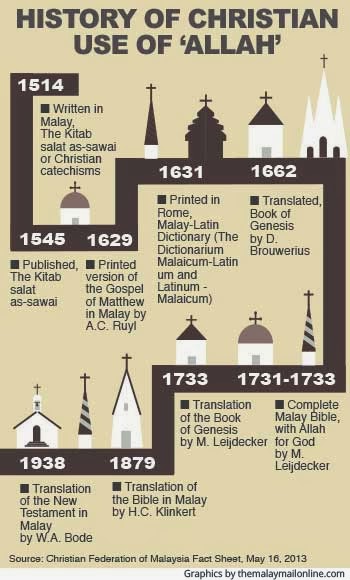
(3)  在1631年出版的马来文- 拉丁文词典里,  “上帝” (Deus) 在马来文中译为 “阿拉” (Alla) .

(4)  在旧版本的 “阿拉伯文圣经” 以及在现代版本的 “阿拉伯文圣经” 中, 基督教徒一直都在惯用 “阿拉” 字眼. 时间已相当久远,  伊斯兰教产生前就已采用了. 当时, 这些基督徒生活在埃及、黎巴嫩、伊拉克、印尼、马来西亚、汶萊等亚非国家.

(5)  从1629年起, 印尼和马来亚的马来文 “马修的福音” (圣经) 中, 就已使用 “阿拉” 字眼. 从1733年起, 第一部完整的马来文圣经, 以及从1879年起, 第二部完整的马来文圣经, 都使用 “阿拉” 的字眼, 从未曾间断过.

(6)  现代马来文学之父孟希.阿都拉 (Munshi Abdullah) 曾经把基督教的福音译成马来文. 他也把 “上帝” 一词译为 “阿拉”.

(7)  讲马来语的马来半岛、沙巴、砂劳越的原住民基督教徒, 世世代代都在使用 “阿拉” 字眼; 整个马来西亚都在使用印尼文圣经, 也采用 “阿拉” 字眼.  

(8)  至少在过去的30年, 天主教堂都一直在自由使用印尼文的圣经 (Alkitab) . 印尼文的圣经也在使用 “阿拉” 字眼.

(9)  所有使用阿拉伯文、印尼文、马来文的国家中, 基督教徒都在使用 “阿拉” 字眼, 沒产生过问题, 也沒破坏或违反公共秩序, 也沒影响伊斯兰教徒的情绪.

            上面所说的, 就是本案的实情. 每个案件的判決都必须以实情为依据. 但是, 料想不到的是, 上诉庭三司的判词完全沒考虑到高庭法官判词所查实的案情. 这点肯定是严重的錯误.


3. 最高法院有重要案例可遵循, 但上诉庭判词却只字不提
不可思议的一件事就是, 上诉庭三司各自分別写的判词, 其中沒有一个判词提起过我国宪法以往极其重要的案例. 上诉庭法官必须考虑与遵循这些案例, 因为这些案例和本案有密切关联.
1992年最高法院《诺丁沙列案 》 : 不得使基本人权变得 “虚幻,毫无意义”
举例说, 1992年, 我国最高法院有个重要案例 《诺丁沙列案 》 (Nordin Salleh case) [1992 MLJ 697]. 这个案例确认: 在检测政府的行动是不是侵犯宪法所阐明的基本人权时, 法庭的职责所在就是, 关注这政府的行动所引起的后果. 如果其后果会使到基本人权变得 “虚幻、毫无意义” 的话 , 那就是违宪的行动.
如果 《先鋒报》一案中, 上诉庭三司曾考虑过上述最高法院的案例, 判決可能就不同了. 禁止基督教徒在膜拜时使用《阿拉》字眼 , 将使宗教自由基本权利变得 “虚幻与毫无意义”. 这是简单不过的道理. 仅仅以这个理由, 上诉庭就应驳回內政部长的上诉.  

4.  上诉庭误解 “伊斯兰教是联邦宗教” 的含义
上诉庭误解了“伊斯兰教是联邦宗教” [宪法第3条] 的含义. 同时, 还忽略了其他两项重要条文的內容. 毫无疑问, 伊斯兰教是联邦宗教, 但是, 有关条文下半段已交代清楚, 人民可以和平与和谐地信奉其他宗教. (宪法第3 条)
参照一下加拿大的宪法 《前言》: “加拿大国体是建立在确认上帝至高无上与法治的原则上的”. 要注意的是, 我国宪法条文沒赐予伊斯兰教 这样的 “至高无上” 的地位. 我国宪法起草人非常了解法律与权利, 有高低主次之分.

5.《联邦宪法》 才是我国 “至高无上” 的法律
宪法规定了伊斯兰教是我国联邦宗教后, 接下去另一项条文立即就阐明, “我国《联邦宪法》 是国家 “至高无上” (supreme) 的法律”. 这就是说, 宪法高于其他一切法律 [第4(1)条], 包括第3 条文的伊斯兰教是联邦宗教的条文.  伊斯兰教是联邦宗教的宪法条文 (第3 条) 沒有 “至高无上” 这个词语. 也就是说, 这项条文必须屈服于 (而不可凌驾于) 第4 条文 “宪法至高无上” 的条文.
另外一点, 新兴的马来亚独立后, 沒有意思把国家变成一个 “神权国”, 而是长期保留了 “世俗国” 的地位. 这点, 有历史事实、独立前东姑等对我国宪政所发表的言论、独立前的相关备忘录等文件、最高法院对宪法作出的、有权威性的判例等等, 足以证明我国是个世俗国. 这不是別有居心者随心所意, 基于政治权宜之计, 发表毫无事实根据、无视法治精神的言论, 所能抺煞的!
更重要的是, 信奉自己所选择的宗教权利, 是宪法基本自由权利的章节里所明文规定的. (第11条). 基本自由权利就是基本人权. 其他基本人权的条文, 包括: 人身自由、法律面前人人平等、不得有歧视现象存在、言论自由、集会结社自由等, 对享有宗教自由都有密切的关系.  

6.“宗教自由” 是绝对的基本人权
在 《联邦宪法》 下, 宗教自由是基本人权之一. 宪法保障人民可信仰、奉行、传播自己的宗教 [第11(1)条]. 每个宗教社群有权管理自己的宗 教事务[第11(3)条].
要注意的是, 宪法对待所有的基本人权, 不是一视同仁, 不是一律平等的. 在宪法下,  基本人权可分为两类:
(1)  有些基本人权是绝对的, 不受任何限制.

(2)  另一些基本人权是有限度的; 可以受到某种限制.

膜拜宗教的权利是绝对的, 不可加以限制 (见第10, 11条). 自由信仰宗教的权利, 就包含了以下的绝对权利:
a.信仰和奉行任何宗教的权利; 
b..豁免或不必为某特定宗教 (不是自己所信仰的宗教) 缴纳稅务的权利; 
c..每个宗教社群有权管理自己的宗教事务, 建立和维持宗教和慈善机构的权利. 
d. . 有权不接受其他宗教的膜拜仪式或膜拜行为.

“绝对权利” 和 “有限权利” 如何区分?
   要如何区分宪法保障下的绝对权利和有限权利呢? 一个最好的例子就是: 国会可制定法律限制言论自由和集会结社自由 (第10条). 但是, 国会不可制定法律限制或削弱宗教自由[第11(1), 11(3)条]. 
   举个具体的例子: 某些人想组织一个气功协会. 这和行使结社自由权利有关. 政府可以施加条件, 控制和监管太极协会的活动. 宪法对待宗教团体的情況则不同. 国会不能通过法律, 对宗教团体施加类似的限制或监管. 宪法所施加的唯一限制是: 在享有绝对宗教自由时, 宗教团体的活动不可触犯一般的法律, 如: 维护 “公共秩序、公众健康、或道德准绳” 的一般法律 [第11(5)条].
再举一个实际例子: 每年在大宝森节, 到黑风洞朝圣的印裔族群, 不得侮辱其他宗教. 不然的话, 政府就有权以破坏公共秩序为理由, 采取措施对付相关人士. 不过, 公共秩序是不是已受到影响, 政府必须拿出证据来证明.
在私人场地, 情況则不同. 如果有宗教社群在基督教堂或庙堂里祈祷膜拜, 或者家庭成员在自己家里膜拜祈祷, 政府就不可以援引相关的限制条文 [第11(5)条], 以破坏公共秩序等为由, 来对付他们. 这是因为教堂、庙宇、住所, 都是私人场地, 不是公共场所. 

7. 人人都享有绝对的宗教自由权利
此外, 在《联邦宪法》下, 言论自由、集会自由、结社自由的基本人权, 只限公民才能享有. 非公民不能享有这些自由权利. 但是, 宗教自由基本人权则不同. 在我国, 不论是公民, 还是非公民, 人人都可享有宗教自由的权利.
   只要身在马来西亚的每个人, 都可享有绝对的宗教自由权利. 这就是宗教自由基本人权和其他基本自由权利不同之处. 上面已说过, 每个人都享有宗教自由的基本人权, 不分公民、国民、 或戶籍.  只要他身在马来西亚, 他就可享受宗教自由的基本人权. 他有权选择信奉任何宗教. 他可以信仰、奉行、传播任何宗教.
   政府或有关当局无权规定, 你必须选择某个宗教, 放弃某个宗教 (穆斯林除外), 改变宗教信仰, 或完全不信教 (指无神论者、不可知论者等). 这个宗教自由是绝对的权利, 不可剥夺的权利.
如何检验宗教自由是绝对的基本人权?
要检验宗教自由的绝对性, 可从三方面着手:
(1)  我国宪法有对付危害社会秩序的条文. 那就是, 如果有大批人采取行动 (或威胁要采取行动) 危害国家,  国会可以制定法令, 剥夺人民的许多基本人权, 如: 人身自由、行动自由、言论自由、集会结社自由、财产权等. 但是, 宗教自由则是一个例外; 国会不可制定法令限制或削減宗教自由. (宪法第149条,)

(2)  同样的, 我国宪法有条文规定, 在某些情況下, 元首可以颁布紧急状态, 接着, 可以制定紧急法令, 削減或剥夺我国人民的一切基本人权; 但是, 这类紧急法令, 不可削減或剥夺宗教自由权利 [宪法第150(6A) 条].

(3)  我国法庭早已有判例, 确认宗教自由基本人权的重要性. 自从制定 《1960年內安法令》 以来, 总共有将近10,000人在 《內安法令》 或其他防范性扣留法令下, 被扣留. 他们是在未经法庭审讯的情況下被扣留的.  有不少被扣留者向法庭申请, 挑战这类无审讯扣留案, 认为那是不合法的. 但是, 往往都不成功. 在众多案件中, 挑战成功的少数重要案件之一, 就是涉及宗教自由的加马鲁丁案 ([1989] 1MLJ418).

8.  1989年最高法院《加马鲁丁案》 :  政府不可援引ISA剥夺宗教自由
那是1989年的案例. 加马鲁丁向穆斯林弘扬基督教教义. 结果, 他在1987年的 “茅草行动” 大逮捕中被扣留. 经高庭审讯后,高庭法官判他无罪释放. 政府把这案子上诉到最高法院去. 然而, 最高法院还是确认, 高等法庭的判定是正确无误的. 两个不同的法院法官都确认: 只因加马鲁丁选择了他自己的宗教信仰, 并且还向穆斯林传播他的宗教 (基督教), 政府就援引 《內安法令》 扣留人, 那是违宪的.
根据这个案例, 在宪法下, 天主教徒有权阅读和翻译圣经. 这是他们信仰和奉行自己的宗教的基本人权. 他们有权管理自己的宗教事务. 这个基本人权是绝对的, 不容剥夺或削減的. 政府, 或者有关当局, 无权从中作梗和干预.
各宗教的信徒, 对他们的宗教经典都享有平等权利.  各宗教的圣书或宗教经典, 都应受到大家的尊重, 并且, 应受到世界各国的保护, 除非他是希特勒等盖世魔王. 这就意味着, 任何政府机构都沒有权利, 改写这些圣经里的字眼, 或要求改写任何字眼. 
上诉庭三司各自的判词只字未提这些触及信仰自由核心地位的案例.

9.上诉庭判词的基本结论太过广泛  后果影响深远
虽然法庭审理的是天主教 《先鋒报》 的出版问题, 但是, 上诉庭的判決却超越了这个范围, 影响了所有书籍和出版刊物. 这是案件的基本结论. 它将成为先例. 往后, 在同样的情況下, 所有法院都必须遵循这个先例.
因此, 这个判例也影响了东马人民一路来使用的马来文圣经. 这些圣经不能再使用 “阿拉” 字眼了. 这个上诉庭判決的严重性在于: 这等于说, 基督教的圣书得受审查. 其实, 这是全世界任何世俗国家, 都不应该做的事. 
东马人民宗教自由也受影响
就在沙巴和砂劳越庆祝马来西亚成立50周年之际, 我国布城的法院却告诉我国人民, 东马人民不准阅读他们自己选择的圣经译本. 这是令人惊讶的事.
在马来西亚成立之前, 砂劳越和北婆罗州 (现称沙巴) 人民的基本要求之一, 就是一项保证. 那就是: 英帝国主义不应由马来亚帝国主义所取代; 英殖民统治不会由吉隆坡殖民统治所取代.
如果1961- 1963年间, 讨论成立马来西亚时, 有人提出, 在马来西亚成立50 年內, 东马人民不准阅读含有 “阿拉” 字眼的马来文圣经, 对东马人民来说, 可以肯定, 是件极其不合理的事.

10. 法官不应自行引述 “资料”  无视双方代表律师意见
上诉庭其中一名法官, 似乎沒花心思在斟酌案中的实情, 却在网络上自行搜索资料. 其实, 法庭应根据诉讼双方提供的资料来判案. 但是, 在此案中, 诉讼双方都未提供这类网络资料给上诉庭. 也就是说, 法官私自在进行搜索资料的工作. 实际上, 这么做是违反自然公正法则的, 因为他沒邀请诉讼双方的代表律师, 針对这些资料, 发表他们各自的意见. 在这种情況下, 法官又犯了一项严重的错误.
我国最高法院 - 联邦法院 - 审理这个案件时, 不应考虑这名法官所 自行 “发现” 的证据.

11.  悬而未決的问题: 法庭要如何执行这项判決?
法官所作出的判決, 必须要有实际用途. 是不是能执行判決, 那是极为重要的. 如果天主教《先鋒报》执意继续使用 “阿拉” 字眼, 他们可能要面临准证被吊銷的危机. 但是, 圣经里的 “阿拉” 字眼, 要如何处理呢?看来, 政府可以采用两种方法, 来执行上诉庭的判決:
(1)从基督教堂和每个教徒的住家搜出圣经, 然后, 全部充公. 最后用一把火将圣经烧掉.

(2)走访基督教堂和每个教徒的住家, 把圣经里的 “阿拉” 字眼全部刪掉, 或者, 把圣经里有 “阿拉” 字眼的页面撕掉.

当你考虑到政府要如何执行判決时, 判決的严重性立刻就浮出水面. 可以想像得到, 基督教堂和每个教徒家庭可能群起抗议政府人员触动他们的圣经. 如果圣经受损坏的话, 其后果更加不堪设想.
如果这些人顽抗到底, 政府会不会使用暴力对付? 为了国家利益, 政府应采用细腻的技巧和有理智地处理这件事, 因为所涉及的是少数社群的基本人权, 尤其是宗教自由权利. 

12. 政府获得的只是 “得不偿失的胜利”
我们不是在危言耸听. 法庭判決可能产生不可避免的不良后果. 总检察长究竟有沒有忠告过政府, 可能发生这类后果?  法庭的判決令政府获得的, 只是得不偿失的胜利, 以极大代价換取到的胜利. 这是因为这样的判決已破坏了多元文化社会的族群关系. 付出的代价确实是太大了. 这怎能是具有责任感的当权者所实施的一项良好施政?  

13. 听听我国最杰出的法官敦苏芬语重心长的一番话 
1982年, 我国最杰出的法官, 也就是前最高法院院长敦苏芬, 曾经在新加坡国立大学, 发表过一篇重要演词. 在演词中, 他语重心长地说:

“在一个像你们 (新加坡)和我们的多元种族和多元宗教的社会里, 我们的法官可能是马来人、华人、或印度人, 也可能是穆斯林、兴都教徒等. 但是, 我们会尽量避免分辨自己属于哪一个特定种族或宗教.  如果把我们的名字从判词中刪除, 沒有人能分辨出我们属于哪一个种族或宗教. 这么一来, 就可保证各族群的权利, 特別是少数族群的权利, 不会被人踩在脚底下. ” (见FA Trinidade 与 HP Lee 合编的 《马来西亚宪法》 1986年版本, 第200, 216页)

自从敦沙烈 (另一名前最高法院院长), 于1988年,  遭前首相马哈迪医生撤职后,  我国司法独立受到严重侵蚀. 自此以后, 敦苏芬就变成了直言不讳地批评我国司法的著名人士. 敦苏芬肯定不会认同上诉庭三司对此案的处理方法.  一般公众人士都认为,  針对天主教 《先鋒报》 一案的上诉庭判词, 三司本身的宗教信仰, 起着举足轻重的影响.最后, 希望我国目前的最高法院 – 联邦法院, 能作出维护宗教自由的判词, 结束这场引起各族群之间紧张关系与社会不和谐的无谓争议.  (完)

 [注: 这篇法律文章, 基本上, 取材自我国资深律师通美.汤姆斯 (Tommy Thomas) 的文章: “The Allah Decision is Wrong in Constitutional Law ” [见2013年Aliran 期刊 (第 37 卷 第33-40页)]. 由于他纯粹以法律专业水平撰写这篇文章, 一般读者要完全理解它, 可能有些难度. 本文采用较为浅显易懂的文字加以整理, 以供大家参考. 通过本文, 希望读者们对 “阿拉” 事件, 能有个较为客观、符合宪法的正确看法.]

Tuesday, October 22, 2013

Award-winning American Muslim scholar on Allah ruling: “We are laughing at you”


By Elizabeth Zachariah. Published by The Malaysian Insider on 22 October 2013.

A well-known American Muslim theologian has joined a long list of critics over the recent Court of Appeal ruling on the use of the word Allah, saying it was a "political decision more than anything else".

"This notion that Malaysian Muslims need to be protected by the court because you can't think for yourself, you can't make decisions on your own. We are laughing at you," said Reza Aslan, speaking on BFM Radio's Evening Edition programme yesterday.

"That you can control people's ideas, their behaviour, their faith and their minds simply by trying to control the words that they use, is absurd. It is an embarassment to a modern, constitutional, democratic and deeply Muslim state like Malaysia," he added.

Aslan insisted that Christians using the word Allah - which means God in Arabic - were not a threat to Islam.

"A Taliban put a bomb in the Quran and took it to a mosque in Pakistan, where Muslims were slaughtered on one of the holiest days in the Muslim calendar. You want to talk about threats to Islam? That's a threat to Islam," he said, in dismissing the argument that allowing Christians to use the word in their worship was a threat to Malaysian Muslims.

He was referring to an incident during the Aidiladha holidays, in which Afghan governor Arsala Jamal was killed while scores were injured after a bomb placed in a copy of the Quran went off in a mosque during the Eid sermon.

Aslan, who wrote the international bestseller No God But God: The Origins, Evolution, and Future of Islam, said he was mystified by the court ruling on October 14, stressing that the word Allah was merely an Arabic term for God, "any God".

"Allah is constuction of the the word al-Ilah. That's what the word is," he explained.

"Al-Ilah means 'The God'. Allah is not the name of God. Frankly, anyone who thinks that Allah is the name of God, is not just incorrect, but is going against the Quran itself. It is almost a blasphemous thought to think that Allah has a name.

"And this is not an interpretation. It is a historical fact," Reza added...

Aslan poured scorn on the court verdict, asking, "How can you read that and not laugh?"

Soon after the court ruling last week, he had taken to Twitter and remarked, "How stupid has Malaysia just become? In honor of Malaysia banning the word Allah by non-Muslims I suggest US ban the word 'twerking' by anyone over age of 17," he said, referring to a type of sexually provocative dance.

Much of Aslan's interview yesterday was made available on Podcast.

In it, he slammed those who argue that the faith of Malaysian Muslims can be undermined if Christians use the word Allah.

"This idea that not only should Christians not be able to use this word, but that using the word is somehow a threat to Islam... that Malaysian (Muslims) are so stupid if they hear a Christian use the word Allah, they will accidentally become Christians. I mean, the idiocy of that statement speaks for itself," he said.

Echoing many other Muslim scholars and writers, Aslan said Christians and Jews in the Arabian peninsula since before the time of the Prophet Muhammad had been referring to God as Allah.

"Why? Because they spoke Arabic... that's why. Not because Allah meant a specific God but because that it is nothing more than the Arabic word for God. It is not an opinion. It is a fact," he pointed out.

"Any Imam that tells you God has a name, is blasphemous. It is as simple as that. Allah is not God's name. Muslims do not own the word itself," said the 41-year-old Iranian-American, who is Visiting Professor of Islamic Studies at the University of Iowa.

Read more here:

Thursday, October 17, 2013

Allah Saga: It is Wrong to Deny Fundamental Rights on the Premise that Others May Be Confused


The Malaysian Bar is deeply concerned by the decision of the Court of Appeal delivered on 14 October 2013 in what is commonly referred to as the ‘Herald’ or ‘Allah’ case.

The concerns arise from the Court’s interpretation of Article 3(1) of the Federal Constitution on the status of Islam and other religions and Article 11(1) and (4) on the fundamental right to profess and practice a religion.

Any interpretation of the Constitution must invite the greatest scrutiny as it impacts on the fundamental freedoms guaranteed to all citizens. 

We are particularly concerned with the following findings, that:

I. The insertion of the words “in peace and harmony” in Article 3(1) is to protect the sanctity of Islam and “also to insulate against any threat…to the religion of Islam”;

Article 3(1) of the Federal Constitution expressly provides that “Islam is the religion of the Federation; but other religions may be practiced in peace and harmony in any part of the Federation”. 

The Court of Appeal found that this Article was inserted as a byproduct of the social contract by our founding fathers, and that the purpose and intention of the words “in peace and harmony” was to protect the sanctity of Islam as the religion of the country and to insulate it against any threat. This is an unnatural reading of the provisions in Article 3(1). The words in their clear and ordinary meaning provides for the right of other religions to be practiced unmolested and free of threats.

In referring to the social contract, effect should be given to the understanding as at 1957 and not to the numerous amendments that have since been made to the Federal Constitution in violation thereof. Paragraph 57 of the White Paper in 1957 which gave rise to Articles 3(1) and 11(4) of the Federal Constitution provides as follows:

“There has been included in the proposed Federal Constitution a declaration that Islam is the religion of the Federation. This will in no way affect the present position of the Federation as a secular State, and every person will have the right to profess and practice his own religion and the right to propagate his religion, though this last right is subject to any restrictions imposed by State law relating to the propagation of any religious doctrine or belief among persons professing the Muslim religion.”

II. The use of the word ‘Allah’ in the Malay version of the Herald would cause or create confusion amongst persons professing the religion of Islam;

It is unreasonable and contrary to the Constitutional scheme that a fundamental liberty is liable to be denied on the basis that some person or persons would be confused. 

The decision does not in any way aid in addressing or resolving the alleged confusion amongst persons professing the religion of Islam, when in fact that word ‘Allah’ is used by more than one community in this country and by peoples of different faiths in the Arab world and other Muslim countries. Rather, the effect of the decision would be to encourage a perpetual state of confusion or ignorance as justifiable grounds for denying the rights of others. The course that ought to have been taken should be to educate those persons who would be confused and not to restrict or injunct the exercise of rights by others.

III. The use of the word ‘Allah’ in the Malay version of the Herald would have the potential to threaten or harm public order and safety; and

Having recited that religious sensitivities are a threat to public order and safety, the decision unfortunately serves to reinforce the notion that the use or threat of violence would win the day in court. It is unacceptable that citizens are denied their Constitutional rights of religious freedom and expression on the basis that others who disagree or who are confused would resort to aggression.

The law should not be interpreted and declared so as to condone, encourage, and perpetuate such aggression and threats of violence. Rather, the law ought to be visited upon those who would resort to threats or violence. 

IV. The finding that the word ‘Allah’ is not an essential and integral part of the faith and practice of Christianity.

There appears to be no basis for the findings by the Court of Appeal that the word is not an integral part of the faith or practice of Christianity other than what has been described in the written judgments as “a quick research” and research conducted on the internet.

It is troubling that the court would conduct research on its own via the internet and come to conclusions of alleged facts with respect to a person’s religion without its veracity being tested.

In any event, it is for a party asserting exclusive rights to the use of the word ‘Allah’ to establish that they have such exclusive rights, rather than for others to have to establish that the use of the word is integral to their faith. By most accounts, there is no prohibition on the use of the Arabic word ‘Allah’ by peoples of different faiths in the Arab world and other countries. It is difficult to discern how we are able to declare exclusivity of a word over which we do not have proprietary rights.

The Malaysian Bar calls upon all quarters to address the issue with maturity and calmness. It must be reminded that everyone must respect the right of the publishers of the Herald to seek to appeal the matter to the Federal Court, if they so wish. They should be permitted to pursue this without any threats or intimidation.

Christopher Leong
President
Malaysian Bar

16 October 2013

We should not let the Allah issue be exploited by Umno or its media!


Pakatan Rakyat (PR) today said that it will not support the call for a ban on the use of the word "Allah" if it is used with good intentions, properly and not in a degrading manner. PR de facto head Datuk Seri Anwar Ibrahim said PR and Christians in general had been unreasonably attacked over the matter. "We should not let it (the Allah issue) be exploited by Umno or its media," he told a press conference today.

Although the Court of Appeal ruling on Monday prohibiting the use of the word "Allah" was limited to the Bahasa Malaysia section of the Catholic weekly The Herald, the implications on the grounds are far-reaching with some Malay rights groups calling for the ban to be extended to churches in Sabah and Sarawak.

Anwar said PR had referred the matter to religious experts, including PAS president Datuk Seri Abdul Hadi Awang, even before the ruling, and international Islamic scholars. PR will issue a statement today on the opposition coalition's joint stand on the word.

Meanwhile, Sarawak Dayak Iban Association (Sadia) secretary-general Nicholas Mujah said calls for the ban to be extended to Sabah and Sarawak are uncalled for. "Unlike in Peninsular Malaysia, the Sarawak Muslims are not confused and the Christians are also not confused with the usage of the word," he said when asked to respond to a call by Perkasa to extend the ban to the two states. He said the call is against the spirit of the 1963 Malaysia Agreement and the Cobbold Commission Report on the formation of Malaysia.

Sarawak Dayak National Union (SDNU) issued a statement that any ruling to stop Dayaks from using the word is tantamount to infringing Christians' constitutional rights. Its president, Tan Sri William Mawan Ikom, who is state social development minister, said it is also against the fundamental right to freedom of worship.

Sarawak Dayak Graduates Association (SDGA) president Dr Dusit Jaul said he agreed with state Land Development Minister Tan Sri Dr James Masing's stand that any ban on the use of the word is an infringement of the rights of Christians in Sarawak.

Constitutional lawyer Syahredzan Johan said the Court of Appeal's decision has set a precedent that may be used in the future to ban similar words or publications. He said in The Herald case, the home minister was acting under the Printing Presses and Publications Act 1984 (PPPA). "That is a federal law, which is also in relation to national security. That is why in the future, they may use PPPA to perhaps ban words in the Al-Kitab, the Bahasa Malaysia version of the Bible.

Meanwhile, Malaysian Gurdwara Council president Jagir Singh said the ruling will affect Sikhs in the country who also use the word in their prayers. "Since the (judgment) is wide, it will affect us. If you go by the ruling of the court, there is no exemption for anybody. It is blanket and will affect every publication (which uses the word Allah)," said Jagir.


International media reports:

By Jennifer Pak. Published by BBC News, Kuala Lumpur on 14 October 2013.

The verdict does not come as a surprise to the two million Christians in Malaysia. Many of them believe that the case stems from a tight race between the governing Malay-Muslim party, UMNO, and the opposition Islamic party, PAS.

The Allah ban is seen as an attempt by UMNO to boost its Islamic credentials and win back votes. It's an issue that crops up in the government-linked media ahead of an election and promptly dwindles after the vote.

Christians are so convinced that this issue is about political posturing that most followers say they will continue to use the offending Bibles and use the word Allah in their worship.

Not all Muslims back the ban. But one of the most outspoken supporters is an influential group called Perkasa, which is backed by former prime minister Mahathir Mohamad - a champion of Malay-Muslim rights.


Published by the National Editorial on 14 October 2013.

Like the history of most religions, the history of Islam is complex and much debated. But there are a few elements that are not in dispute, chief among them that the God of the Quran is the same as the God of the Bible and of the Torah before it. The mission of Islam, as expressed in the Quran, is not to bring a new faith, but to update the messages of the monotheistic faiths before it.

It is therefore surprising to see, as The National reports today, that a Malaysian court has ruled that a Christian newspaper may not use the word “Allah” to refer to God. The court overturned a previous decision by a lower court, ruling that “Allah” as a term is not exclusive to Islam. This causes a problem for the country’s substantial Christian minority, who have used the word “Allah” to refer to God for decades.

In a fellow Muslim country with substantial Christian and Hindu populations, this feels like the wrong decision. The UAE is rightly proud of its society that allows people from all over the world to practise their faiths openly and without discrimination. Indeed, that inclusiveness is inherent in Islam. One of the reasons Islam was able to spread so far, so rapidly, was the inclusive nature of the faith: for at least two centuries after the coming of Islam, the Arabs ruled vast regions where the majority were not Muslims. The word “Allah” is never exclusive to Islam – indeed, both Christians and Jews used the word “Allah” to refer to God even before the coming of Islam.

That remains the case today. When Christians across the Middle East pray to God, they use the term “Allah”. Walk into a church in Cairo, Baghdad or Beirut this coming Sunday and you will hear the name of “Allah” invoked. That also applies to the Jews of the Arab world, who for centuries have prayed to “Allah”. The Quran itself is explicit on this subject, declaring, in Surah Al Ankabut, that Muslims should tell People of the Book (Christians and Jews) that “our God and your God is one”.

The Malaysian decision overlooks not merely the theology, but also the etymology of the word. The word “Allah” is derived from the Arabic “al-ilah”, the god. It’s found its way across the world and entered Malay from Arabic.

Arabic as a language is a vehicle for faith, be that Christianity, Judaism or Islam. The God of the three monotheistic religions is the same god. It is unsurprising, therefore, that all three faiths in the Arabic-speaking world (and beyond) refer to God as “Allah”. And if they have the same God, they should have the right to call their deity by the same name.

Link:
http://www.thenational.ae/thenationalconversation/editorial/word-allah-is-not-exclusive-to-islam?fb_action_ids=10151976505061974&fb_action_types=og.recommends&fb_source=other_multiline&action_object_map=%7B%2210151976505061974%22%3A1427094640843412%7D&action_type_map=%7B%2210151976505061974%22%3A%22og.recommends%22%7D&action_ref_map=%5B%5D

By Endy M. Bayuni, published by The Jakarta Post on 16 October 2013.

The controversy in Malaysia started when Muslims raised objections to the use of the word Allah by the Roman Catholic Church in its publications. Although the lower court already ruled in favor of the church in 2009, the Malaysian government decided to take up the issue on behalf of Muslims and appealed. Not surprisingly, this week it won the case, ironically on the eve of the Muslim’s Sacrifice Day.

The controversy on the use of the word “Allah” goes beyond semantics, or else it would not have provoked such emotional reactions from all sides concerned.

And it is a debate that sooner or later will come to Indonesia, for the seeds of exclusivity have already been deeply planted among Muslims in the country with the world’s largest Muslim population. Like their Malay Muslim brothers, Indonesian Muslims who share the same Malay root language, translate the phrase Lailaha Illallah to Tiada tuhan selain Allah (in English: No God but Allah), instead of the literal translation “No god but God”.

Something quite fundamental is lost in the translation when Indonesians make a distinction between “God” and “Allah”, two words that essentially mean the same thing. But this erroneous translation may have become the basis that put Muslims in much of Southeast Asia to claim exclusivity to God.

I am no historian, so I do not profess to know the reason for the translation, but since this part of the world was predominantly Hindus and Buddhists before Islam came in the 14th century, the distinction between Allah and God may have been important in helping to convert people who then believed in many deities.

The late Islamist scholar Nurcholish Madjid drew sharp rebukes when he suggested that Indonesians should translate the term to “No god but God”, so the idea was dropped prematurely. Exclusivity to the claim of God is equally strong in Indonesia, if not stronger, than in Malaysia.

Indonesia has had its share of debates on Islam’s claim to exclusivity, including whether non-Muslims should be allowed to say the traditional Islamic greeting assalamu’alaikum (which means peace be upon you) and other popular Islamic expressions such as Alhamdulillah (praise be to God) and Insya Allah (God willing).

It’s only a matter of time before someone takes the cue from Malaysia and starts raising objections to non-Muslims using the word Allah. The problem with religious exclusivism is that it breeds intolerance, which leads to prejudices against the others.

Indonesia and Malaysia may rightfully claim to have developed a more moderate strand of Islam, and history has actually proven that Muslims in this part of the world to be more tolerant when compared to their brothers and sisters in Islam’s place of origin in the Middle East or in South Asia.

But there is only a thin line dividing tolerance and intolerance, so we should not take this moderation for granted. With the rising exclusivism that the Muslim majorities in these two countries are pushing, we may be witnessing the Islam in Malaysia and Indonesia becoming less and less tolerant. In fact, it may already be happening.

Which begs the question: Is there anyone in this country that is pushing for more religious inclusivism? Insya Allah.

Read more here:
http://m.thejakartapost.com/news/2013/10/16/no-one-has-monopoly-claim-god-on-use-allah-malaysia.html

Monday, October 14, 2013

Allah case: Church to fight on


The Herald will appeal the appellate court's decision to set aside the High Court's ruling permitting it to use the term "Allah" in its publication. Saying this, the weekly's editor Father Lawrence Andrew, said the Court of Appeal's decision contradicts government policy.

Referring to the Catholic Church's argument that the Malay-speaking congregation commonly used the term in reference to God, Lawrence said: "We cannot reconcile how on the one hand the Christian community is allowed to freely use, import and distribute the Al-Kitab which uses the word 'Allah' extensively, by virtue of the govt's 10-point solution for their worship and instruction of their prayer."

"It is also a retrograde step in the development of the law into the fundamental liberties of religious minorities in this country," he told reporters outside the Palace of Justice here today. "In our view, the Court of Appeal ought to have interpreted the Federal Constitution in order to uphold rather to diminish the rights of the minorities," he added.

Disappointed that the decision to set aside the earlier High Court judgment which ruled that it was against the Church's constitutional right to discontinue using the term, the priest insisted that evidence submit during the course of the trial had showed that the word "Allah" is not exclusive to Islam. 

"It goes against evidence itself and by the use of the word by the Christians is a danger to public order is not proved yet till today," he said after a three-man bench read out the gist of the judgment this morning. 

Justices Datuk Seri Mohamed Apandi Ali, Datuk Mohd Zawawi Salleh and Datuk Abdul Aziz Abdul Rahim had unanimously ruled that the home minister, in banning The Herald from using Allah in its Malay edition, had made a decision in the interest of safeguarding public order. The judges also state that no constitutional right was infringed in the process and that the word "Allah" is not an integral part of the Christian faith. 

The Church, in its submissions, had stated that the Malay edition of the publication citing excerpts of the Al-Kitab, a translation of the Bible in Bahasa Malaysia. "We have not caused disharmony, for the 18 years of The Herald's publication, we have not caused any inconveniences," asserted Lawrence. "So we feel that this is unrealistic, given that the use of the word 'Allah' by Bahasa Malaysia- speaking congregation and other indigenous groups especially in Sabah and Sarawak for generations," he said.  

"We are not discouraged by this decision. We trust in God, justice will be served. We will appeal," said Lawrence. 

Link:
http://www.fz.com/content/herald-appeal-decision-contradicts-government-policy#ixzz2hgPhR9UK

To what extent will Prime Minister Najib Razak now push the issue remains to be seen. However, there is already deep concern he might seize on the ruling and use the precedent to force Christian groups into surrendering more of their rights whenever it was politically beneficial to him, or whenever he wanted to curry favour with the Muslims.

Some even fear that the Muslim extremists or ultras in Malaysia, flushed by today's victory, might get more demanding. This would set the stage for a collision course with the Christians, especially those from Sabah and Sarawak. The already high racial and religious disunity is bound to rise at least by another notch and this could destabilize Malaysia even more.

Nasharuddin was among those who attended the hearing at the Palace of Justice in Putrajaya this morning. Ibrahim Ali, the head of ultra Malay rights group Perkasa too was present. However, the Muslim NGOs while noisy and emotional failed to gather more than 200 or so protesters. Shouts of Allahu Akbar or God is Great cut through the cool morning breeze outside the grand court complex, while group prayers were also held. When the government's lawyers came to announce the decision, they were greeted like heroes.

Read more here:
http://www.malaysia-chronicle.com/index.php?option=com_k2&view=item&id=174491:catholic-magazine-herald-denied-the-right-to-use-allah-by-malaysias-appeals-court&Itemid=2#axzz2hh7V2U3M

But Khalid said that rather than banning the use of ‘Allah’ by non-Muslims for fear of retaliation by “stupid people”, the government should focus on educating the Muslims on what the Quran said over the issue. “The government should educate Muslims regarding all the verses of the Quran which mentions non-Muslims discussing about Allah with the Prophet Muhammad, and using the word freely without any hindrance whatsoever,” the Shah Alam MP said. “Instead, our government seems to be very proud that we are the only Muslim nation that practices this ban – that we are going beyond even what the Prophet Muhammad had done...”

He rejected Department of Islamic Development’s (Jakim) line of argument that allowing non-Muslims to use ‘Allah’ would threaten the faith of Muslims, saying: “It’s just like how everybody uses the word ‘God’ and ‘Tuhan’. There’s no confusion there.” On the contrary, Khalid insisted that opening up the word ‘Allah’ to other religions would build a common platform among the country’s different believers, and hence encourage interfaith discussions.“The question of pluralism also doesn’t come into play because the Quran says the only religion accepted by Allah is Islam,” he added.

Khalid also maintained that the issue was political rather than religious – he claimed that right wing Malay groups were championing the cause to make Islam exclusive to Malays and erect barriers between themselves and the non-Muslims in the country. “They want to maintain special position, hegemony in the country… they want to distance the Malays from the non-Malays in the country, so that issues such as good-governance, which is supported by non-Malays, does not become a matter of interest for the Malays,” said Khalid.

Read more here:
http://www.freemalaysiatoday.com/category/nation/2013/10/14/we-respect-allah-ruling-but%E2%80%A6/

Sarawak will continue to allow the use of the word Allah in Bahasa Malaysia and native language Bibles and church publications, said State Land Development Minister Tan Sri Dr James Masing, following the Court of Appeal's ruling today not to allow Catholic weekly The Herald to use the term.

Masing described the ruling as “not genuine”, saying the use of the word Allah predated Islam. “We (Christians in Sabah and Sarawak) have been using the word Allah for over 100 years. Why suddenly we are now told we cannot use it?" he asked, adding that the court's decision would have a negative impact on non-Muslims beyond Sabah and Sarawak. “Did they have a dream that Allah said they (the Christians) can't use the word Allah?” he asked, referring to the opposition by some Muslim groups in West Malaysia on the usage of the word in Christian texts.

Referring to Muslims in Sabah and Sarawak as "brothers", Masing said they had no qualms about Christians using the word. Masing reminded Christians in the state that Sarawak Chief Minister Tan Sri Abdul Taib Mahmud had in the past weighed in on the issue by giving assurance that he would not stop them from using the word Allah.

PKR Sarawak chief Baru Bian, saying he was stunned by the decision, said churches and Christians in Sabah and Sarawak would continue using the word Allah. “I am stunned by the decision.

“We have produced very clear facts that we were promised a guarantee by our forefathers when Sabah and Sarawak helped form Malaysia. The ruling appears to go against the fundamental rights that were promised," said Baru, adding that the decision goes against the Malaysia agreement.

Baru, a church elder of the Kuching Evangelical Church for over a decade until he joined politics, said the ruling went against Article 11 of the Federal Constitution which allows people to profess and propagate their religious beliefs.

Read more here:
http://www.themalaysianinsider.com/malaysia/article/its-worship-as-usual-sarawak-christians-will-continue-use-allah-state-minis

Reverend Dr Herman Shastri, general secretary of the Council of Churches Malaysia (CCM), who was also present in court, expressed disappointment with the ruling, saying that he did not agree with the argument that the word "Allah" was not integral to Christianity.

"The learned judges obviously did not take into consideration that the Christians in Sabah and Sarawak and Malay-speaking Christians in Peninsular Malaysia have been using the word even before Independence," he argued.

He explained that Christians in the Middle East and Indonesia have been using the word "Allah", adding that the word predates Islam. "Even in the Quran it is mentioned that the Christians and Jews believe in Allah, which explains why PAS had also said that Christians can use the word. "But here, the judges made a ruling without calling expert evidence. This is very disappointing," added Shastri.

He said the CCM could not understand the "public order" argument accepted by the court. "The people in East Malaysia have been using the word and they have been living in peace, so what public order are they talking about? Just because a few extremists are making a big issue of this does not make it a national security issue," he said. Shastri noted that Putrajaya's 10-point solution to Christians in Sabah and Sarawak had not affected public order.

Read more here:

Whatever the High Court rules on the “Allah” issue today, churches in Sarawak like this one that conduct their services in the native languages have no plans to change the way they worship, with many saying that “Allah” will continue to be used in their prayers.

At this church in Kampung Tabuan yesterday, which caters to the largely Iban villagers in the surrounding areas, the service was conducted in Iban. The liturgy alone – the booklet that sets out the fixed set of Eucharistic rites and words to be used in worship – contained no fewer than 80 of the words “Allah Taala”, which means God Almighty in Iban. The word was also used in the hymns and in the sermon of Reverend Nelson Sinken.

The secretary of the Parochial Council of Churches, Maxwell Landong, told The Malaysian Insider after the service, “Since I started going to church, the words Allah Taala have been used by the church to refer to God. It’s our language and there are no other words I know that were used to refer to God.”

He added, “We have been using Allah in our liturgy, our Iban-language Bibles, publications, prayers and sermons for as long as I can remember. The Muslims in Sarawak have accepted that. So what is the fuss? Why now?” He pointed out that if the court ruled against the Catholic Church’s use of the word, it would be difficult to enforce the ruling here. He said that on a personal basis he would still pray to Allah Taala and read Bibles that use the word Allah to refer to God “no matter what the court says”.

For his part, Reverend Sinken was sanguine on today’s highly anticipated Court of Appeals decision on the dispute between Christians and certain Malaysian Muslim authorities over the use of the word. “I'm not worried,” Reverend Sinken said. He did not offer prayers for divine intervention or speak on the subject in his sermon. Echoing the exact sentiments of Landong, Reverend Sinken said of the Christians, “We in Sarawak have been using the word Allah for years without problem. It’s also our language. I'm sure the court will take all those into consideration.”

Like the majority of the churchgoers here yesterday, Dorothy Gregory is optimistic that the court will decide in the favour of “what is fair and just”. There are many similar words in the Iban and Malay languages. For example, “hutan” (jungle) in Malay is “utan” in Iban. “Jalan” (walk) in Malay is “jalai” in Iban and “makan” (eat) in Malay is “makai” in Iban.

When asked what could happen if the court ruled that Christians cannot use the word “Allah”, both Landong and Reverend Sinken said it would be up to the Archbishop to determine what they should do next.

Datuk Bolly Lapok is the Anglican Archbishop for Sarawak and Brunei.

Earlier, Bishop Lapok, as chairman of the Association of Churches in Sarawak, said the association “finds it unacceptable that practice of the Christians in Sabah and Sarawak who for generations had used Allah in worship, long before the very idea of Malaysia was conceived, is now held as unlawful by the government”.

He said that to stop saying Allah in the practice of their faith would be tantamount to a block on religious freedom. He added, “This is abhorrent, wholly unacceptable and a flagrant betrayal of the Malaysia Agreement, which guaranteed the inalienable rights of non-Muslims in Sarawak and Sabah to religious freedom.” Lapok said the churches expect the federal government to abide by the Federal Constitution, which guaranteed religious freedom. He said the native churches will continue to use Bibles with the word Allah as it was “their fundamental right”.

He reminded the government that people in Sabah and Sarawak were promised the right to practise their religion when Sabah and Sarawak were courted to join the Malay states of Malaya to form Malaysia. He said the government must respect and abide by that promise.

Read more here:
http://www.themalaysianinsider.com/malaysia/article/inside-a-church-a-hundred-times-the-sound-of-allah

The Court of Appeal’s ruling on the “Allah” issue exposes the rights of Malaysia’s religious minorities to oppression under the guise of appeasing the majority, lawyers said today.

In expressing its disappointment at the appellate court’s ruling, the Catholic Lawyers’ Society said the voices of moderation appeared to be “drowned out” by the religiously intolerant, stressing that the minorities’ rights in Malaysia must be protected.

“To find that the minority must yield to the majority also sends a frightening message that the minorities’ rights are subject to the whims and fancies of the majority.

“The minorities rights to freedom of religion are enshrined in the Federal Constitution and must be upheld at all times and not oppressed by the majority,” the Catholic Lawyers’ Society wrote in a press statement signed off by its president, Viola De Cruz Silva.

Read more here:
http://www.themalaymailonline.com/malaysia/article/lawyers-allah-appeal-opens-door-to-oppression-of-religious-minorities

Saturday, September 7, 2013

Freedom: Another Casualty of the Gay Agenda


By Frank Turek. Posted on 28 August 2013 by The Christian Post.

If you think that same sex marriage and "non-discrimination" laws are all about love and tolerance, you couldn't be more wrong. A decision out of the New Mexico Supreme Court last week clearly shows why. The decision is itself intolerant and discriminatory.

According to the Court, Christian photographer Elane Huguenin violated New Mexico's "non-discrimination" law by politely declining to photograph a same-sex commitment ceremony. Although the lesbian couple that brought the complaint easily found another photographer, Elane Photography now must pay nearly $7,000 in court costs for merely exercising her First Amendment rights.

The First Amendment of the U.S. Constitution was put in place to prevent exactly what the New Mexico Supreme Court has done: using the strong arm of government to force citizens to advocate (not just tolerate) ideas and behaviors that contradict their religious or moral convictions. Forcing people to support same sex weddings or commitment ceremonies is forcing them to advocate same sex behavior.

The First Amendment protects not only the right to free speech, but also the right not to be coerced into speech. Former Chief Justice of the U.S. Supreme Court, Warren Burger wrote, "The right of freedom of thought protected by the First Amendment against state action includes both the right to speak freely and the right to refrain from speaking at all. . . . A system which secures the right to proselytize religious, political, and ideological causes must also guarantee the concomitant right to decline to foster such concepts." Wooley v. Maynard, 430 U.S. 705, 714 (1977). Even the U.N. Human Rights Committee recognizes a universal human right not to be coerced into advocating any idea. (You know our country is stuck on stupid when our courts are getting human rights lessons from the U.N.!)

Now, if you justify this decision because you disagree with Elane Photography's religious or moral position, you're not thinking like an American (or a U.N. person). Imagine a homosexual videographer being forced to video a speech that a conservative makes against homosexual behavior and same sex marriage. Should that homosexual videographer be forced to do so? Of course not! Then why Elane Photography?

It is important to understand that Elane Photography was not refusing service because of the "sexual orientation" or sexual attractions of the couple. In fact, Elane Photography was happy to work with lesbian clients on other projects that did not involve advocating homosexual behavior (for example, taking professional head shots). In this case however, she declined service because she did not want to use her artistic talents to advocate sexual actions that went against her moral and religious beliefs.

But isn't this just like a white photographer refusing to photograph a black wedding? I know it's very fashionable to compare homosexuality to race, but the comparison is completely fallacious. And as Chesterton said, "Fallacies do not cease becoming fallacies when they become fashions."

First, homosexuality, unlike race, is a behavior, and statistically a harmful behavior. As a result, people have good moral reasons-even beyond religious beliefs-for opposing or not wanting to advocate homosexual behavior. But since race hurts no one, there is no moral justification for refusing to serve someone merely due to race.

Second, people are born into their race but not their sexual behavior. Sexual behavior is always a choice, race never is. You will find many former homosexuals, but you will never find a former African American. (I know whom you're thinking about. Let him rest in peace!).

Now, some believe there is a gay gene for homosexual attractions. But there's not only no evidence for a gay gene, identical twin studies suggest it doesn't exist. Yet even if we one day find some kind of genetic component to homosexual attractions, that would not mean that homosexual actions must be advocated by anyone. Being born with certain tendencies doesn't necessarily justify acting on those tendencies. If it did, Elane Huguenin could have justified her actions by simply claiming that she was born with the anti-gay gene!

New Mexico Justice Richard C. Bosson justified his actions this way: "The Huguenins are free to think, to say, to believe, as they wish; they may pray to the God of their choice and follow those commandments in their personal lives wherever they lead. The Constitution protects the Huguenins in that respect and much more. But there is a price, one that we all have to pay somewhere in our civic life."

I have a newsflash for Justice Bosson: People in North Korea and Iran are free to think, believe and pray to the God of their choice too! But that's not freedom of religion. The "free exercise" of religion means that you can actually live according to your religious beliefs. Justice Bosson and his misguided colleagues are essentially saying, "You can be a Christian as long as you don't act like a Christian. It's fine if your pastor or the Bible tells you to do something, as long as you don't actually do it." So we can't obey God anymore? Is that the "price" we have to pay, Justice Bosson? Looks like the time for peaceful civil disobedience is here. Jail anyone?

Despite his inane ruling, Justice Bosson does seem to recognize the chilling implications of his decision. He wrote: "…the Huguenins… now are compelled by law to compromise the very religious beliefs that inspire their lives. Though the rule of law requires it, the result is sobering. It will no doubt leave a tangible mark on the Huguenins and others of similar views."

This is only one of many "tangible marks" that the mainstream media continues to ignore as they cheer on intolerance disguised as "gay rights." There is a long and growing list of marks tattooed on people of faith and people of conscience who are being discriminated against beyond just the Huguenins. This is not tolerance or "non-discrimination." It is exactly the opposite. It is totalitarianism-do what we say, or else!

Our country has a choice to make: either maintain the value of freedom enshrined in our Constitution, or usurp the value of freedom by mandating conformity to the gay agenda. Unless the church and other freedom-loving people begin to speak up and get involved – and by that I mean in politics, education, the media, and law-we will lose the very freedoms our founders spilled their blood to secure.

Yes, there is a price to pay. But the price isn't giving up your Constitutional rights as the New Mexico Supreme Court mandates. The price is getting involved to protect those rights.

P.S. Click here https://itunes.apple.com/podcast/cross-examined/id337782458 and go to the top of the list to hear my in-depth interview with Jordan Lorence, the Alliance Defending Freedom (ADF) attorney who argued the case for Elane Photography. You can also see Jordan interviewed by Shannon Bream here. ADF is considering an appeal to the United States Supreme Court.