Showing posts with label frustration. Show all posts

Thursday, May 12, 2016

#1MDB: Digging Up More Dirt


S’porean Ex-banker Linked With 1MDB Faces New Forgery Charge
By Kelly Ng. Published by Today Online on 12 May 2016.

Former private banker Yeo Jiawei, who has been linked with global investigation into Malaysia’s state investment fund 1Malaysia Development Bhd (1MDB), is facing an additional charge of forgery which Singapore prosecutors described on Thursday (May 12) as opening up “an entirely new front” in the probe by the Republic’s authorities.

Yeo, 30, now faces a total of seven charges. While the previous six charges made no mention of 1MDB or any related entities or individuals, the new charge alleges that Yeo had fraudulently signed a reference letter on Dec 23, 2013 to Citigroup Inc’s head of anti-money laundering to facilitate a transfer of US$11.95 million (S$16.37 million) from SRC International (Malaysia) Limited to Affinity Equity International Partners Limited, a firm owned by someone called Tan Kim Loong.

SRC International, which is a subsidiary owned by Malaysia’s Finance Ministry, had made headlines earlier this year for having transferred millions of ringgit into the personal accounts of Malaysian Prime Minister Najib Razak.


Najib's Stepson Alleged To Have Used US$50m From 1MDB To Buy Properties In U.S. - WSJ Report
By Chen Shaua Fui. Published by The Edge Markets on 12 May 2016.

Prime Minister Datuk Seri Najib’s stepson Riza Aziz Najib was alleged to have used at least US$50 million (RM201 million) diverted from 1Malaysia Development Bhd (1MDB) to acquire luxury properties in New York and Los Angeles, according to documents sighted by The Wall Street Journal (WSJ) and people familiar with the matter.

WSJ reported today that Riza Aziz had used money originating from 1MDB to buy a 7,700-square-foot duplex in the Park Laurel condominium tower, overlooking New York’s Central Park. He bought the US$33.5 million property from Jho Low.

Riza Aziz also bought an 11,000-square-foot walled mansion in Beverly Hills, with a 120-foot-long pool, for more than US$17.5 million, WSJ reported.  

The Journal wrote that the financing of those purchases was under investigation by the Federal Bureau of Investigation (FBI), which is conducting a wide-ranging inquiry into alleged misappropriation of billions of dollars from 1MDB, according to people familiar with the probe.

Investigators believe money used to buy the two properties, was part of at least US$238 million transferred to Red Granite Capital, an offshore company wholly-owned by Aziz, from Aabar Investment PJS Ltd, which was registered at BVI (Aabar BVI).

Aabar BVI has a similar name with the subsidiary company of International Petroleum Investment Co (IPIC), a business partner of 1MDB. Investigators believe Aabar BVI played a central role in the alleged multibillion-dollar fraud.

The Journal previously reported Aziz’ film company received US$155 million in loans originating from 1MDB, much of which went into financing the 2013 movie The Wolf of Wall Street, it added.


WSJ link: 

Malaysia Says Fiscal Position Intact, Denies It Will Raise GST To Pay 1MDB Debts
By Melissa God. Published by Channel NewsAsia on 12 May 2016.

Malaysia says its fiscal position will not be affected by defaults from its wholly owned subsidiary 1Malaysia Development Berhad (1MDB) and denied rumours that its raising the country's broad based consumption tax - the GST - to shore up its coffers.

Deputy Finance Minister Chua Tee Yong on Thursday (May 12) slammed those responsible for spreading rumours on social media that the government is set to raise Goods and Services Tax (GST) from 6 to 8 per cent in June to raise money to pay 1MDB's debts in the wake of troubled state fund recent default to bondholders.

Malaysia introduced the broad based consumption tax in April last year to replace the sales and services tax, to diversify its revenue to make it less reliable on income from oil and gas. But the GST has been blamed for rising cost of living, burdening the people who are already feeling the heat from a lower ringgit and a slowing economy.

Thursday, May 5, 2016

#SarawakElection: Whose Money? The Owner Becomes A Beggar

By Nawar Firdaws. Published by Free Malaysia Today on 4 May 2016.

Now is not a suitable time to consider increasing the oil royalty for Sarawak, said Prime Minister Najib Razak today. This, he explained, was due to the massive losses in the country’s revenue caused by the significant drop in global crude oil prices. “The national revenue is in a critical state, having lost RM40 billion.

“But we will try to support Sarawak’s development needs and we have approved more allocations for the state, on top of what was provided in the 2016 Budget.” Najib was speaking at a press conference held after a Cabinet meeting this afternoon. The meeting took place at Wisma Bapa Malaysia here – the first time after 2011 that the Cabinet has met outside Putrajaya.

Read more here:
http://www.freemalaysiatoday.com/category/nation/2016/05/04/pm-this-is-not-a-suitable-time-to-increase-oil-royalty/


By Daryll Law. Published by Borneo Post Online on 5 May 2016.

Prime Minister Datuk Seri Najib Tun Razak has announced an allocation of RM20 million over the next two years for the state People’s Volunteer Corps (Rela) specifically for the purchase of uniforms.

“I will approve RM10 million for uniforms, I will approve RM10 million this year, I will approve RM10 million next year, so it is now RM20 million,” he said when addressing a crowd of about 12,000 Rela personnel at the leaders-meet-Rela programme at Borneo Convention Centre Kuching (BCCK), yesterday.

Meanwhile, Najib on behalf the Chief Minister Datuk Patinggi Tan Sri Adenan Satem, announced that the state government had also allocated a 38-acre plot of land in Sematan for the setup of a Rela training centre.

Read more here: http://www.theborneopost.com/2016/05/05/najib-rm20-million-allocation-for-rela/

Tuesday, September 2, 2014

Lynas gets full operating licence before TOL expiry date!

By Eileen Ng. Published by The Malaysian Insider on 2 September 2014.
The Lynas rare-earth refinery in Gebeng, Pahang has been granted a Full Operating Stage Licence (FOSL), days before its two-year Temporary Operating Licence (TOL) expires midnight today.
The Atomic Energy Licensing Board (AELB) director-general Hamrah Mohd Ali said the board met on August 21 and agreed to issue a two-year FOSL to Australian rare earth miner and producer Lynas after it fulfilled all the conditions set.
"They have complied with all the conditions set by us during the TOL stage and that is why the licence was issued," he told The Malaysian Insider when contacted today.
He said this included having a permanent disposal facility, a condition set by the TOL, which Lynas detractors had accused the Australian company of failing to comply with.
To this Hamrah said: "We work based on science and facts, not hearsay. They have submitted all the relevant documents to the board which showed they have complied with the conditions set and that is why we granted the licence to them."
Hamrah said the board could issue FOSL of between one and three years but he could not explain why Lynas was given a two-year licence.
"It is up to the board to decide on the tenure of the licences. Lynas is one of the 2,000 plants in Malaysia where we issue licences but the company can renew their licence after the two years has lapsed," he said.
The Australian mining company chose Malaysia for its operations following generous incentives including pioneer status and a 12-year tax holiday. It employs some 300 personnel in its Kuantan facility.
Despite strong protest from environmentalists, in September 2012, the AELB granted Lynas (Malaysia) Sdn Bhd a TOL for a two-year period ending on September 2, 2014.
In December last year, the board said Lynas had submitted last July the results of its research on recycling its waste for commercial purposes.
However, it said further study was needed on the findings.
The main concern over the rare-earth processing plant was contamination of the coastal environment and the adverse health impact which could result from the mismanagement of radioactive waste streams.
This fear stemmed from the experience in the 1980s at Mitsubishi Chemical’s Asian Rare Earth plant in Bukit Merah, Ipoh, which was shut down more than two decades ago and linked to cases of leukaemia because of radioactive exposure, some of which were fatal.
The board had on several occasions assured residents that it was monitoring the operations of the Lynas plant around the clock and said it had found radiation levels onsite and offsite to be within acceptable limits.
Link: http://www.themalaysianinsider.com/malaysia/article/lynas-gets-full-operating-licence-before-tol-expiry-date

RM6 billion injection of public funds into Malaysia Airlines (MAS) is a bailout or an investment?

Published by The Malay Mail Online on 29 August 2014.

The RM6 billion injection of public funds to turn around the fortunes of ailing national carrier Malaysia Airlines (MAS) is not a bailout but an investment, Prime Minister Datuk Seri Najib Razak said today. Najib said state fund Khazanah Nasional intends to fully recover the RM6 billion investment but that recovery for the ailing national carrier could take longer than the three years envisaged by the restructuring plan announced today.

“This is an investment, not a bailout,” Najib told reporters after the Umno Supreme Council meeting here. “The recovery may take more than three years. But we believe in three years we will see a positive turnaround,” he added. Najib also said that any downsizing of the company will be done in the most humane and compassionate way.

Khazanah announced today that the carrier will trim its workforce by 6,000 although Ahmad Jauhari Yahya will stay on as chief executive until July 2015. He said that a foreign CEO, if hired, will make room for a local eventually. 

Najib also claimed the plan is rooted in making MAS a commercially viable airline, and Putrajaya would need to subsidise MAS if it wants to keep certain routes. The prime minister also said that the airline is being kept alive as Malaysians want MAS as a national carrier.

Read more: http://www.themalaymailonline.com/malaysia/article/rm6-billion-mas-turnaround-plan-is-not-a-bailout-says-najib

Published by Reuters on 29 August 2014.

Malaysia Airlines (MASM.KL) (MAS) will slash nearly a third of its 20,000 workforce and cut back its global route network as part of a radical 6 billion ringgit ($1.9 billion) restructuring following the devastating impact of two jetliner disasters.

The 42-year-old company will be de-listed by the end of the year under the broad revival plan announced by state fund Khazanah Nasional on Friday that aims to bring long-elusive efficiency and global standards to the loss-making carrier.

The 6,000 job cuts were higher than expected by the industry and mark a painful new blow for staff after a traumatic year for the national flag-carrier and the Southeast Asian country. Khazanah, which owns a majority stake in MAS, said it would invest in "re-skilling" those who lose jobs and pledged to set up a panel to improve often rocky relations between unions and management.


Published by Bloomberg on 29 August 2014. By Chong Pooi Koon, Choong En Han and Elffie Chew.

Malaysian Airline System Bhd. (MAS), which lost two jetliners in air disasters this year, will eliminate 6,000 jobs as the national carrier restructures.

Chief Executive Officer Ahmad Jauhari Yahya, whose term was due to end next month, will lead the carrier until July 1, Azman Mokhtar, managing director of majority owner Khazanah Nasional Bhd., said today in Kuala Lumpur. The full impact of the disasters will only be seen in the second half, the airline said yesterday after reporting its sixth quarterly loss.

Sovereign wealth fund Khazanah made a 1.38-billion ringgit ($438 million) buyout offer this month to take Malaysia Airlines private, and the funds are part of 6 billion ringgit it is investing to return the carrier to profit in three years. Prime Minister Najib Razak has said “painful steps” need to be taken to overhaul the airline, which has racked up 4.9 billion ringgit in losses since the start of 2011.

“We believe the fastest way is actually to create a hard reset and create a clean slate,” Azman said. “We needed to have a fresh start because the current MAS, unfortunately the cost structure does not work, unfortunately the revenue has been consistently below its cost.”

The national carrier that traces its beginnings to the 1930s will cut its workforce to 14,000 from 20,000, with Khazanah setting aside funds for retrenchment costs. It’s struggling to repair its image after MH370 vanished in March and MH17 was shot down over Ukraine last month.

CEO Search

As part of the restructuring, Khazanah will review Malaysia Airlines’ services to Europe, renegotiate supply contracts and move the carrier’s headquarters and operations to Kuala Lumpur International Airport, the fund said. It will spend 1.6 billion ringgit on revamp and retrenchment costs.

Khazanah’s buyout will result in the company’s delisting, targeted for completion by year-end. The airline is expected to be relisted in three to five years, Khazanah said. A global search will be carried out to find a new CEO by the end of this year, it said.

Khazanah will invest in a “staggered and conditional basis” over the next three years, it said in a statement. “While funds have been made available, they come with strict conditions, so as to ensure that MAS truly resets its business model and cost structures, in order to be truly sustainable.”

The 6 billion ringgit it is pumping into the carrier is not a bailout, Azman said today as the fund outlined its plans in a 40-page report titled “Rebuilding a National Icon.” Shares of Malaysia Airlines (MAS) were suspended from trading today. They have lost 19 percent of its market value this year.

Tainted Image

“The need to restructure the company was accelerated” after the disasters damaged the brand, Ahmad Jauhari said in a statement yesterday. “Our company has had to undergo a thorough re-examination and re-evaluation in order to reposition ourselves as a stronger and more sustainable Malaysia Airlines for the future.”

The March 8 disappearance of Flight 370, en route to Beijing from Kuala Lumpur with 239 people on board, sparked street protests in Beijing and prompted boycotts by Chinese travelers. No trace of the plane has been found in the world’s longest search for a missing jet in modern aviation history.

The airline’s yields, or measure of ticket prices, fell 4 percent in the second quarter to 21.7 sen, the company said. It filled 73.7 percent of its seats in that period, 6.7 percentage points lower than a year earlier.

Rebuild Sales

“We expected the impact of MH370” on second-quarter performance, Ahmad Jauhari said. “Given that, our team put in much hard work and effort to regain market confidence and rebuild sales. Tragically, just as we were beginning to see signs of recovery in all regions, we were dealt the blow of MH17.”

Flight 17 carried 298 people and was shot down in Ukraine July 17 on a route Malaysia Airlines said was declared safe by the International Civil Aviation Organization. The Ukrainian government blamed the downing on pro-Russian rebels in the country’s eastern part.

Average weekly bookings fell 33 percent immediately after the incident, the airline said yesterday. Unverified images of near-empty Malaysia Airlines planes have circulated on social media since MH17 crashed. The airline will review its European routes, Khazanah said today.

Malaysia Airlines said it retired its older Boeing Co. 737-400 aircraft at the end of June, six months earlier than planned, to save fuel costs and increase productivity. It had a fleet of 127 aircraft at mid-August.

The company’s cash and cash equivalent dropped to 2.38 billion ringgit at the end of June, compared with 3.25 billion ringgit at the end of March, it said.

The net loss widened to 307 million ringgit last quarter from a year earlier, the company said. Revenue fell to 3.59 billion ringgit. The carrier will probably lose more than 1 billion ringgit in 2014 and continue to report losses through 2016, according to analyst estimates compiled by Bloomberg.

Tuesday, April 29, 2014

Why Is Malaysia Hiding Its Report on MH370?


By Clive Irving. Published by The Daily Beast on 28 April 2014.

Day 50 of the search for Flight MH370 has come and gone without one fragment of the Boeing 777 being found. This is extraordinary. The greatest mystery in aviation history eludes explanation in spite of the enormous effort being made in the far reaches of the Indian Ocean.

Two questions prevail over many others: Are enough resources being devoted to the underwater search? Is it realistic to persist with the search during the Southern Hemisphere’s winter when the conditions can only get worse?

A reasonable way of assessing the answers to both questions is to measure the effort against the only similar exercise in recent experience: the search for Air France Flight 447 in the south Atlantic that began in 2009.

First of all, it’s striking that the Flight 447 search was never a continuous and open-ended effort. It was carried out over a period of a little more than two years in four discrete, limited-time operations. The first began immediately after the Airbus disappeared at the beginning of June 2009, and concluded, with a final tally of floating wreckage and bodies, at the end of that month.

The second was carried out for three weeks between July and August 2009. Although this search located nothing, it did provide valuable information that contributed to eventual success. A multi-beam echo sounder attached to the hull of a French research ship mapped the profile of the seabed—a formidable combination of deep valleys, sharp ridges, and sand-covered plateaus—that would greatly increase the efficiency of the autonomous underwater vehicles, UAVs, deployed in later searches. (The British Royal Navy’s HMS Echo has been performing the same sonar mapping work in the search zone west of Perth, Australia.)

The third search, a year later, was divided into two phases and in total lasted from April 2 to May 24, without result. It deployed much more sophisticated deep-water equipment, including a towed Orion deep-water sonar scanner and three highly advanced remote-controlled Remus UAVs from the Woods Hole Oceanographic Institution in Massachusetts. (There has been discussion of sending an Orion, owned by the U.S. Navy but operated by a company called Phoenix International, to Australia to supplement the Bluefin-21.)

The fourth operation, which was again split into two phases, lasted from March 24 until May 13, 2011 and was successful. It was one of the three Remus vehicles, again operated by the Woods Hole team that on April 2 detected a concentration of debris at a depth of nearly 13,000 feet. The recovery of the debris and bodies was made by another vehicle, the Remora III, operated by Phoenix International.

It was only then that the searchers realized that in the first 2009 operation two towed ping detectors, similar to the one deployed three weeks ago in the search for Flight MH370, had passed very close to the debris field without detecting it, which warns us that ping location is far from being a perfected science.

The flight data recorder was retrieved and taken to the BEA headquarters in Paris. Steps were taken to ensure total transparency. The data from the recorder was downloaded in the presence of investigators from Brazil (many of the passengers were Brazilian), the United Kingdom and Germany (both partners in Airbus), the U.S. National Transportation Safety Board, and two representatives from the French judicial system.

It is clear that the search for the remains of the Air France Airbus A330 was carefully planned, systematic and well-resourced, each operation timed for the season when the south Atlantic was at its least challenging in terms of weather.

Of course, the searchers had a boost that the search for Flight MH370 does not have: the early discovery of wreckage. But, even with that advantage, the Atlantic search demonstrated that there is no point in using the most effective deep-diving equipment until the area can be narrowed to a searchable size. Then, and only then, can the technology work—first the location of debris and then its recovery.

In the search for Flight MH370, the Australians seemed confident that they had a sufficiently focused target zone of 154 square miles, hard decisions now have to be made. The single Bluefin-21 UAV could be supplemented by either Orion or Remus-type UAVs, but none has yet been requested and those available would take at least two weeks to arrive, either from Europe or the U.S.

Or, given the likelihood of worsening sea conditions as winter deepens, a decision could be taken to call off the search for at least six months. That would be politically unpalatable, given the very vocal anguish and frustration of the families of the missing. But it would also be realistic.

As well as questions about the future of the search, there are others raised by the persistent lack of transparency in Kuala Lumpur about the crash investigation. 

Last week the Malaysian prime minister, Najib Razak, told CNN’s Richard Quest that an initial report on Flight 370 had been sent to the International Civil Aviation Organization, the ICAO. That was somewhat surprising. It’s not customary for air accident investigation reports to go to the ICAO. It’s the responsibility of each nation’s accident investigation agency to release the reports directly to the public as they see fit, according to long-established protocols that demonstrate the independence of the investigators from both political and industry influence.

As it happens, the case of Air France 447 serves as an international benchmark for the integrity of crash investigations.

Only one month after Flight 447 disappeared, French investigators issued their first brief report. They could not explain the sequence of events leading to the accident, but were able to rule out scenarios that could have fed public alarm and conspiracy theories. The airplane had not broken up in the sky. It had hit the water with great force, but there was no evidence from pieces of wreckage of either fire or an explosion.

Five months later, without any additional physical evidence to work with, the BEA issued an update on their investigation. By then they were able to identify a critical sequence of events—and what had probably triggered them. The Airbus’s speed gauges, external devices called pitot tubes, were vulnerable to icing in turbulent weather at high altitude. Consequently they had given false readings which, in turn, had caused the autopilot system to shut down.

And the BEA was already emphatic about an issue that had suddenly been made urgent by the challenges encountered in searching for the Airbus’s black boxes. Among their recommendations to the European Aviation Safety Agency, EASA, and the ICAO, were:

“To make it mandatory, as rapidly as possible, for airplanes performing public transport flights over maritime areas to be equipped with an additional ULB [underwater locator beacon] capable of transmitting on a frequency and for a duration adapted to the pre-localisation of wreckage;

“To study the possibility of making it mandatory for airplanes performing public transport flights to regularly transmit basic flight parameters (for example position, attitude, speed, heading).”

This was, it should be emphasized, in November 2009.

There was never any doubt about the BEA’s commitment to go public with what they found. They were well aware of the public anxiety that follows a large loss of life in unexplained circumstances.

At the same time though, as they pressed on with their investigation, the BEA was under the increasing scrutiny of four powerful interests, Air France, Airbus, the aerospace conglomerate Thales who manufactured the speed gauges, and the two very aggressive unions that represent French airline pilots.

The investigators were careful to preface their reports with this caveat: “…the investigation is not conducted in such a way as to apportion blame or to assess individual or collective responsibility. The sole objective is to draw lessons from this occurrence which may help to prevent future accidents or incidents.”

The BEA’s final report in July 2012, reflecting the value of the data retrieved from the black boxes, ran to more than 200 pages. It was descriptive, prescriptive, and exemplary in its clarity.

Careful not to blame, it nonetheless left no doubt that that the fate of Flight 447 required urgent action on at least three issues: the flawed speed gauges, Air France’s failure adequately to train pilots to take control after an autopilot failure in the “blind” situation of a night flight, and to equip airliners with live streaming of data that would end the dependency on black boxes in accidents over water. (They also recommended that the battery life of the pingers used to locate sunken black boxes be extended from 30 to 90 days—something that the Florida manufacturer of the Boeing 777’s pingers is now finally offering.)

So, why did the Malaysians not follow this model and, instead of sending their report to the ICAO in Montreal, release it themselves?

Everybody involved in assisting the Malaysians has been very tight-lipped about what is going on.

Boeing staff have been in Kuala Lumpur working alongside technicians from the NTSB. In a statement, Boeing said: “We continue to serve as technical adviser to the NTSB and in that role we have been an active and engaged party to the investigation.” The British, represented by the Air Accidents Investigation Board, AAIB, are equally buttoned-up: They explained that they are there as part of a large international effort because the Boeing 777 was powered by Rolls-Royce engines, but concluded, “it is not appropriate for the AAIB to comment further on the investigation.” Investigators from the BEA spent a week in Kuala Lumpur advising on the organization and operation of undersea searches, but they left late in March.

In any case, the investigation has had no physical evidence to work with. Something as basic as the timeline of Flight MH730 from when it took off to when it was last spotted on radar has never emerged in a form that could inspire confidence—the whole issue of radar coverage and intercepts has been used more to fuel speculation for bizarre theories than to bring dependable detailing to the narrative.

Boeing and the U.S. investigators are in an uncomfortable place. No doubt lawyered up for future liability litigation Boeing is, at the same time, trapped in an investigation that few aviation experts have any confidence in. With the Malaysians in charge, there is a clear risk for Boeing of being compromised by a process that is not sealed off from political influence and agendas.

The Malaysian prime minister did say that the report sent to the ICAO was pressing for the mandatory adoption of live data streaming from airliners, which is rather like a bank manager who has not installed alarms complaining that it was too easy to rob his bank. He did tell Richard Quest that the report might be released this week.

To put it mildly, transparency is not exactly second nature to Malaysian politicians. It’s a single-party state unused to public scrutiny. By sending their first report to the ICAO, the Malaysian politicians can argue that they have shared responsibility for it with the appropriate United Nations agency. In fact, the ICAO is culpable in the inexcusable failure to act on the BEA’s 2009 recommendation that critical performance data should be live-streamed from airplanes flying over water.

Monday, October 14, 2013

Allah case: Church to fight on


The Herald will appeal the appellate court's decision to set aside the High Court's ruling permitting it to use the term "Allah" in its publication. Saying this, the weekly's editor Father Lawrence Andrew, said the Court of Appeal's decision contradicts government policy.

Referring to the Catholic Church's argument that the Malay-speaking congregation commonly used the term in reference to God, Lawrence said: "We cannot reconcile how on the one hand the Christian community is allowed to freely use, import and distribute the Al-Kitab which uses the word 'Allah' extensively, by virtue of the govt's 10-point solution for their worship and instruction of their prayer."

"It is also a retrograde step in the development of the law into the fundamental liberties of religious minorities in this country," he told reporters outside the Palace of Justice here today. "In our view, the Court of Appeal ought to have interpreted the Federal Constitution in order to uphold rather to diminish the rights of the minorities," he added.

Disappointed that the decision to set aside the earlier High Court judgment which ruled that it was against the Church's constitutional right to discontinue using the term, the priest insisted that evidence submit during the course of the trial had showed that the word "Allah" is not exclusive to Islam. 

"It goes against evidence itself and by the use of the word by the Christians is a danger to public order is not proved yet till today," he said after a three-man bench read out the gist of the judgment this morning. 

Justices Datuk Seri Mohamed Apandi Ali, Datuk Mohd Zawawi Salleh and Datuk Abdul Aziz Abdul Rahim had unanimously ruled that the home minister, in banning The Herald from using Allah in its Malay edition, had made a decision in the interest of safeguarding public order. The judges also state that no constitutional right was infringed in the process and that the word "Allah" is not an integral part of the Christian faith. 

The Church, in its submissions, had stated that the Malay edition of the publication citing excerpts of the Al-Kitab, a translation of the Bible in Bahasa Malaysia. "We have not caused disharmony, for the 18 years of The Herald's publication, we have not caused any inconveniences," asserted Lawrence. "So we feel that this is unrealistic, given that the use of the word 'Allah' by Bahasa Malaysia- speaking congregation and other indigenous groups especially in Sabah and Sarawak for generations," he said.  

"We are not discouraged by this decision. We trust in God, justice will be served. We will appeal," said Lawrence. 

Link:
http://www.fz.com/content/herald-appeal-decision-contradicts-government-policy#ixzz2hgPhR9UK

To what extent will Prime Minister Najib Razak now push the issue remains to be seen. However, there is already deep concern he might seize on the ruling and use the precedent to force Christian groups into surrendering more of their rights whenever it was politically beneficial to him, or whenever he wanted to curry favour with the Muslims.

Some even fear that the Muslim extremists or ultras in Malaysia, flushed by today's victory, might get more demanding. This would set the stage for a collision course with the Christians, especially those from Sabah and Sarawak. The already high racial and religious disunity is bound to rise at least by another notch and this could destabilize Malaysia even more.

Nasharuddin was among those who attended the hearing at the Palace of Justice in Putrajaya this morning. Ibrahim Ali, the head of ultra Malay rights group Perkasa too was present. However, the Muslim NGOs while noisy and emotional failed to gather more than 200 or so protesters. Shouts of Allahu Akbar or God is Great cut through the cool morning breeze outside the grand court complex, while group prayers were also held. When the government's lawyers came to announce the decision, they were greeted like heroes.

Read more here:
http://www.malaysia-chronicle.com/index.php?option=com_k2&view=item&id=174491:catholic-magazine-herald-denied-the-right-to-use-allah-by-malaysias-appeals-court&Itemid=2#axzz2hh7V2U3M

But Khalid said that rather than banning the use of ‘Allah’ by non-Muslims for fear of retaliation by “stupid people”, the government should focus on educating the Muslims on what the Quran said over the issue. “The government should educate Muslims regarding all the verses of the Quran which mentions non-Muslims discussing about Allah with the Prophet Muhammad, and using the word freely without any hindrance whatsoever,” the Shah Alam MP said. “Instead, our government seems to be very proud that we are the only Muslim nation that practices this ban – that we are going beyond even what the Prophet Muhammad had done...”

He rejected Department of Islamic Development’s (Jakim) line of argument that allowing non-Muslims to use ‘Allah’ would threaten the faith of Muslims, saying: “It’s just like how everybody uses the word ‘God’ and ‘Tuhan’. There’s no confusion there.” On the contrary, Khalid insisted that opening up the word ‘Allah’ to other religions would build a common platform among the country’s different believers, and hence encourage interfaith discussions.“The question of pluralism also doesn’t come into play because the Quran says the only religion accepted by Allah is Islam,” he added.

Khalid also maintained that the issue was political rather than religious – he claimed that right wing Malay groups were championing the cause to make Islam exclusive to Malays and erect barriers between themselves and the non-Muslims in the country. “They want to maintain special position, hegemony in the country… they want to distance the Malays from the non-Malays in the country, so that issues such as good-governance, which is supported by non-Malays, does not become a matter of interest for the Malays,” said Khalid.

Read more here:
http://www.freemalaysiatoday.com/category/nation/2013/10/14/we-respect-allah-ruling-but%E2%80%A6/

Sarawak will continue to allow the use of the word Allah in Bahasa Malaysia and native language Bibles and church publications, said State Land Development Minister Tan Sri Dr James Masing, following the Court of Appeal's ruling today not to allow Catholic weekly The Herald to use the term.

Masing described the ruling as “not genuine”, saying the use of the word Allah predated Islam. “We (Christians in Sabah and Sarawak) have been using the word Allah for over 100 years. Why suddenly we are now told we cannot use it?" he asked, adding that the court's decision would have a negative impact on non-Muslims beyond Sabah and Sarawak. “Did they have a dream that Allah said they (the Christians) can't use the word Allah?” he asked, referring to the opposition by some Muslim groups in West Malaysia on the usage of the word in Christian texts.

Referring to Muslims in Sabah and Sarawak as "brothers", Masing said they had no qualms about Christians using the word. Masing reminded Christians in the state that Sarawak Chief Minister Tan Sri Abdul Taib Mahmud had in the past weighed in on the issue by giving assurance that he would not stop them from using the word Allah.

PKR Sarawak chief Baru Bian, saying he was stunned by the decision, said churches and Christians in Sabah and Sarawak would continue using the word Allah. “I am stunned by the decision.

“We have produced very clear facts that we were promised a guarantee by our forefathers when Sabah and Sarawak helped form Malaysia. The ruling appears to go against the fundamental rights that were promised," said Baru, adding that the decision goes against the Malaysia agreement.

Baru, a church elder of the Kuching Evangelical Church for over a decade until he joined politics, said the ruling went against Article 11 of the Federal Constitution which allows people to profess and propagate their religious beliefs.

Read more here:
http://www.themalaysianinsider.com/malaysia/article/its-worship-as-usual-sarawak-christians-will-continue-use-allah-state-minis

Reverend Dr Herman Shastri, general secretary of the Council of Churches Malaysia (CCM), who was also present in court, expressed disappointment with the ruling, saying that he did not agree with the argument that the word "Allah" was not integral to Christianity.

"The learned judges obviously did not take into consideration that the Christians in Sabah and Sarawak and Malay-speaking Christians in Peninsular Malaysia have been using the word even before Independence," he argued.

He explained that Christians in the Middle East and Indonesia have been using the word "Allah", adding that the word predates Islam. "Even in the Quran it is mentioned that the Christians and Jews believe in Allah, which explains why PAS had also said that Christians can use the word. "But here, the judges made a ruling without calling expert evidence. This is very disappointing," added Shastri.

He said the CCM could not understand the "public order" argument accepted by the court. "The people in East Malaysia have been using the word and they have been living in peace, so what public order are they talking about? Just because a few extremists are making a big issue of this does not make it a national security issue," he said. Shastri noted that Putrajaya's 10-point solution to Christians in Sabah and Sarawak had not affected public order.

Read more here:

Whatever the High Court rules on the “Allah” issue today, churches in Sarawak like this one that conduct their services in the native languages have no plans to change the way they worship, with many saying that “Allah” will continue to be used in their prayers.

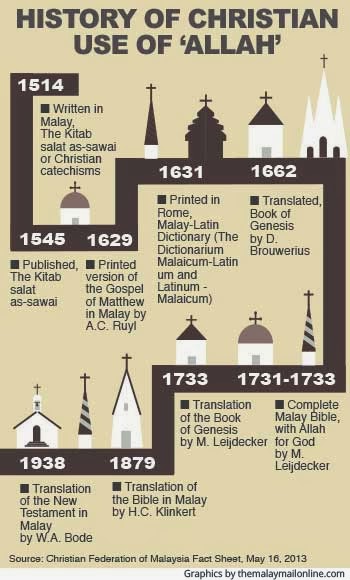
At this church in Kampung Tabuan yesterday, which caters to the largely Iban villagers in the surrounding areas, the service was conducted in Iban. The liturgy alone – the booklet that sets out the fixed set of Eucharistic rites and words to be used in worship – contained no fewer than 80 of the words “Allah Taala”, which means God Almighty in Iban. The word was also used in the hymns and in the sermon of Reverend Nelson Sinken.

The secretary of the Parochial Council of Churches, Maxwell Landong, told The Malaysian Insider after the service, “Since I started going to church, the words Allah Taala have been used by the church to refer to God. It’s our language and there are no other words I know that were used to refer to God.”

He added, “We have been using Allah in our liturgy, our Iban-language Bibles, publications, prayers and sermons for as long as I can remember. The Muslims in Sarawak have accepted that. So what is the fuss? Why now?” He pointed out that if the court ruled against the Catholic Church’s use of the word, it would be difficult to enforce the ruling here. He said that on a personal basis he would still pray to Allah Taala and read Bibles that use the word Allah to refer to God “no matter what the court says”.

For his part, Reverend Sinken was sanguine on today’s highly anticipated Court of Appeals decision on the dispute between Christians and certain Malaysian Muslim authorities over the use of the word. “I'm not worried,” Reverend Sinken said. He did not offer prayers for divine intervention or speak on the subject in his sermon. Echoing the exact sentiments of Landong, Reverend Sinken said of the Christians, “We in Sarawak have been using the word Allah for years without problem. It’s also our language. I'm sure the court will take all those into consideration.”

Like the majority of the churchgoers here yesterday, Dorothy Gregory is optimistic that the court will decide in the favour of “what is fair and just”. There are many similar words in the Iban and Malay languages. For example, “hutan” (jungle) in Malay is “utan” in Iban. “Jalan” (walk) in Malay is “jalai” in Iban and “makan” (eat) in Malay is “makai” in Iban.

When asked what could happen if the court ruled that Christians cannot use the word “Allah”, both Landong and Reverend Sinken said it would be up to the Archbishop to determine what they should do next.

Datuk Bolly Lapok is the Anglican Archbishop for Sarawak and Brunei.

Earlier, Bishop Lapok, as chairman of the Association of Churches in Sarawak, said the association “finds it unacceptable that practice of the Christians in Sabah and Sarawak who for generations had used Allah in worship, long before the very idea of Malaysia was conceived, is now held as unlawful by the government”.

He said that to stop saying Allah in the practice of their faith would be tantamount to a block on religious freedom. He added, “This is abhorrent, wholly unacceptable and a flagrant betrayal of the Malaysia Agreement, which guaranteed the inalienable rights of non-Muslims in Sarawak and Sabah to religious freedom.” Lapok said the churches expect the federal government to abide by the Federal Constitution, which guaranteed religious freedom. He said the native churches will continue to use Bibles with the word Allah as it was “their fundamental right”.

He reminded the government that people in Sabah and Sarawak were promised the right to practise their religion when Sabah and Sarawak were courted to join the Malay states of Malaya to form Malaysia. He said the government must respect and abide by that promise.

Read more here:
http://www.themalaysianinsider.com/malaysia/article/inside-a-church-a-hundred-times-the-sound-of-allah

The Court of Appeal’s ruling on the “Allah” issue exposes the rights of Malaysia’s religious minorities to oppression under the guise of appeasing the majority, lawyers said today.

In expressing its disappointment at the appellate court’s ruling, the Catholic Lawyers’ Society said the voices of moderation appeared to be “drowned out” by the religiously intolerant, stressing that the minorities’ rights in Malaysia must be protected.

“To find that the minority must yield to the majority also sends a frightening message that the minorities’ rights are subject to the whims and fancies of the majority.

“The minorities rights to freedom of religion are enshrined in the Federal Constitution and must be upheld at all times and not oppressed by the majority,” the Catholic Lawyers’ Society wrote in a press statement signed off by its president, Viola De Cruz Silva.

Read more here:
http://www.themalaymailonline.com/malaysia/article/lawyers-allah-appeal-opens-door-to-oppression-of-religious-minorities

Tuesday, January 8, 2013

#KL112 Himpunan Kebangkitan Rakyat


Saturday, 12th January 2013 at the Himpunan Kebangkitan Rakyat.


Kuala Lumpur Legal Aid Centre                             
Tingkat 9, Wisma Kraftangan     
No.9, Jalan Tun Perak
50050 Kuala Lumpur         

Tel: 03-2691 3005 / 03-2693 2072
Fax: 03-2693 0527

Thursday, December 20, 2012

Stop Lynas group vows to fight on


By G Lavendran. Published by Free Malaysia Today on 20 December 2012.

The Save Malaysia Stop Lynas (SMSL), a coalition of non-governmental organisations against the Lynas rare earth plan in Kuantan, has vowed to continue its legal battle against the granting of the temporary operating licence (TOL) to Lynas recently. 

The group said it will go on with its campaign against Lynas despite failing to win its appeal at the Court of Appeal yesterday, against a High Court decision which refused to grant a stay on the government’s decision to award Lynas the TOL. Tan Bun Teet, an applicant to revoke the TOL and a spokesperson for SMSL, said although “we didn’t think we would win the stay on the TOL through this appeal, we had to exhaust this legal avenue to test the court system”.

“We now have three judicial review cases, all armed with strong technical and scientific evidence in court. We will fight till the end to stop Lynas,” he said in a statement. “Radiation and hazardous substances are not something one should be complacent with. Lynas will be producing a massive amount of toxic waste. Lynas has no safe plan to dispose of this waste. Lynas is now at odd with our ministers who insisted that that waste be transported out of Malaysia, which Lynas has declined. Yet the court had done nothing to halt the TOL until the waste management issue has been sorted out,” he added.

“Lynas’ suggestion to turn its radioactive waste contaminated with other hazardous substances such as chemical compounds and heavy metals [into commercially safe products] will lead to its toxic waste spreading far and wide, subjecting more innocent public to its hazards. Once again I call on concerned residents and citizens to stand together with us to do something to protect your family, investment and your future in Kuantan and in Malaysia. The government has failed in its duty of care to protect you. The choice is now in your hands to do something to reclaim your safe space here in this country,” said Tan.

Another applicant to the case, Ismail Abu Bakar, said in the same statement that SMSL was disappointed with the outcome of the appeal as the court did not take into full consideration the scientific facts and technical details provided by our experts.

“We have been informed by highly qualified and skilled independent experts that the Lynas project has many problems with pollution and waste management,” he said.

SMSL also asserted that the court has neglected to take into consideration that the two judicial review cases are aimed at nullifying the approval of the TOL. “If these cases succeed, the TOL now granted to Lynas will no longer be legally valid and Lynas’ operation stopped,” the statement said.

Ram Punusamy, a local resident and active Stop Lynas campaigner, said the court did not accept SMSL’s request for the precautionary principle to be adopted to make sure that Lynas has settled its waste management and pollution problems identified by SMSL’s experts.

The application for a judicial review case will be heard in court on Jan 29, 2013.

Thursday, August 30, 2012

Statutory Rape: Courts sending out mixed signals


Published by The StarOnline on 30 August 2012.

NOW that their trials are over, former national youth squad bowler Noor Afizal Azizan can go on to fulfil the promise of his bright future and electrician Chuah Guan Jiu can focus on his fixed job and many years ahead. Through it all, no one spoke of the 13-year-old girl Noor Afizal took to a hotel to spend the night with, or the 12-year-old schoolgirl who was “coaxed” to go to her 21-year-old electrician boyfriend's flat instead of to school because he said he was too sick to take her.

These were prepubescent girls who were deemed to have consented to sex with the older boys they were dating and Court of Appeal president Justice Raus Sharif wrote in his written judgment that Noor Afizal had not “tricked the girl into submitting to him”.

In the electrician's case, Sessions judge Sitarun Nisa Abdul Aziz also thought the “sexual act was consensual”, even though DPP Lim Cheah Yit recounted how the girl had repeatedly asked Chuah to take her to school. If she did give consent, there was certainly trickery and fraud involved.

The fact remains that the girls were 12 and 13, children barely out of primary school. They are not old enough to be able to legally buy cigarettes, or even obtain medical treatment if they had contracted sexual transmitted diseases.

The law on statutory rape was meant to protect these very girls. Section 375(g) of the Penal Code states unequivocally that a man has committed statutory rape if he has sexual intercourse with a girl under 16 years of age, with or without her consent.

It is rooted in the presumption that girls below 16 have not attained the mental maturity to consent to sex, and this law was enacted to protect children from abuse. It places the onus on those around her to not have sexual intercourse with her, even if she gives consent, because she is not deemed mature enough to give consent.

In other words, the older guys should have known better. Noor Afizal and Chuah were found guilty of raping the underaged girls, but were not jailed. They were bound over for five years and three years respectively on a RM25,000 good behaviour bond.

The public uproar has been over how these young men got away with a slap on the wrist, and how the emphasis has been on not blighting their future.

Our teenagers are growing up inundated with overt sexual messages from the media and the Internet, without the benefit of a full-fledged sex education curriculum, or avenues to get answers. Clearly, our young people are having sex with each other but there is a line drawn by the law. And that is sex with girls below 16 children is off limits, even to their peers.

By letting Noor Afizal and Chuah off lightly, are the courts sending out mixed signals? Are they saying these two girls aged 12 and 13 are capable of giving consent for sex, and are they saying future good behaviour is sufficient punishment for having sex with minors? What is the message that teenage boys and younger men are getting? At the root of it all, this is about protecting our children boys and girls.

A 12-year-old girl was lured by a man twice her age into his flat, and coaxed into having sex with him, and he got away with a promise to behave himself for the next three years. Where does that leave her? What about her worth? What are we doing for these two girls? How do we protect other naive young girls from being sweet-talked by an older teen into a sexual relationship if he knows he could be found guilty of statutory rape but walk away with a promise to behave? If we do not uphold unequivocally our intolerance of sex with underaged girls, what does that say about us?

Related reports:
Adult women especially if they are less educated and financially dependent have problems saying “no” to their boyfriends and husbands sometimes even fathers uncles and brothers. Female employees often have to say “yes” to their bosses or risk losing their jobs. If these women well above the legal age have difficulties in turning away sexual advances what more a 12 or 13-year-old girl? This is why the statutory rape law exists. It presupposes that an underage person cannot have the wherewithal to refuse sex with an older person. Even if the person is only a few years older. And if the younger person is female growing up in a society where men are assumed to always hold more power in any relationship then what choice would she have but to say “yes”?

Suhakam has voiced “great concern” over sentences meted out recently on two offenders guilty of statutory rape, saying they may not have protected the interest of the victims. “Whether the rights, protection and best interests, not to mention the future, of our minors have been and will be upheld and safeguarded in cases involving statutory rape is now doubtful in the light of those sentences,” said the human rights commission’s chairman Hasmy Agam.
Hasmy said that Suhakam was alarmed that the consent of the child victims appeared to be one of the mitigating factors in both cases, though he noted that there had been similar sentences in the past in cases of statutory rape committed by young first offenders... He said that the vulnerability of a child was also recognised by the Convention of the Rights of the Child (CRC) “which states, inter alia, that the child by reason of his/her physical and mental immaturity needs special safeguards and care, including appropriate legal protection.” “It is also of great concern that the lenient sentences meted out might send the wrong message to would-be offenders, thus would not be an effective deterrence for statutory rape cases,” he argued.

Sebuah NGO yang memperjuangkan hak wanita mempersoalkan kemunasabahan seorang kanak-kanak memberi keizinan untuk melakukan hubungan seks dengan seorang lelaki yang lebih tua. "Di segi perundangan dan moral, bolehkah mereka memberi keizinan itu?" soal Pengarah Eksekutif Pertubuhan Pertolongan. Wanita (WAO), Ivy Josiah, ketika dihubungi untuk mengulas mengenai dua kes penggantungan hukuman yang dijatuhkan ke atas perogol kanak-kanak. Beliau menegaskan bahawa, di segi undang-undang, kanak-kanak di bawah umur tidak boleh memberi keizinan itu dan itulah sebabnya undang-undang seperti Akta Kanak-Kanak 2001 digubal untuk melindungi mereka.

Wednesday, August 22, 2012

Crime Statistics – Let the truth be told!


Published by Free Malaysia Today on 22 August 2012. FMT LETTER: From Veteran Cop, via e-mail.

...There are several types of crime where the classification can be manipulated from index to non-index. The maneuvering begins at the police district level which receives the report and subsequently transmitted to the State Police Headquarters and Federal Police Headquarters. The crimes which were manipulated are:
  • Robbery cases under the Penal Code are classified as index crime. This offence will be classified as non-index under section 382 of the Penal Code. Since, section 382 of the Penal Code is a non-index crime, therefore will not be reflected in the crime statistics.
  • Burglary under section 457 of the Penal Code is an index crime. This offence will be classified as non-index under sections 452 or 453 of the Penal Code. Since, sections 452 and 453 of the Penal Code are non-index crime therefore will not be reflected in the crime statistics.
  • Causing hurt under sections 324 and 326 are index crimes. These offences will be classified under section 148 of the Penal Code. Since, section 148 of the Penal Code is a non-index crime therefore will not be reflected in the crime statistics.

The under classification of the index crime to non-index crime runs into several thousand cases. Of course, by removing these cases from the crime statistics will reflect that the crime has gone down.

A simple way of ascertaining the extent of cases taken off from the index crime category for the purpose of reducing the crime statistics is by asking the police to provide the statistics of cases classified under sections 148, 382, 452 and 453 of the Penal Code since the implementation of the NKRA to date. Then a comparison should be made with the statistics of cases under the said sections in the last three years preceding the NKRA.

You will discover a sudden hike in the number of cases under those sections after the introduction of the KPI. This figure should then be compared with the figure of the same sections for the three years preceding the NKRA.  The result will confirm that for the period of three years prior to NKRA, cases classified under sections 382, 452 and 453 are almost nil and under section 148 may have only few reported cases. The number of cases recorded under the four sections for the 3 years after the NKRA minus the number of cases recorded for the 3 years before the NKRA will be the figure that has been manipulated.

Other factors that suppress the crime statistics during the NKRA period are:
  • There are many cases under the index crime category that are not opened for investigation and were closed with no further action (NFA). These cases involve robberies, snatch thefts and burglaries. Police take no further action for the reason there is no sufficient ground for proceeding with the matter if the suspect cannot be identified, the loss is minimal or there is no lead to proceed further. There are thousands of cases of this nature and since these cases are not opened for investigation, therefore, will not be reflected in the crime statistics. No profiling is done on these cases, but merely swept under the carpet. Without profiling then the trend, pattern, target areas and possible suspects could not be studied to address the recurrence of these incidents.
  • There are also cases short-changed in order to achieve the KPI. Say, for example, in a particular day there are 10 cases of burglaries reported in a certain housing area. Only one case will be opened for investigation and the other nine cases will be cross-referred to the one case that was opened. For the 10 cases of burglaries, the statistics should be 10 cases of index crime. Since, there is only one case that was opened for investigation therefore the other nine cases will not be reflected in the index crime statistics.
  • Dark figures (crimes not reported) are not factored into the crime statistics. There is a theory that for every 10 cases reported there will be one case not reported. People do not report crime when they have lost faith in the police. Lack of faith may arise when the people have the impression that the police will not treat the report seriously; ineffective investigation due to incompetence; practicing double standards; no confidence the police can solve the case or bring  justice to the victim or can recover the lost items; discriminative investigation based on the person’s background, influence, or status in society; minor trauma or losses treated with scorn; cases can be compromised by suspects getting away through bribery, influence be it political or social standing; exhaustive in going to the police station and lodging report; and last but not least is distrust and suspicion about the police.

Overall, the crime has indeed gone up. There are many flaws in the statistics dished out to the public. The statistics was tailored to justify the KPI and appease the powers that be. It is better for the police to tell the truth and shame the devil. In response to Dr. Lim Teck Ghee, the police said, “Crime statistics released by the PDRM are the actual figures of criminal cases reported to and investigated by the police department. These figures are auto-generated by the department’s computer system i.e. the Police Reporting System (PRS). In this way, no alteration or adjustment to the figures can be done, in order to portray a rosy picture of the crime situation as claimed by certain quarters.”

The rationalization of the computer system (PRS) to validate the crime figures is a flawed excuse. The system picks up only what has been fed into it. PRS system does not control classification of cases. To demonstrate that the GTP, NKRA and KPI are a success, classification of cases was doctored and entered into the system which will surely produce the result that was desired.

The police made another assertion, “All crime data and statistics generated within the PDRM system have been audited and verified by Pricewaterhouse Coopers Malaysia.” Do you expect accountants to audit and verify classification of cases? Are they going through all the police reports to ensure the nature of crime committed, categorizing the correct section of the offence under the law, and classification of the case as index or non-index? Be truthful on their role that is only limited to calculating the figures given by the police. In fact, it is a waste of public funds hiring accountants to just vet the figures if only the police are honest in the first place.

End the charade on public relations (PR) exercises to erase the fear of crime. Stop fooling the public with PR programs, like ‘high profile policing’, ‘high visibility patrol’ ‘walkabout’ ‘stop and talk, ‘meet and greet’, and ‘singing in shopping malls’, that won’t work when criminals are still milling around. Spending huge money hiring consultants with no background or expertise in criminal field to advise the police was the biggest blunder. It is a shame on the police organization of 205 years, having police officers of more than 30 years in service and experience with educational background from degree to PHD, unable to tackle the crime situation...

There must be a climate of fear and respect towards the police. The fear must come from the wrongdoers and those who intend to contravene the law. Respect is from those who feel secured when seeing the men in blue. Are the police doing the right thing to earn that respect? People are feeling unsecured with the crime situation and the fear of being a victim keep increasing. Ironically, even the policemen are having the same sentiment. Camouflaging crime figures will only aggravate the situation further. Be honest and tell the truth.