Showing posts with label Freedom of Expression. Show all posts

Monday, May 18, 2015

Malaysia: Crackdown on Freedom


Published on 14 May 2015 by Al Jazeera.

Meet the Malaysians arrested under a controversial law that critics say is being used to silence government opponents.

Thursday, November 27, 2014

Malaysia to retain and prop up Sedition Act, says PM


Published by Reuters on 27 Nov 2014.

Malaysian Prime Minister Najib Razak on Thursday bolstered a law protecting the sanctity of Islam and the country's traditional rulers, the sultans, in an about-turn to scrap a law banning criticism of the government.

Najib pledged in 2012 to repeal the Sedition Act - a relic of the British colonial era intended to keep a tight lid on racial tensions and social unrest in the multi-ethnic country - as part of a raft of liberal reforms to promote openness.

Rights groups and lawyers have criticized the Sedition Act, saying it inhibits freedom of speech.

The Malaysian leader told a meeting of his ruling United Malays National Party (UMNO) party that the act would be maintained and strengthened.

The 1948 Sedition Act, which criminalizes speech with an undefined "seditious tendency", will be boosted with additions to defend the sanctity of Islam, and penalize those who call for the separation of Sabah and Sarawak states from Malaysia, said Najib.

In a flurry of cases this year, Malaysian prosecutors have charged anti-government activists and opposition politicians with sedition. Out of more than a dozen prosecutions under the Act this year, at least five have centered on comments voiced about the sultans or their powers.

The three-party opposition, which has eroded the ruling coalition's majority in two straight elections, says the Sedition Act is being employed selectively against its members, allies and social activists to undermine the alliance.

(Reporting By Al-Zaquan Amer Hamzah and Ebrahim Harris; Editing by Jeremy Laurence)

Link: 

Monday, October 20, 2014

Malaysia lawyers march against Sedition Act


By Sumisha Naidu. Posted on 16 Oct 2014 18:10 by Channel NewsAsia.

Suited up, under the blazing sun, hundreds of Malaysia's lawyers and their supporters marched on Parliament on Thursday (Oct 16) in a rare demonstration of discontent against the nation's Sedition Act.

Chris Leong, President of Malaysian Bar Council, said: "The Sedition Act is repugnant because the Sedition Act seeks to compress and restrict democratic space. It punishes speech. It punishes expression of thought by thinking Malaysians."

This was only the fourth time in the Malaysian Bar Council's more than 60-year history that it has staged a demonstration such as the one on Thursday. But the Council said the protest was necessary to pressure Prime Minister Najib Razak's administration to fulfil its promise. Mr Najib had pledged to repeal the Act two years ago - an Act the British had introduced in the 1940s to curb dissent against colonial rule.

But since March last year, the Council believes at least 30 people have been investigated or charged for sedition. One of them was student activist Adam Adli, who has been sentenced to a year in prison for allegedly seditious comments he made during a talk about the results of Malaysia's 13th general elections.

"The way I look at it was that I didn't really create any unrest among the people," he told Channel NewsAsia. "What I did was I create unrest among the government, those in charge in the office, and that's why I was charged and convicted."

Aidila Razak, a journalist, said: "My colleague Susan Loone, she's also assistant editor at Malaysiakini, she heads the northern bureau. She's been arrested for actually just doing her job, and I think that's really repulsive. It has nothing to do with sedition, she was just reporting what other people had said."

Dubbed the "Walk for Peace and Freedom", representatives from the Bar Council had hoped to submit a memorandum to Mr Najib. But they were just as happy that a Minister in the Prime Minister's Office, Mah Siew Keong, had received them. "We had a fruitful discussion and he had assured us that all of [the lawyers'] views contained in a memorandum addressed to the prime minister will be conveyed to the prime minister," he said.

The Malaysian government has said it will consider abolishing the Sedition Act when its intended replacement, the National Harmony Bill, is ready. But analysts suspect the prime minister may renege on his pledge to repeal the Act altogether.

There are many strong advocates for the Act within Mr Najib's party. And they argue the Act is to safeguard national unity. "Walk against sedition has not made an impact because most Malaysians want safeguards against racially/religiously offensive speech," tweeted Youth and Sports Minister Khairy Jamaluddin.

Tricia Yeoh, Chief Operating Officer, Institute for Democracy and Economic Affairs, said: "There would be some quarters who believe the Sedition Act should either be abolished, or maybe tempered down, so that it's not so harsh. But that would receive a huge backlash from other side of the ruling party, which believes that there should be a stronger reaction from the government when there are criticisms being made."

Still, the Malaysian Bar Council is undeterred. It says the walk is just the beginning of a long and sustained campaign, one that it hopes will lead to the revoking of the Sedition Act once and for all.


By Shannon Teoh. Published by The Straits Times on 16 Oct 2014.
NEARLY 500 Malaysian lawyers braved the noon day heat in their suits and ties to protest this year's "sedition blitz" outside Parliament building on Thursday morning, saying they were dutybound to fight an unjust law.
Over 20 people, including academics, lawmakers and students, have been hauled up for questionable offences under the Sedition Act, such as insulting the ruling Umno party and saying top judges have erred in case decisions. Some of them have been convicted.
This is despite Prime Minister Najib Razak's pledge in 2012 to repeal the law as part of a raft of democratic reforms to win over liberal voters in last year's general election. Critics say the Sedition Act is used to stifle political dissent.
Link: http://www.straitstimes.com/news/asia/south-east-asia/story/malaysia-lawyers-protest-against-sedition-act-urges-najib-honour-his

BY MUZLIZA MUSTAFA. Published on 16 October 2014 by The MalaysianInsider.
For the fourth time in its history, the Malaysian Bar today rallied, this time, against the Sedition Act 1948 demanding that Putrajaya repeal the colonial-era law, which in recent weeks had been used against opposition politicians and activists.
In a fiery speech at the start, Bar Council president Christopher Leong said the act was created to shut people up and Putrajaya was using it just to do that.
“This is an unprecedented abuse against lawyers, students, journalist and civil society. We are here to claim back the democratic public place. As much as you may try, you cannot stop our freedom of expression, our thoughts. We will ask why," said Leong.
Despite the heat, hundreds of lawyers in suits gathered at Padang Merbok from 9.40am today for the “justice and freedom walk against the Sedition Act”.
The Malaysian Bar previously walked in protest against the Peaceful Assembly Act in 2012, against allegations that judicial appointments were fixed in 2007 and amendments to the Societies Act in 1982.
The group began walking towards the Parliament at about 11.40am, with lawyers holding placards and banners, chanting "Hidup Hidup Rakyat" (Long live the people) and "Mansuh Mansuh Akta Hasutan" (Abolish Sedition Act).
About 10 of them will be going into the Parliament to hand over the memorandum to the representative of the Prime Minister's Department, calling for the Sedition Act to be abolished.
Leong said the group then met with Minister in the Prime Minister's Department Datuk Mah Siew Keong and handed him the memorandum that called upon Prime Minister Datuk Seri Najib Razak to repeal the Sedition Act as he had promised in 2012.
In the memorandum, the Malaysian Bar also urged Najib and Putrajaya to commit and promote the building of a fair, just, harmonious, unified, moderate, progressive Malaysia and reject all forms of bigotry, racist and religious extremism.
After the meeting, Leong, in a statement, admitted that changes would take time and said that the Bar Council would continue to play its role within the period.
"We are saying that you cannot punish people because they are expressing their thoughts, because you did not like what they said or because you did not agree with what they said.
"The Sedition Act is in fact a counter-productive measure to better Malaysian.”
He said the Malaysian Bar was aware that there were some fault-lines when it came to a multiracial country but the fault-lines should not be dealt using the act.
"We have to deal with it through dialogues and exchanging of ideas.”
Putrajaya embarked on a sedition blitz in recent weeks even after Najib had continued to give assurance that he would abolish the draconian law.
However, Putrajaya was also facing pressure from Umno grassroots and some Malay groups to retain the law, which they said would protect the position of the Malays, Islam and the monarchy.
The prime minister also appeared to renege on his promise with a statement from his office that said Putrajaya would tread carefully with the Sedition Act as it had not yet decided whether to go for a complete repeal, to retain it with amendments, or to introduce new laws.
The statement was contradictory to Najib's pledge two years ago to repeal the Sedition Act and replaced it with a National Harmony Act.
Among those who have fallen under the sedition dragnet are PKR vice-president N. Surendran, who was charged twice last month with sedition, Shah Alam MP Khalid Samad, Seri Delima assemblyman RSN Rayer, Sabah politician David Orok, and Universiti Malaya law professor Dr Azmi Sharom and preacher Wan Ji Wan Hussein.
Published by Today Online Singapore, on 17 Oct 2014.

Ten lawyers acting as representatives for the group then delivered a note to Mr Mah Siew Keong, Minister in the Prime Minister’s Department, who received the document on behalf of Mr Najib.

Saying that the parties had a “fruitful discussion”, Mr Leong added that Mr Mah had given his assurance that he would convey the views of the Malaysian Bar, which represents 16,000 lawyers in Peninsular Malaysia, to the Prime Minister.

“We ask the Prime Minister and government to take into account our views and that he remains steadfast in his pledge and promise made in July 2012 to repeal the Sedition Act,” said Mr Leong outside Parliament.

The lawyers also called for a moratorium on the use of the law, which dates back to 1948 when Malaysia was under British rule.

Before the march started, Mr Leong told reporters that about 13 foreign Bar associations had written to Mr Najib in support of the Malaysian Bar’s campaign.

The Prime Minister described the Sedition Act in July 2012 as the representative of a “bygone era” and said he would replace it with legislation aimed at preventing incitement of religious or ethnic hatred.

However, last month, his office said there would not be a rush to change it, as human rights group Amnesty International and Malaysian civil groups called on him to honour his earlier vow, with more people being charged under the law in recent months.

As a replacement to the Sedition Act, Mr Najib has proposed the National Harmony Act, which he has said would protect freedom of expression. The government has not started drafting the law, however, said a statement from the Prime Minister’s Office last month.

Before the new law comes into place, existing cases under the current Act must be tried under current rules, the government said in August.

Amnesty International Malaysia said last month that the increasing use of the act was fostering a “climate of repression”. From January to September, 12 cases — some involving lawmakers, academics and student — were prosecuted under the Sedition Act — the highest figure since 2009.

Tuesday, October 7, 2014

Malaysia’s Deplorable Sedition Act

Photo from Asia Sentinel.

Published by The New York Times on 6 October 2014. By the Editorial Board.

The Malaysian government has increasingly employed the Sedition Act, a British colonial era law, to intimidate and silence political opponents. The law criminalizes speech uttered “to excite disaffection” against the government and defines sedition so broadly that it is an invitation to authoritarian abuse.

Prime Minister Najib Razak had promised to repeal the act, but, since the general elections in May last year, his government has made full use of the law to hound his critics. While Mr. Najib’s ruling coalition, Barisan Nasional, won 60 percent of the parliamentary seats in the election, for the first time since independence in 1957, the opposition coalition, Pakatan Rakyat, won a 51 percent majority of the popular vote.

The elections seem to have shaken the government enough for it to arrest and prosecute an array of politicians, journalists, academics, students, religious leaders and civil society activists who did not advocate the overthrow of the government. For example, a senior opposition politician was charged with sedition for criticizing a decision by the appeals court in a statement to the news media. A local state assemblyman was charged for allegedly saying “damn, damn” about the government’s United Malays National Organization to several assemblymen. Since 2013, at least 14 people have been charged. Those found guilty can face up to three years in prison.

Mr. Najib’s crackdown is a deplorable attack on free speech and a serious threat to democracy. He appeared to understand this danger when he promised to repeal the Sedition Act. He should do so immediately.

Monday, October 14, 2013

Allah case: Church to fight on


The Herald will appeal the appellate court's decision to set aside the High Court's ruling permitting it to use the term "Allah" in its publication. Saying this, the weekly's editor Father Lawrence Andrew, said the Court of Appeal's decision contradicts government policy.

Referring to the Catholic Church's argument that the Malay-speaking congregation commonly used the term in reference to God, Lawrence said: "We cannot reconcile how on the one hand the Christian community is allowed to freely use, import and distribute the Al-Kitab which uses the word 'Allah' extensively, by virtue of the govt's 10-point solution for their worship and instruction of their prayer."

"It is also a retrograde step in the development of the law into the fundamental liberties of religious minorities in this country," he told reporters outside the Palace of Justice here today. "In our view, the Court of Appeal ought to have interpreted the Federal Constitution in order to uphold rather to diminish the rights of the minorities," he added.

Disappointed that the decision to set aside the earlier High Court judgment which ruled that it was against the Church's constitutional right to discontinue using the term, the priest insisted that evidence submit during the course of the trial had showed that the word "Allah" is not exclusive to Islam. 

"It goes against evidence itself and by the use of the word by the Christians is a danger to public order is not proved yet till today," he said after a three-man bench read out the gist of the judgment this morning. 

Justices Datuk Seri Mohamed Apandi Ali, Datuk Mohd Zawawi Salleh and Datuk Abdul Aziz Abdul Rahim had unanimously ruled that the home minister, in banning The Herald from using Allah in its Malay edition, had made a decision in the interest of safeguarding public order. The judges also state that no constitutional right was infringed in the process and that the word "Allah" is not an integral part of the Christian faith. 

The Church, in its submissions, had stated that the Malay edition of the publication citing excerpts of the Al-Kitab, a translation of the Bible in Bahasa Malaysia. "We have not caused disharmony, for the 18 years of The Herald's publication, we have not caused any inconveniences," asserted Lawrence. "So we feel that this is unrealistic, given that the use of the word 'Allah' by Bahasa Malaysia- speaking congregation and other indigenous groups especially in Sabah and Sarawak for generations," he said.  

"We are not discouraged by this decision. We trust in God, justice will be served. We will appeal," said Lawrence. 

Link:
http://www.fz.com/content/herald-appeal-decision-contradicts-government-policy#ixzz2hgPhR9UK

To what extent will Prime Minister Najib Razak now push the issue remains to be seen. However, there is already deep concern he might seize on the ruling and use the precedent to force Christian groups into surrendering more of their rights whenever it was politically beneficial to him, or whenever he wanted to curry favour with the Muslims.

Some even fear that the Muslim extremists or ultras in Malaysia, flushed by today's victory, might get more demanding. This would set the stage for a collision course with the Christians, especially those from Sabah and Sarawak. The already high racial and religious disunity is bound to rise at least by another notch and this could destabilize Malaysia even more.

Nasharuddin was among those who attended the hearing at the Palace of Justice in Putrajaya this morning. Ibrahim Ali, the head of ultra Malay rights group Perkasa too was present. However, the Muslim NGOs while noisy and emotional failed to gather more than 200 or so protesters. Shouts of Allahu Akbar or God is Great cut through the cool morning breeze outside the grand court complex, while group prayers were also held. When the government's lawyers came to announce the decision, they were greeted like heroes.

Read more here:
http://www.malaysia-chronicle.com/index.php?option=com_k2&view=item&id=174491:catholic-magazine-herald-denied-the-right-to-use-allah-by-malaysias-appeals-court&Itemid=2#axzz2hh7V2U3M

But Khalid said that rather than banning the use of ‘Allah’ by non-Muslims for fear of retaliation by “stupid people”, the government should focus on educating the Muslims on what the Quran said over the issue. “The government should educate Muslims regarding all the verses of the Quran which mentions non-Muslims discussing about Allah with the Prophet Muhammad, and using the word freely without any hindrance whatsoever,” the Shah Alam MP said. “Instead, our government seems to be very proud that we are the only Muslim nation that practices this ban – that we are going beyond even what the Prophet Muhammad had done...”

He rejected Department of Islamic Development’s (Jakim) line of argument that allowing non-Muslims to use ‘Allah’ would threaten the faith of Muslims, saying: “It’s just like how everybody uses the word ‘God’ and ‘Tuhan’. There’s no confusion there.” On the contrary, Khalid insisted that opening up the word ‘Allah’ to other religions would build a common platform among the country’s different believers, and hence encourage interfaith discussions.“The question of pluralism also doesn’t come into play because the Quran says the only religion accepted by Allah is Islam,” he added.

Khalid also maintained that the issue was political rather than religious – he claimed that right wing Malay groups were championing the cause to make Islam exclusive to Malays and erect barriers between themselves and the non-Muslims in the country. “They want to maintain special position, hegemony in the country… they want to distance the Malays from the non-Malays in the country, so that issues such as good-governance, which is supported by non-Malays, does not become a matter of interest for the Malays,” said Khalid.

Read more here:
http://www.freemalaysiatoday.com/category/nation/2013/10/14/we-respect-allah-ruling-but%E2%80%A6/

Sarawak will continue to allow the use of the word Allah in Bahasa Malaysia and native language Bibles and church publications, said State Land Development Minister Tan Sri Dr James Masing, following the Court of Appeal's ruling today not to allow Catholic weekly The Herald to use the term.

Masing described the ruling as “not genuine”, saying the use of the word Allah predated Islam. “We (Christians in Sabah and Sarawak) have been using the word Allah for over 100 years. Why suddenly we are now told we cannot use it?" he asked, adding that the court's decision would have a negative impact on non-Muslims beyond Sabah and Sarawak. “Did they have a dream that Allah said they (the Christians) can't use the word Allah?” he asked, referring to the opposition by some Muslim groups in West Malaysia on the usage of the word in Christian texts.

Referring to Muslims in Sabah and Sarawak as "brothers", Masing said they had no qualms about Christians using the word. Masing reminded Christians in the state that Sarawak Chief Minister Tan Sri Abdul Taib Mahmud had in the past weighed in on the issue by giving assurance that he would not stop them from using the word Allah.

PKR Sarawak chief Baru Bian, saying he was stunned by the decision, said churches and Christians in Sabah and Sarawak would continue using the word Allah. “I am stunned by the decision.

“We have produced very clear facts that we were promised a guarantee by our forefathers when Sabah and Sarawak helped form Malaysia. The ruling appears to go against the fundamental rights that were promised," said Baru, adding that the decision goes against the Malaysia agreement.

Baru, a church elder of the Kuching Evangelical Church for over a decade until he joined politics, said the ruling went against Article 11 of the Federal Constitution which allows people to profess and propagate their religious beliefs.

Read more here:
http://www.themalaysianinsider.com/malaysia/article/its-worship-as-usual-sarawak-christians-will-continue-use-allah-state-minis

Reverend Dr Herman Shastri, general secretary of the Council of Churches Malaysia (CCM), who was also present in court, expressed disappointment with the ruling, saying that he did not agree with the argument that the word "Allah" was not integral to Christianity.

"The learned judges obviously did not take into consideration that the Christians in Sabah and Sarawak and Malay-speaking Christians in Peninsular Malaysia have been using the word even before Independence," he argued.

He explained that Christians in the Middle East and Indonesia have been using the word "Allah", adding that the word predates Islam. "Even in the Quran it is mentioned that the Christians and Jews believe in Allah, which explains why PAS had also said that Christians can use the word. "But here, the judges made a ruling without calling expert evidence. This is very disappointing," added Shastri.

He said the CCM could not understand the "public order" argument accepted by the court. "The people in East Malaysia have been using the word and they have been living in peace, so what public order are they talking about? Just because a few extremists are making a big issue of this does not make it a national security issue," he said. Shastri noted that Putrajaya's 10-point solution to Christians in Sabah and Sarawak had not affected public order.

Read more here:

Whatever the High Court rules on the “Allah” issue today, churches in Sarawak like this one that conduct their services in the native languages have no plans to change the way they worship, with many saying that “Allah” will continue to be used in their prayers.

At this church in Kampung Tabuan yesterday, which caters to the largely Iban villagers in the surrounding areas, the service was conducted in Iban. The liturgy alone – the booklet that sets out the fixed set of Eucharistic rites and words to be used in worship – contained no fewer than 80 of the words “Allah Taala”, which means God Almighty in Iban. The word was also used in the hymns and in the sermon of Reverend Nelson Sinken.

The secretary of the Parochial Council of Churches, Maxwell Landong, told The Malaysian Insider after the service, “Since I started going to church, the words Allah Taala have been used by the church to refer to God. It’s our language and there are no other words I know that were used to refer to God.”

He added, “We have been using Allah in our liturgy, our Iban-language Bibles, publications, prayers and sermons for as long as I can remember. The Muslims in Sarawak have accepted that. So what is the fuss? Why now?” He pointed out that if the court ruled against the Catholic Church’s use of the word, it would be difficult to enforce the ruling here. He said that on a personal basis he would still pray to Allah Taala and read Bibles that use the word Allah to refer to God “no matter what the court says”.

For his part, Reverend Sinken was sanguine on today’s highly anticipated Court of Appeals decision on the dispute between Christians and certain Malaysian Muslim authorities over the use of the word. “I'm not worried,” Reverend Sinken said. He did not offer prayers for divine intervention or speak on the subject in his sermon. Echoing the exact sentiments of Landong, Reverend Sinken said of the Christians, “We in Sarawak have been using the word Allah for years without problem. It’s also our language. I'm sure the court will take all those into consideration.”

Like the majority of the churchgoers here yesterday, Dorothy Gregory is optimistic that the court will decide in the favour of “what is fair and just”. There are many similar words in the Iban and Malay languages. For example, “hutan” (jungle) in Malay is “utan” in Iban. “Jalan” (walk) in Malay is “jalai” in Iban and “makan” (eat) in Malay is “makai” in Iban.

When asked what could happen if the court ruled that Christians cannot use the word “Allah”, both Landong and Reverend Sinken said it would be up to the Archbishop to determine what they should do next.

Datuk Bolly Lapok is the Anglican Archbishop for Sarawak and Brunei.

Earlier, Bishop Lapok, as chairman of the Association of Churches in Sarawak, said the association “finds it unacceptable that practice of the Christians in Sabah and Sarawak who for generations had used Allah in worship, long before the very idea of Malaysia was conceived, is now held as unlawful by the government”.

He said that to stop saying Allah in the practice of their faith would be tantamount to a block on religious freedom. He added, “This is abhorrent, wholly unacceptable and a flagrant betrayal of the Malaysia Agreement, which guaranteed the inalienable rights of non-Muslims in Sarawak and Sabah to religious freedom.” Lapok said the churches expect the federal government to abide by the Federal Constitution, which guaranteed religious freedom. He said the native churches will continue to use Bibles with the word Allah as it was “their fundamental right”.

He reminded the government that people in Sabah and Sarawak were promised the right to practise their religion when Sabah and Sarawak were courted to join the Malay states of Malaya to form Malaysia. He said the government must respect and abide by that promise.

Read more here:
http://www.themalaysianinsider.com/malaysia/article/inside-a-church-a-hundred-times-the-sound-of-allah

The Court of Appeal’s ruling on the “Allah” issue exposes the rights of Malaysia’s religious minorities to oppression under the guise of appeasing the majority, lawyers said today.

In expressing its disappointment at the appellate court’s ruling, the Catholic Lawyers’ Society said the voices of moderation appeared to be “drowned out” by the religiously intolerant, stressing that the minorities’ rights in Malaysia must be protected.

“To find that the minority must yield to the majority also sends a frightening message that the minorities’ rights are subject to the whims and fancies of the majority.

“The minorities rights to freedom of religion are enshrined in the Federal Constitution and must be upheld at all times and not oppressed by the majority,” the Catholic Lawyers’ Society wrote in a press statement signed off by its president, Viola De Cruz Silva.

Read more here:
http://www.themalaymailonline.com/malaysia/article/lawyers-allah-appeal-opens-door-to-oppression-of-religious-minorities

Monday, August 26, 2013

When, why and how Christians use the word ‘Allah’ - CFM


Published by The Malay Mail Online on 22 August 2013.

Introduction and Background

The objective of this document is to explain briefly to those Christians who do not understand when, why and how Churches in Malaysia use the word ‘Allah. It is also for Christians who are confused about how to respond, when confronted by the ignorance of non-Muslims about the Christian use of the word ‘Allah’.

There are many (misleading) statements by non-Christians who claim that we should not use the word, because it is an exclusive Muslim term for the God of Islam and can be used only by Muslims. This is a situation peculiar to Malaysia, as elsewhere in the Muslim world, Arabic-speaking Christians use the word ‘Allah’.

Christians themselves are sometimes ignorant, because unless we pray in Bahasa Malaysia, we pray to ‘God’ in our own language. In English services, for example, nowhere do we use the word ‘Allah’.

However, more than 60 per cent of Malaysian Christians only speak Bahasa Malaysia, and the word used for God in the Bahasa Malaysia Bible (Al-Kitab) since its translation in 1731, is ‘Allah’. The word is used by Bumiputera Christians who only have Bahasa Malaysia as their common language in Sabah, Sarawak and peninsular Malaysia, and by the Baba community in Malacca.

Historical Usage and Meaning

1. The word ‘Allah’ was a term used for the supreme God in a pantheon of gods, before the revelation of Islam. The Shorter Encyclopedia of Islam ed., H. A. R. Gibb & J. H. Kramer and The Oxford Encyclopedia of the Modern Islamic World, ed. John L. Esposito, both affirm and support this contention.

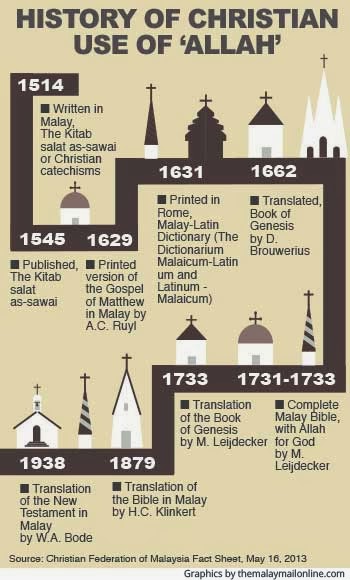
2. Historically, Malay-speaking Christians in South-East Asia have used ‘Allah’ to refer to God. The proof is as follows:

• The Kitab salat as-sawai or Christian catechisms in Malay written in 1514 and published around 1545,

• The printed version of the Gospel of Matthew in Malay by A.C. Ruyl in 1629,

• Malay-Latin Dictionary was printed in Rome in 1631 (The Dictionarium Malaicum-Latinum and Latinum - Malaicum)

• The translation of Genesis by D. Brouwerius (1662),

• M. Leijdecker’s translation (1733),

• H.C. Klinkert’s translation (1879),

• W.A. Bode’s translation (1938), and

• The complete Malay Bible of 1731-1733 containing the word ‘Allah’ for God.

3. Therefore, from the very beginning, the word ‘Allah’ has been used in the liturgy, prayers and worship of those Christians who speak Bahasa Malaysia.

But for centuries, there has been no opposition or uproar about their use of ‘Allah’.

Language

Objections to the use of the word ‘Allah’ comes mostly from political discourse, or those who argue that the translation and usage of the word is a recent decision. This
is not true for the following reasons:

1. In Semitic languages, the word ‘Allah’ has been widely used in the Middle East dating back to the 5th Century BC and up to the time of the expansion of Islam and the spread of the Arabic language in the 7th century AD.

2. The translation of the Al-Kitab is not from the English translation but based on the Hebrew and Greek text of the Bible. In the Hebrew language, the word ‘God’ has the same root form as the Arabic language. So, when the word ‘God’ was first translated into Bahasa Malaysia, the translators merely followed the Arabic Christian usage and retained the word ‘Allah’.

3. As stated earlier, the word ‘Allah’ pre-dates Islam. It is not a creation of the Muslims and its existence does not begin in the Al-Quran.

Should Christians Substitute the word ‘Allah’ with ‘Tuhan’?

This is not possible for the following reasons :

1. In the Malay language, ‘Allah’ means ‘God’ and Tuhan means ‘Lord’. As is obvious when we read the Bible, both God and Lord are used in the Bible, and both have different connotations. Therefore ‘Allah’ cannot be substituted by ‘Tuhan’.

2. The word Tuhan has been applied to Jesus Christ and read as Tuhan Yesus.

If Christians are to substitute the word ‘Allah’ for Tuhan, it will render many Biblical references to God and Jesus incoherent because:

• The meaning of ‘Allah’ and Tuhan are different.

• This is obvious in just one example. In Isaiah chapter 41 and verse 13; also 43 : 3 and 51 : 15. "For I am the LORD, your GOD..." is translated as "Akulah TUHAN, ALLAH kamu...". (ALKITAB : Berita Baik. 2001. 2nd edition. Published by the Bible Society of Malaysia).

• It creates an absurd situation if Christians have to translate the biblical phrase ‘Lord God’ as Tuhan Tuhan. The repeated words Tuhan Tuhan indicates plural in Bahasa Malaysia, and creates the impression that

Christians believe in many Gods, which is unacceptable.

• Bahasa Malaysia-speaking Christians will not be able to affirm the deity of Jesus Christ and teach the doctrine of the Trinity as these two foundational words are essential to maintain and communicate these truths.

Consequences of Banning the Word “Allah”

1. Being denied the use of the word ‘Allah’ disregards the constitutional right of Malaysian citizens to freedom of religion under the Federal Constitution.   
Article 11 of the Federal Constitution safeguards the right of each Malaysianto profess and practice one’s religion of choice. Article 11(3) expresslyprovides that every religious group has the right to manage their own religiousaffairs.

2. In 2009, the High Court handed down a judgement allowing the Catholic Church to use the word ‘Allah’. The government (of all Malaysians, including
Christians) is appealing the judgement and it is pending.

3. There have been other infringements on the right to use words imperative in the Bahasa Malaysia Bible. See the directive of 5 Dec 1986 from the Ministry of Home Affairs stating that, in addition to ‘Allah’, the words: Al-Kitab, Firman, Rasul, Iman, Ibadah, Injil, Wahyu, Nabi, Syukur, Solat and doa are not to be used in the Al-Kitab. In addition, making such prohibitions through fatwa render them only relevant to Muslims as the Shari’a does not apply to nonMuslims.

4. Prohibiting the use of the word ‘Allah’ and these other terms is unjust. Bumiputera Christians should be given the respect and freedom to call God in the only language they have in common. This is important to their religious and cultural identity.

5. If Churches in Malaysia agree to stop using the word ‘Allah’, it means that the right to edit the Scripture of a major world religion has been given over to a secular government. This would be a shameful and an unprecedented development for any religion and government.

Conclusion

Some Muslims have claimed repeatedly that Christians in Malaysia refuse to stop using the word ‘Allah’ because they want to confuse and convert Muslims, thereby posing a threat to national security. The claim is groundless as there has been no evidence offered of any threat to security. These remain unfounded accusations.

On the contrary, such an assertion is made in ignorance of the fact that when Christians use the Al-Kitab, it is simply for Bahasa Malaysia-speaking Christians.

Malaysian Churches have never suggested changing the words ‘God’ and ‘Lord’ to ‘Allah’ and ‘Tuhan’ respectively, in the other languages of the Bible.

* This is the personal opinion of the writer or publication and does not necessarily represent the views of The Malay Mail Online.

* This circular was previously sent out in May and is being circulated again in response to the Court of Appeal ruling.

Link: 

Tuesday, June 18, 2013

Singapore: 2 Plagues And 2 Prosecutions

The Plagues

Singaporeans woke up to another day of haze on Tuesday as the Pollutant Standards Index (PSI) hovered at 121 at 10am. The National Environment Agency released figures showing the country's air quality at 8am to be in the unhealthy range of 109-122. Anything above 100 is unhealthy. NEA figures showed the South region of Singapore to be the worst hit. The haze was the worst in 16 years at 10pm on Monday, with a PSI reading of 155, before dipping slightly to 145 at midnight.

Concerned readers of The Straits Times have sent their photos in showing Singapore, from Tanjong Pagar to Jurong East Central, shrouded in smog. Reader Yap Siew Meng, who sent in a photo montage taken on Monday, said that the haze was so bad that he could not open his eyes fully. Urged reader Joanne Hong: "The Government needs to do something. This is very bad for our children.”

Extracted from: 

The number of people with dengue has crossed the five figure mark with 10,258 cases diagnosed by 3pm on Monday. But the rise in infections appear to have plateaued last week, with 813 cases - or two fewer than the week before. Minister for the Environment and Water Resources Vivian Balakrishnan had said last week that projections by the National Environment Agency had predicted 960 cases last week.

Singapore has just entered the hot season when mosquitoes breed faster and are more able to spread the disease. This morning, Dr Leo Yee Sin, head of the Communicable Disease Centre, said it was likely for the number of cases to exceed 15,000 this year.

Extracted from:

The Prosecutions

The case that has thrown the shameful failings of a core state institution into relief is that of Professor Tey Tsun Hang, who stands accused of accepting sexual favours and gifts from a student in exchange for better grades…

His academic work has been very critical of the Singapore government, also focusing in great detail on the failings of the judicial system and highlighting its shameful subservience to the overbearing powers of the Executive. 

Tey’s publications are well respected and have found a ready audience internationally, where it is harder to suppress the freedom of academic inquiry, and where ideas require true merit to become popular. [One of his article: http://singaporeconsensus.wordpress.com/2012/04/02/excluding-religion-from-politics-and-enforcing-religious-harmony-singapore-style/]

Of course, being a crusader for a clean judiciary does not automatically absolve an individual of criminal charges. The question then becomes whether it is true that Tey accepted favours in exchange for giving better grades.

In order to prove their case, the prosecution would have to prove that he had sexual relations with this student, accepted her gifts, and in turn gave her better grades than she deserved. The defence focused on disproving the last two of these accusations. 

Firstly, it relied on evidence in the form of cheques issued in payment of the gifts that were allegedly given by the student. These cheques proved that Tey had himself paid for the items in question. Secondly, it relied on detailed academic records audited by National University of Singapore (NUS) staff, which clearly indicate that the grades the student received from Tey were completely in accordance with the quality of her work, and were marked according to the exact same standard as that of other students in the class.

These two pieces of evidence should have immediately cleared Tey of any corruption charges. If it can be proven that there were sexual relations between him and the student, then this would constitute a clear and shameful breach of ethics and professionalism. It would then warrant internal discipline proceedings at the NUS level, without sufficient evidence or cause to institute criminal proceedings. 


Alleged sham investments by the City Harvest Church — a registered charity  — came under the spotlight as prosecutors questioned their first witness, Lai  Baoting, the church’s former assistant accountant. Through Lai’s testimony they tried to show that the church’s finance  manager and fund manager were involved in the investments.

The pastor and founder Kong Hee, 48, and five officers have been charged  with varying degrees of involvement in a scheme to siphon off Sg24 million  (19 million) to finance the singing career of his wife, who goes by the name  Sun Ho in the music industry. In addition, more than Sg26 million in church money was allegedly misappropriated to cover up the original diversion…

Edwin Thong, one of the defence lawyers, said Thursday that an external auditor did not question the authenticity of the investments. The six accused appeared light-hearted, whispering and smiling at some  points during the hearing.

“Christian, remember the goodness of God in the frost of adversity,” Kong tweeted after the court adjourned Thursday, quoting from 19th century British preacher Charles Spurgeon.

Scores of church members trooped to the court for a second day Thursday to  lend their support, with some queuing from 4.30 am to ensure a seat. The church, which has a membership of more than 30,000, has affiliates in  neighbouring Malaysia and other countries. It is known for services that resemble pop concerts and had assets  estimated at more than Sg100 million in 2009. The pastor’s wife, now in her early 40s, was hoping international stardom  would help spread the church’s message, according to previous reports in the  Singapore media.

Read more here: 

In 1993, Dr Chee Soon Juan was sacked by his employer the National University of Singapore for allegedly using research funds to send his wife’s doctoral thesis to the United States. Just a few months earlier, he became the first Singaporean academic to join an opposition party and contest in the general election.

Thursday, May 23, 2013

Sedition dragnet reeks of double standard


Batu MP Chua Tian Chang, activist Haris Ibrahim and PAS’s Tamrin Ghafar were arrested for sedition today and brought to the Jinjang police station for questioning, according to reports. It is understood the trio were detained separately in an apparent police crackdown today. This is the third police investigation into sedition since the May 5 general election...


The first was student activist Adam Adli Abdul Halim who was charged with sedition in the Jalan Duta court complex this morning. The 24-year-old pleaded not guilty and was released on a RM5,000 court bail with his trial set for a mention on July 2...


According to the charges read out this morning, his words had a seditious tendency and were aimed at rallying Malaysians to change the current government through undemocratic means.

His statement, in Malay: “Take my details, lodge a police report, because today, I would like to invite all those here today to gather and take to the streets to seize back our power! Can we do that? Can we do that? Can we do that? We do not have much time left, get ready, buy shoes, buy tracksuits, buy jeans, get ready to take to the streets because in a third world country like Malaysia, elections cannot topple a government. Only the people’s power can topple a government. Remember, ladies and gentlemen, this is the only opportunity we have.”

Charged under Section 4(1)(b) of the Sedition Act 1948, the Universiti Pendidikan Sultan Idris undergraduate faces a jail term of not less three years, or a fine of up to RM5,000 or both, if convicted. Adam Adli, who came to court in a black T-shirt, was represented by lawyers Datuk Ambiga Sreenevasan, N. Surendran, Afiq M. Noor and Shamsul Iskandar Mat Akin.

Read more here: 

Speaking to FMT, S Vell Paari said he was concerned to learn about the arrests of Anything But Umno (ABU) leader Haris Ibrahim, PKR vice-president Tian Chua and PAS’ Thamrin Ghaffar. The trio were held this afternoon in connection with a forum on May 13, where a call was made to topple the Barisan Nasional government via street protests. Vell Paari said the arrests would anger the public further as the authorities would be perceived to be practicing double standard when it comes to enforcing the Sedition Act.

“While the likes of [Perkasa leaders] Ibrahim Ali and Zulkifli Noordin; and academic Ridhuan Tee Abdullah are allowed to roam free despite making incendiary remarks about race and religion, these opposition figures are however swiftly hauled up. “Even the Utusan Malaysia frontpage in the aftermath of the general election, which read ‘Apa Lagi Cina Mahu? [What more do the Chinese want], screamed sedition but our leaders chose to defend the publication,” added the MIC strategy director.

Vell Paari said this development did not bode well for Prime Minister Najib Tun Razak’s administration. “As it is BN suffers from a severe perception crisis and these arrests would just aggravate the situation,” he warned. Vell Paari said while the police had the right to investigate those who called for street protests to topple the government, it should not resort to using draconian laws...

Talk is rife that the government’s hard stance stemmed from the appointment of Ahmad Zahid Hamidi as the new home minister, who is said to be reintroducing the facets of Mahathirism. Speaking on condition of anonymity, a BN source said that he would not be surprised if former premier Dr Mahathir Mohamad was pulling the strings. “Najib was given his chance and he blew it. His electoral performance was worse than his predecessor Abdullah Ahmad Badawi. “So perhaps Umno is now looking to its grand wizard to set the house in order,” he told FMT.

Read more here:
https://www.freemalaysiatoday.com/category/nation/2013/05/23/sedition-dragnet-reeks-of-double-standard/

Wednesday, May 22, 2013

Radio Free Sarawak Receives International Media Award In Amman


Published by Sarawak Report on 21 May 2013.

Radio Free Sarawak received the highly prestigious Pioneer of Free Media Award from the International Press Institute at its annual conference in Amman last night.

Accompanied by two London colleagues founder Clare Rewcastle Brown received the honour on behalf of the whole RFS team of Sarawak Malaysian producers and presenters.

The award was established in 1996 to honour media or organizations which have fought to ensure freer and more independent media in their countries.

The other two honours presented by the IPI’s Executive Director Alison Bethel McKenzie were the World Press Freedom Hero Awards, bestowed on two highly distinguished journalists, Marie Colvin and Mika Yamamoto, who were both killed in Syria last year.

In her address to the 300 guests present at the gala dinner at the Hussein Club in Amman Alison Bethel McKenzie said:

“It is my pleasure and honour to hand the 2013 IPI Free Media Pioneer Award to Radio Free Sarawak.  Radio Free Sarawak was established by journalist Clare Rewcastle Brown and started broadcasting in November 2010 and bills itself as “the independent radio station that brings you the news you want to hear not what others want you to hear”. In practice this bold mission has involved among other things on-going attempts to expose alleged government corruption in Malaysia”

Ms Bethel McKenzie outlined how, broadcasting via shortwave radio and podcast, Radio Free Sarawak’s contributors have been detained by police and accused of possible acts of sedition by ministers in Malaysia.  Along with facing accusations of spreading malicious lies and threatening unity and harmony among races.

“During the bitterly contested 2011 Sarawak elections Radio Free Sarawak and its sister site Sarawak Report were subjected to what were believed to be deliberate, if ultimately unsuccessful efforts to silence them via cyber attacks. They have refused to be silenced. Instead they continue to broadcast loud and clear, critically and courageously”

Back on air shortly

The programme, which has taken a short recess following the election, is due back on air shortly to keep up its role informing the native people of Sarawak and hearing their views.

In her acceptance speech Clare Rewcastle Brown expressed honour and thanks for this recognition and support from the world’s oldest and most prestigious institute for international press freedom on behalf of her Sarawak Malaysian team of journalists and presenters and also on behalf of the station’s longhouse listeners.

“Malaysia is not used to a free media and we have provoked very aggressive reactions. Prominent politicians have accused us of sedition, filed police reports, accused us of poisoning the minds of the Dayak people of spreading lies, of acting as a virus and this has manifested itself in extraordinary cyber-attacks during this recent election and indeed jamming attacks as well and we find it telling that our small voice has provoked such an enormous and angry reaction in Malaysia, although it has also helped to enhance our status in many ways.  It has shown that reform is needed in the media and we will carry on our work in bringing an opportunity, a platform to some of the world’s most isolated and intimidated communities, living in the jungle far away from anyone and having that jungle cut away from under them, their rivers polluted, food becoming hard to find and really not knowing what is going on around them”.

Link: 

Tuesday, May 21, 2013

Jangan Mempolitikkan Pelaksanaan Undang-undang

PUTRAJAYA, 20 Mei (Bernama) — Menteri Dalam Negeri Datuk Seri Dr Ahmad Zahid Hamidi mengingatkan pemimpin pembangkang supaya tidak mempolitikkan segala pelaksanaan dan tindakan pihak berkuasa dalam usaha memelihara keamanan dan kesejahteraan negara.

Pihak berkenaan boleh menghadapi risiko besar sekiranya terus berbuat demikian, katanya pada sidang media selepas memulakan tugas hari pertama sebagai menteri dalam negeri.
“(Penasihat DAP) Lim Kit Siang dan (Setiausaha Agung DAP) Lim Guan Eng harus membezakan antara objektif politik, langkah politik dengan pelaksanaan undang-undang. Jangan mempolitikkan segala pelaksanaan undang-undang yang dilaksanakan oleh IGP (ketua polis negara) atau lain-lain agensi yang berada di bawah KDN,” katanya.
Ahmad Zahid berkata ketua polis negara, ketua-ketua jabatan dan agensi di bawah KDN, diberi kuasa sepenuhnya bagi melaksanakan tugas dan tanggungjawab mereka mengikut bidang kuasa masing-masing, tanpa campur tangan politik.
Sebarang tindakan yang dilakukan di bawah KDN tidak boleh dianggap sebagai tindakan bermotifkan politik, tetapi berlandaskan kepada asas-asas perundangan yang sedia ada, katanya.
Beliau mengingatkan bahawa kerajaan tidak lagi memberi amaran, sebaliknya akan mengambil tindakan tegas terhadap mana-mana pihak yang bertindak di luar batasan menjejaskan ketenteraman awam negara.
“Kami tidak akan berkompromi untuk mengambil tindakan sebagaimana yang termaktub dalam undang-undang, akta dan enakmen yang sedia ada, katanya.
Menyentuh kenyataan pemimpin-pemimpin pembangkang berhubung beberapa perkara berkaitan kenyataan beliau baru-baru ini, soal perundangan, pilihan raya dan sebagainya, Ahmad Zahid berkata perkara itu boleh dipertikai di Parlimen.
“Sebagai orang politik, kita berjumpa di gelanggang politik, gelanggangnya bukan di jalanan, bukan di padang terbuka, tetapi di Dewan Rakyat. Jangan gunakan forum di tempat lain,” jelas beliau.
Ahmad Zahid turut membidas Ketua Umum PKR Datuk Seri Anwar Ibrahim yang meminta beliau supaya tidak menjadikan negara ini seperti milik keluarganya
“Negeri ini pun bukan negeri bapa dia punya. Memang bukan (milik) bapa saya. Ini (pun) bukan negeri bapa dia,” katanya.
Anggota Parlimen Bagan Datoh itu dibidas kerana membuat kenyataan menggesa mereka yang tidak berpuas hati dengan keputusan pilihan raya di Malaysia supaya berhijrah ke negara di mana mereka boleh mempraktikkan kepercayaan politik mereka.
Ahmad Zahid juga berkata bagi memastikan pelaksanaan KDN berjalan lancar, cadangan, pandangan dan kerjasama padu daripada semua pihak dialu-alukan, selain kritikan dan teguran.
“Kami perlukan sokongan dan dukungan daripada masyarakat keseluruhannya, ini termasuk pemimpin-pemimpin politik, sama ada dalam kerajaan mahupun di luar kerajaan, NGO, individu dan institusi.
“Bukan sekadar memberikan maklum balas, aduan atau rungutan tetapi memberikan cadangan dan kerjasama kepada apa yang sedia ada dalam perundangan,, peruntukan yang digaris pandukan. Ia bukan untuk kepentingan politik kami,” katanya...
Asal berita :


Wednesday, May 1, 2013

Radio DJs' silent protest over MCA's negative ads. Bravo!


Published by Malaysiakini on 1 May 2013.

Deejays at the Chinese radio station 988 have posted black-and-white pictures of themselves on their official Facebook fanpages in a silent protest against MCA's election campaign advertisements aired by the station.

Some of them have also posted these pictures on their own Facebook pages with the message, "We exercise our own discretion. The station's advertisements do not represent our stance." Malaysiakini has been given to understand that the DJs are unhappy with the 988 for broadcasting a number MCA's negative advertisements over the radio station, which they feel are libellous and will sow fears among their audience.


These advertisement include one that says "a vote of DAP is a vote for PAS", and that once Pakatan is in power, it will hamper the growth of the country's economy and implement hudud. 

Insiders say the DJs raised their opposition to the BN election advertisements with the station management before the broadcasts started, but to no avail despite backing from some of their senior managers.

Halt advertisements, say listeners

However, a source stressed that the move was merely the personal action of the DJs and did not reflect the official stance of 988. MCA's direct attack on DAP through these advertisements have already drawn the ire of listeners and netizens alike. A number of them have also expressed their dissatisfaction on the station's official Facebook page and have demanded that the advertisements be halted.

A check today showed that the black-and-white pictures of the DJs have been removed from the 988 webpage. It is learned that radio station management issued a notice to all staff stating that the protest action violates company policy and that the black-and-white pictures must be removed by today or disciplinary action would be taken.

988 station is owned by the MCA-controlled Star Publications (M) Bhd. Malaysiakini tried to contact the senior manager for human resources and administration at Star Publications, Henry Asokan, for comment, but without success.

The Star too has been running advertisements saying, "a vote of DAP is a vote for PAS".

Ads not endorsed by radio station

Besides the protest from the 988 DJs, an anonymous group has created a Chinese-language video criticising the MCA election advertisements, which has been circulating online.

"You may not see us working behind the scenes, but you can hear our voices on TV and on radio... Of late, the mainstream media has been continuously broadcasting disgusting campaign ads, and we feel both sad and angry," the group says in the video.

It adds: "Angry, not just because of the media's political stance, but also the false information contained within this series of ads. The slanderous and fictitious content continuously spreads fear and threats. We refuse to record these irresponsible ads. We support a two-party system. Give us back a blue sky (clean) advertising."

On the night of April 23, 988 station responded via Facebook and Twitter, saying that what it aired were purely paid advertisements and not a part of the station's programming, endorsement, or stance. "As a broadcaster, we hope Malaysians will use the vote in their hands and perform their duty and their rights wisely," it said.

Wednesday, January 23, 2013

Anwar menang saman terhadap Utusan


Oleh Aisha Geoffrey. Diterbitkan oleh Keadilan Daily.

KUALA LUMPUR 21 Januari 2013: Ketua Umum KEADILAN, Datuk Seri Anwar Ibrahim hari ini menang kes saman fitnah RM50 juta terhadap Utusan Melayu Bhd dan ketua pengarangnya berhubung artikel berkaitan temu bualnya yang disiarkan oleh BBC tahun lalu. Keputusan penghakiman itu dibacakan Hakim Mahkamah Tinggi Kuala Lumpur, Datuk VT Singham di sini pagi ini.


Utusan didapati bersalah memfitnah Anwar kerana menuduh beliau menyokong pergerakan lesbian, gay, biseksual dan transeksual (LGBT). Singham memutuskan artikel itu bersifat fitnah dan bertujuan menjatuhkan reputasi Anwar sebagai pemimpin politik. Beliau berkata, keputusan itu dibuat kerana mengambil kira fakta dan bukti yang dibentangkan sepanjang perbicaraan, menunjukkan Utusan dipunyai oleh Umno.

“Artikel tersebut adalah terpesong, tidak tepat dan di luar maksud yang diperkatakan,” kata Singham dalam penghakimannya. Keputusan itu merujuk artikel bertajuk ‘Tolak Anwar-Hassan’ yang disiarkan muka depan akhbar kawalan Umno itu pada 17 Januari 2012.

Anwar memfailkan fitnah terhadap Utusan dan Ketua Pengarangnya, Datuk Abdul Aziz Ishak 20 Januari tahun lalu, yang didakwanya telah mencetak dan menerbitkan berita berhubung komen beliau bersama BBC mengenai undang-undang berkaitan dengan homoseksual.

“Mahkamah berpuas hati (dalam artikel tersebut) bahawa ini adalah fitnah kepada plaintif,” kata Singham. Menurutnya, Utusan tidak mengamalkan kewartawanan yang bertanggungjawab. Sedangkan katanya, defendan mempunyai peluang untuk membetulkan fakta selepas Anwar menghantar notis peguam untuk keterangan.

“Wartawan dan editor mempunyai hak untuk menyiarkan berita, tapi bukan fitnah, atau berita palsu,” tempelak Singham dalam penghakimannya. Katanya, hakim memainkan peranan penting dalam memastikan kebebasan badan kehakiman.

“Keadilan perlu dilaksanakan tanpa dipengaruhi mana-mana pihak mahupun parti politik, semua keputusan perlulah selari dengan fakta yang dibentangkan,” jelas Singham. Beliau mengarahkan Utusan membayar gantirugi kos sebanyak RM45,000 kepada Anwar manakala pampasan damage (teruk) ditetapkan ke satu tarikh kemudian.