Showing posts with label Home Ministry. Show all posts

Thursday, October 17, 2013

Allah Saga: It is Wrong to Deny Fundamental Rights on the Premise that Others May Be Confused


The Malaysian Bar is deeply concerned by the decision of the Court of Appeal delivered on 14 October 2013 in what is commonly referred to as the ‘Herald’ or ‘Allah’ case.

The concerns arise from the Court’s interpretation of Article 3(1) of the Federal Constitution on the status of Islam and other religions and Article 11(1) and (4) on the fundamental right to profess and practice a religion.

Any interpretation of the Constitution must invite the greatest scrutiny as it impacts on the fundamental freedoms guaranteed to all citizens. 

We are particularly concerned with the following findings, that:

I. The insertion of the words “in peace and harmony” in Article 3(1) is to protect the sanctity of Islam and “also to insulate against any threat…to the religion of Islam”;

Article 3(1) of the Federal Constitution expressly provides that “Islam is the religion of the Federation; but other religions may be practiced in peace and harmony in any part of the Federation”. 

The Court of Appeal found that this Article was inserted as a byproduct of the social contract by our founding fathers, and that the purpose and intention of the words “in peace and harmony” was to protect the sanctity of Islam as the religion of the country and to insulate it against any threat. This is an unnatural reading of the provisions in Article 3(1). The words in their clear and ordinary meaning provides for the right of other religions to be practiced unmolested and free of threats.

In referring to the social contract, effect should be given to the understanding as at 1957 and not to the numerous amendments that have since been made to the Federal Constitution in violation thereof. Paragraph 57 of the White Paper in 1957 which gave rise to Articles 3(1) and 11(4) of the Federal Constitution provides as follows:

“There has been included in the proposed Federal Constitution a declaration that Islam is the religion of the Federation. This will in no way affect the present position of the Federation as a secular State, and every person will have the right to profess and practice his own religion and the right to propagate his religion, though this last right is subject to any restrictions imposed by State law relating to the propagation of any religious doctrine or belief among persons professing the Muslim religion.”

II. The use of the word ‘Allah’ in the Malay version of the Herald would cause or create confusion amongst persons professing the religion of Islam;

It is unreasonable and contrary to the Constitutional scheme that a fundamental liberty is liable to be denied on the basis that some person or persons would be confused. 

The decision does not in any way aid in addressing or resolving the alleged confusion amongst persons professing the religion of Islam, when in fact that word ‘Allah’ is used by more than one community in this country and by peoples of different faiths in the Arab world and other Muslim countries. Rather, the effect of the decision would be to encourage a perpetual state of confusion or ignorance as justifiable grounds for denying the rights of others. The course that ought to have been taken should be to educate those persons who would be confused and not to restrict or injunct the exercise of rights by others.

III. The use of the word ‘Allah’ in the Malay version of the Herald would have the potential to threaten or harm public order and safety; and

Having recited that religious sensitivities are a threat to public order and safety, the decision unfortunately serves to reinforce the notion that the use or threat of violence would win the day in court. It is unacceptable that citizens are denied their Constitutional rights of religious freedom and expression on the basis that others who disagree or who are confused would resort to aggression.

The law should not be interpreted and declared so as to condone, encourage, and perpetuate such aggression and threats of violence. Rather, the law ought to be visited upon those who would resort to threats or violence. 

IV. The finding that the word ‘Allah’ is not an essential and integral part of the faith and practice of Christianity.

There appears to be no basis for the findings by the Court of Appeal that the word is not an integral part of the faith or practice of Christianity other than what has been described in the written judgments as “a quick research” and research conducted on the internet.

It is troubling that the court would conduct research on its own via the internet and come to conclusions of alleged facts with respect to a person’s religion without its veracity being tested.

In any event, it is for a party asserting exclusive rights to the use of the word ‘Allah’ to establish that they have such exclusive rights, rather than for others to have to establish that the use of the word is integral to their faith. By most accounts, there is no prohibition on the use of the Arabic word ‘Allah’ by peoples of different faiths in the Arab world and other countries. It is difficult to discern how we are able to declare exclusivity of a word over which we do not have proprietary rights.

The Malaysian Bar calls upon all quarters to address the issue with maturity and calmness. It must be reminded that everyone must respect the right of the publishers of the Herald to seek to appeal the matter to the Federal Court, if they so wish. They should be permitted to pursue this without any threats or intimidation.

Christopher Leong
President
Malaysian Bar

16 October 2013

Monday, October 14, 2013

Allah case: Church to fight on


The Herald will appeal the appellate court's decision to set aside the High Court's ruling permitting it to use the term "Allah" in its publication. Saying this, the weekly's editor Father Lawrence Andrew, said the Court of Appeal's decision contradicts government policy.

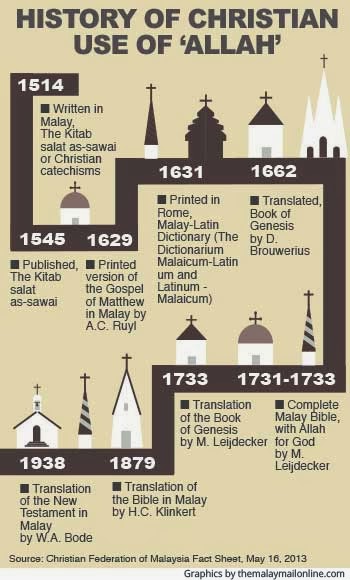
Referring to the Catholic Church's argument that the Malay-speaking congregation commonly used the term in reference to God, Lawrence said: "We cannot reconcile how on the one hand the Christian community is allowed to freely use, import and distribute the Al-Kitab which uses the word 'Allah' extensively, by virtue of the govt's 10-point solution for their worship and instruction of their prayer."

"It is also a retrograde step in the development of the law into the fundamental liberties of religious minorities in this country," he told reporters outside the Palace of Justice here today. "In our view, the Court of Appeal ought to have interpreted the Federal Constitution in order to uphold rather to diminish the rights of the minorities," he added.

Disappointed that the decision to set aside the earlier High Court judgment which ruled that it was against the Church's constitutional right to discontinue using the term, the priest insisted that evidence submit during the course of the trial had showed that the word "Allah" is not exclusive to Islam. 

"It goes against evidence itself and by the use of the word by the Christians is a danger to public order is not proved yet till today," he said after a three-man bench read out the gist of the judgment this morning. 

Justices Datuk Seri Mohamed Apandi Ali, Datuk Mohd Zawawi Salleh and Datuk Abdul Aziz Abdul Rahim had unanimously ruled that the home minister, in banning The Herald from using Allah in its Malay edition, had made a decision in the interest of safeguarding public order. The judges also state that no constitutional right was infringed in the process and that the word "Allah" is not an integral part of the Christian faith. 

The Church, in its submissions, had stated that the Malay edition of the publication citing excerpts of the Al-Kitab, a translation of the Bible in Bahasa Malaysia. "We have not caused disharmony, for the 18 years of The Herald's publication, we have not caused any inconveniences," asserted Lawrence. "So we feel that this is unrealistic, given that the use of the word 'Allah' by Bahasa Malaysia- speaking congregation and other indigenous groups especially in Sabah and Sarawak for generations," he said.  

"We are not discouraged by this decision. We trust in God, justice will be served. We will appeal," said Lawrence. 

Link:
http://www.fz.com/content/herald-appeal-decision-contradicts-government-policy#ixzz2hgPhR9UK

To what extent will Prime Minister Najib Razak now push the issue remains to be seen. However, there is already deep concern he might seize on the ruling and use the precedent to force Christian groups into surrendering more of their rights whenever it was politically beneficial to him, or whenever he wanted to curry favour with the Muslims.

Some even fear that the Muslim extremists or ultras in Malaysia, flushed by today's victory, might get more demanding. This would set the stage for a collision course with the Christians, especially those from Sabah and Sarawak. The already high racial and religious disunity is bound to rise at least by another notch and this could destabilize Malaysia even more.

Nasharuddin was among those who attended the hearing at the Palace of Justice in Putrajaya this morning. Ibrahim Ali, the head of ultra Malay rights group Perkasa too was present. However, the Muslim NGOs while noisy and emotional failed to gather more than 200 or so protesters. Shouts of Allahu Akbar or God is Great cut through the cool morning breeze outside the grand court complex, while group prayers were also held. When the government's lawyers came to announce the decision, they were greeted like heroes.

Read more here:
http://www.malaysia-chronicle.com/index.php?option=com_k2&view=item&id=174491:catholic-magazine-herald-denied-the-right-to-use-allah-by-malaysias-appeals-court&Itemid=2#axzz2hh7V2U3M

But Khalid said that rather than banning the use of ‘Allah’ by non-Muslims for fear of retaliation by “stupid people”, the government should focus on educating the Muslims on what the Quran said over the issue. “The government should educate Muslims regarding all the verses of the Quran which mentions non-Muslims discussing about Allah with the Prophet Muhammad, and using the word freely without any hindrance whatsoever,” the Shah Alam MP said. “Instead, our government seems to be very proud that we are the only Muslim nation that practices this ban – that we are going beyond even what the Prophet Muhammad had done...”

He rejected Department of Islamic Development’s (Jakim) line of argument that allowing non-Muslims to use ‘Allah’ would threaten the faith of Muslims, saying: “It’s just like how everybody uses the word ‘God’ and ‘Tuhan’. There’s no confusion there.” On the contrary, Khalid insisted that opening up the word ‘Allah’ to other religions would build a common platform among the country’s different believers, and hence encourage interfaith discussions.“The question of pluralism also doesn’t come into play because the Quran says the only religion accepted by Allah is Islam,” he added.

Khalid also maintained that the issue was political rather than religious – he claimed that right wing Malay groups were championing the cause to make Islam exclusive to Malays and erect barriers between themselves and the non-Muslims in the country. “They want to maintain special position, hegemony in the country… they want to distance the Malays from the non-Malays in the country, so that issues such as good-governance, which is supported by non-Malays, does not become a matter of interest for the Malays,” said Khalid.

Read more here:
http://www.freemalaysiatoday.com/category/nation/2013/10/14/we-respect-allah-ruling-but%E2%80%A6/

Sarawak will continue to allow the use of the word Allah in Bahasa Malaysia and native language Bibles and church publications, said State Land Development Minister Tan Sri Dr James Masing, following the Court of Appeal's ruling today not to allow Catholic weekly The Herald to use the term.

Masing described the ruling as “not genuine”, saying the use of the word Allah predated Islam. “We (Christians in Sabah and Sarawak) have been using the word Allah for over 100 years. Why suddenly we are now told we cannot use it?" he asked, adding that the court's decision would have a negative impact on non-Muslims beyond Sabah and Sarawak. “Did they have a dream that Allah said they (the Christians) can't use the word Allah?” he asked, referring to the opposition by some Muslim groups in West Malaysia on the usage of the word in Christian texts.

Referring to Muslims in Sabah and Sarawak as "brothers", Masing said they had no qualms about Christians using the word. Masing reminded Christians in the state that Sarawak Chief Minister Tan Sri Abdul Taib Mahmud had in the past weighed in on the issue by giving assurance that he would not stop them from using the word Allah.

PKR Sarawak chief Baru Bian, saying he was stunned by the decision, said churches and Christians in Sabah and Sarawak would continue using the word Allah. “I am stunned by the decision.

“We have produced very clear facts that we were promised a guarantee by our forefathers when Sabah and Sarawak helped form Malaysia. The ruling appears to go against the fundamental rights that were promised," said Baru, adding that the decision goes against the Malaysia agreement.

Baru, a church elder of the Kuching Evangelical Church for over a decade until he joined politics, said the ruling went against Article 11 of the Federal Constitution which allows people to profess and propagate their religious beliefs.

Read more here:
http://www.themalaysianinsider.com/malaysia/article/its-worship-as-usual-sarawak-christians-will-continue-use-allah-state-minis

Reverend Dr Herman Shastri, general secretary of the Council of Churches Malaysia (CCM), who was also present in court, expressed disappointment with the ruling, saying that he did not agree with the argument that the word "Allah" was not integral to Christianity.

"The learned judges obviously did not take into consideration that the Christians in Sabah and Sarawak and Malay-speaking Christians in Peninsular Malaysia have been using the word even before Independence," he argued.

He explained that Christians in the Middle East and Indonesia have been using the word "Allah", adding that the word predates Islam. "Even in the Quran it is mentioned that the Christians and Jews believe in Allah, which explains why PAS had also said that Christians can use the word. "But here, the judges made a ruling without calling expert evidence. This is very disappointing," added Shastri.

He said the CCM could not understand the "public order" argument accepted by the court. "The people in East Malaysia have been using the word and they have been living in peace, so what public order are they talking about? Just because a few extremists are making a big issue of this does not make it a national security issue," he said. Shastri noted that Putrajaya's 10-point solution to Christians in Sabah and Sarawak had not affected public order.

Read more here:

Whatever the High Court rules on the “Allah” issue today, churches in Sarawak like this one that conduct their services in the native languages have no plans to change the way they worship, with many saying that “Allah” will continue to be used in their prayers.

At this church in Kampung Tabuan yesterday, which caters to the largely Iban villagers in the surrounding areas, the service was conducted in Iban. The liturgy alone – the booklet that sets out the fixed set of Eucharistic rites and words to be used in worship – contained no fewer than 80 of the words “Allah Taala”, which means God Almighty in Iban. The word was also used in the hymns and in the sermon of Reverend Nelson Sinken.

The secretary of the Parochial Council of Churches, Maxwell Landong, told The Malaysian Insider after the service, “Since I started going to church, the words Allah Taala have been used by the church to refer to God. It’s our language and there are no other words I know that were used to refer to God.”

He added, “We have been using Allah in our liturgy, our Iban-language Bibles, publications, prayers and sermons for as long as I can remember. The Muslims in Sarawak have accepted that. So what is the fuss? Why now?” He pointed out that if the court ruled against the Catholic Church’s use of the word, it would be difficult to enforce the ruling here. He said that on a personal basis he would still pray to Allah Taala and read Bibles that use the word Allah to refer to God “no matter what the court says”.

For his part, Reverend Sinken was sanguine on today’s highly anticipated Court of Appeals decision on the dispute between Christians and certain Malaysian Muslim authorities over the use of the word. “I'm not worried,” Reverend Sinken said. He did not offer prayers for divine intervention or speak on the subject in his sermon. Echoing the exact sentiments of Landong, Reverend Sinken said of the Christians, “We in Sarawak have been using the word Allah for years without problem. It’s also our language. I'm sure the court will take all those into consideration.”

Like the majority of the churchgoers here yesterday, Dorothy Gregory is optimistic that the court will decide in the favour of “what is fair and just”. There are many similar words in the Iban and Malay languages. For example, “hutan” (jungle) in Malay is “utan” in Iban. “Jalan” (walk) in Malay is “jalai” in Iban and “makan” (eat) in Malay is “makai” in Iban.

When asked what could happen if the court ruled that Christians cannot use the word “Allah”, both Landong and Reverend Sinken said it would be up to the Archbishop to determine what they should do next.

Datuk Bolly Lapok is the Anglican Archbishop for Sarawak and Brunei.

Earlier, Bishop Lapok, as chairman of the Association of Churches in Sarawak, said the association “finds it unacceptable that practice of the Christians in Sabah and Sarawak who for generations had used Allah in worship, long before the very idea of Malaysia was conceived, is now held as unlawful by the government”.

He said that to stop saying Allah in the practice of their faith would be tantamount to a block on religious freedom. He added, “This is abhorrent, wholly unacceptable and a flagrant betrayal of the Malaysia Agreement, which guaranteed the inalienable rights of non-Muslims in Sarawak and Sabah to religious freedom.” Lapok said the churches expect the federal government to abide by the Federal Constitution, which guaranteed religious freedom. He said the native churches will continue to use Bibles with the word Allah as it was “their fundamental right”.

He reminded the government that people in Sabah and Sarawak were promised the right to practise their religion when Sabah and Sarawak were courted to join the Malay states of Malaya to form Malaysia. He said the government must respect and abide by that promise.

Read more here:
http://www.themalaysianinsider.com/malaysia/article/inside-a-church-a-hundred-times-the-sound-of-allah

The Court of Appeal’s ruling on the “Allah” issue exposes the rights of Malaysia’s religious minorities to oppression under the guise of appeasing the majority, lawyers said today.

In expressing its disappointment at the appellate court’s ruling, the Catholic Lawyers’ Society said the voices of moderation appeared to be “drowned out” by the religiously intolerant, stressing that the minorities’ rights in Malaysia must be protected.

“To find that the minority must yield to the majority also sends a frightening message that the minorities’ rights are subject to the whims and fancies of the majority.

“The minorities rights to freedom of religion are enshrined in the Federal Constitution and must be upheld at all times and not oppressed by the majority,” the Catholic Lawyers’ Society wrote in a press statement signed off by its president, Viola De Cruz Silva.

Read more here:
http://www.themalaymailonline.com/malaysia/article/lawyers-allah-appeal-opens-door-to-oppression-of-religious-minorities

Wednesday, September 11, 2013

Ministers Who Are Unhappy With Rakyat, Please Resign


Those who cannot accept Malaysia's first-past-the-post system should emigrate to practise their political beliefs elsewhere, newly appointed Home Minister Datuk Seri Zahid Hamidi said today. In his column in Utusan Malaysia, Zahid said the Pakatan Rakyat's claims of having won the 13th general election by popular vote were claims based on its interpretation of the list system, or single transferable vote. "These methods, as interpreted by the Opposition, are only used in countries where the head of state and ruling party are chosen in a proportionate representation electoral system where seats are won based on the number of votes received," he said. He added that Malaysia had inherited its first-past-the-post system from the UK. "Those who do not want to follow it can emigrate elsewhere to practise the list system, or single transferable vote system, used in republican nations. "If they are truly loyal citizens, they will accept the political and electoral system as enshrined in our Federal Constitution. They also have to admit the truth of defeat in the first-past-the-post system," he said.

Read more here: http://www.malaysia-chronicle.com/index.php?option=com_k2&view=item&id=101172:those-not-happy-with-ge13-results-can-leave-the-country-zahid&Itemid=2#axzz2eYQIeLVV


Federal Territories Minister Datuk Seri Tengku Adnan Tengku Mansor wants Malaysians to stop complaining over the skyrocketing price of properties. "If houses are expensive, then don't buy from the developer or else, don't grumble too much," he said, adding that everyone is bound by the simple rule of "willing buyer and willing seller". "If the houses developers are selling is expensive, then don't buy."

Those who have no confidence in the country’s education system as outlined in the National Education Blueprint can send their children to study abroad, said Education Minister II Datuk Seri Idris Jusoh. “If some people feel the system is not good and want to send their children overseas to study, the government cannot stop them. But the Ministry will work towards improving the country’s education system," said Idris after a forum in Shah Alam today. “We cannot please everyone. We have our own objectives and we will continue to implement them. It is not my own decision before we came up with this blueprint.

Tuesday, June 4, 2013

EAIC Is Unable To Cope, Form IPCMC Now!


By Boo Su-Lyn. Published by The Malaysian Insider on 4 June 2013.
The Enforcement Agency Integrity Commission (EAIC) has acknowledged it is hamstrung by only having one investigating officer to probe complaints of misconduct against 19 enforcement agencies, as public outcry grows over deaths in police custody. It also has an annual budget of just RM7 million.
EAIC CEO Nor Afizah Hanum Mokhtar said the commission has 23 staff members, including the investigating officer, clerks, a driver, legal adviser, administrative officer and an operations director. 
“We have very limited manpower,” Nor Afizah Hanum told The Malaysian Insider in an exclusive interview at her office here yesterday. 
“We had six investigator posts that we got from MACC. They withdrew five on 16th May,” she added, referring to the Malaysian Anti-Corruption Commission (MACC).
Amid the outcry over recent deaths in police custody, there has been growing calls from the opposition and the Bar Council for the government to set up an Independent Police Complaints and Misconduct Commission (IPCMC).
The Malaysian Bar, civil society groups and several politicians from both sides of the divide have called for the IPCMC to be implemented to reform the police force since 2006.
The IPCMC, which was mooted by a royal commission chaired by former Chief Justice Tun Mohamed Dzaiddin Abdullah but shot down by the police, was to be modelled on the United Kingdom’s Independent Police Complaints Commission (IPCC), as well as other police oversight bodies in New South Wales and Queensland in Australia, and Hong Kong.
Speaking to The Malaysian Insider yesterday Nor Afizah Hanum said the sole investigating officer remaining at the EAIC also came from the MACC and has 11 years’ experience as an investigator.
The MACC, in contrast, has a budget of RM276 million this year and will receive an additional 150 posts annually to boost its manpower from 2,500 staff to 5,000, English daily The Star reported last September.
The EAIC, which was set up in April 2011, investigates complaints of misconduct against the police force, the Immigration Department, the Customs Department, the Rela Corps, the National Anti-Drug Agency, the Malaysian Maritime Enforcement Agency, the Department of Environment, the Department of Occupational Safety and Health, the National Registration Department (NRD), the Department of Civil Aviation, the Road Transport Department (RTD), the Department of Industrial Relations, the Department of Fisheries, the Department of Wildlife and National Parks, the Manpower Department, the Health Ministry (Enforcement), the Tourism Ministry (Enforcement and Licensing units), the Domestic Trade, Co-operatives and Consumerism Ministry (Enforcement) and the Ministry of Urban Wellbeing, Housing and Local Government (Enforcement).
Nor Afizah Hanum said the EAIC needed an annual budget of at least RM25 million, as well as at least 10 investigating officers and 10 research officers. “We hope to expand till 78 personnel... we have a requirement for research officers to work in a taskforce to study rules and procedures and do visits to lock-ups, prisons,” she said. 
She added that the EAIC has received 469 complaints as of May 31 this year since it was formed in 2011, with 353 complaints against the police. Twenty-one complaints were lodged against the Immigration Department, 15 against the RTD, 10 against the Ministry of Urban Wellbeing, Housing and Local Government, and nine against the Customs Department. 
She said the EAIC, however, has yet to receive complaints of deaths in custody, police shootings or assault by enforcement officers. “We haven’t received complaints of a criminal element,” said Nor Afizah Hanum. 
She added that the complaints ranged from police inaction on cases, inaction of immigration authorities against illegal immigrants, a policeman having an affair with someone else’s wife, or the NRD revealing one’s personal particulars to another party without consent.
The former Sessions Court judge said investigations were opened for 124 out of 469 complaints, with one case resulting in a recommendation of disciplinary action against the police.
According to human rights group Suaram, 218 cases of alleged deaths in custody in Malaysia took place from 2000 to this month, with its records showing that nine of those cases occurred in 2012, while eight cases occurred so far this year...
The Home Ministry reportedly told Parliament last October that 298 people were shot dead by the police between 2007 and August 2012, including 151 Indonesians and 134 Malaysians, which is an average of one deadly shooting a week.
A United Nations Working Group on Arbitrary Detention 2010 visit to Malaysian prisons and detention centres reported in 2011 that between 2003 and 2007, “over 1,500 people died while being held by authorities.”
Read more here:
There is no need to establish the Independent Police Misconduct and Complaints Commission (IPCMC), said Minister for Governance and Integrity Paul Low.
He said there is an existing channel called the Enforcement Agency Integrity Commission (EAIC) that would perform the same duties as the IPCMC.
“There is no need to form the IPCMC, we already have a channel that allows the public to lodge complaints with regard to the enforcement agencies called the EAIC,” he said.
“There is lack of awareness. I believe that the only thing left to do is to educate the public on how one can lodge a complaint via the EAIC,” he added.
Read more here:

Friday, May 31, 2013

Deaths in Custody — We Don't Want To "De-motivate" The Police, Do We?


The statistics regarding deaths in police custody in Malaysia is a leaf out of the macabre: 156 persons died in police custody between 2000 and February 2011,1 and it has been reported that there were at least six such deaths in 2012,2 with this being the fifth one in 2013.3  This data is alarming, as it points to an average of at least one death in police custody per month since 2000. 

The Malaysian Bar is dismayed and saddened by the news of yet another death in police custody, involving 32-year-old N Dharmendran.  He was reportedly arrested on 11 May 2013, and died on 21 May 2013 whilst in police remand at the Kuala Lumpur police contingent headquarters. 

The death of N Dharmendran is tragic and inexcusable.  It is yet another incident that raises serious questions about the treatment and safety of detainees in police custody, and the methods of interrogation used.  It underscores the importance of the requirement for those in police custody to have immediate access to legal counsel upon arrest. 

In the case of N Dharmendran’s arrest, the protocol prescribed under the Yayasan Bantuan Guaman Kebangsaan (“YBGK”) scheme, which is an initiative made possible by Prime Minister Dato’ Sri Najib Tun Abdul Razak, and supported by the Government, does not appear to have been complied with by the police.  The guidelines for enforcement officers stipulate that as soon as an arrest has been made, and before the suspect is questioned, the police officer must inform the suspect’s family (or friend) of the arrest, and must also provide details of the suspect and the arrest to YBGK, who will then despatch a lawyer to offer legal representation to the arrested person.  

However, we understand that YBGK did not receive any notification from the police about N Dharmendran’s arrest.  We regret to note that this is the second occasion that we are aware of where YBGK was not notified of an arrest, and the detainee later died in police custody.  In the first incident, 32-year-old K Nagarajan had been found dead on 24 Dec 2012 in the Dang Wangi police station lockup.

The present state of affairs has led to much public outrage and an erosion of confidence in the police.  The police must be proactive in ensuring that the wrongful actions of some amongst them do not tarnish the standing of the whole force.  Unless this is addressed, the police force will unfortunately remain a diminished institution in the eyes of the public. 

The unabated deaths in police custody reinforce the Malaysian Bar’s repeated calls for the Government to implement the recommendation of the Royal Commission to Enhance the Operation and Management of the Royal Malaysia Police, in its report published in May 2005, for the setting up of an Independent Police Complaints and Misconduct Commission (“IPCMC”) to function as an independent and external oversight body to investigate complaints about police personnel.

It is untenable for the Government to continue to ignore the dire need for the IPCMC, in the face of continuing cases of deaths in police custody.

Read more here:


There is no need to establish the Independent Police Misconduct and Complaints Commission (IPCMC), said Minister for Governance and Integrity Paul Low. He said there is an existing channel called the Enforcement Agency Integrity Commission (EAIC) that would perform the same duties as the IPCMC.

“There is no need to form the IPCMC, we already have a channel that allows the public to lodge complaints with regard to the enforcement agencies called the EAIC,” he said. “There is lack of awareness. I believe that the only thing left to do is to educate the public on how one can lodge a complaint via the EAIC,” he added.

Meanwhile, Low also said he had brought up N Dhamendran’s case at the Cabinet meeting held yesterday. Dhamendran, 32, died in police custody on May 21. The post-mortem reported concluded that he had died of blunt force trauma and the case has been classified as murder.

The police headquarters in Bukit Aman has since established the case as murder and had set up an independent task force to investigate the issue. “We as the government, need to act on this issue urgently. I brought it up at the Cabinet meeting yesterday and the outcome was positive,” Low told a press conference.

He said Home Minister Ahmad Zahid Hamidi has agreed to cooperate and work with the relevant people. “The minister has also promised to urge the police to hasten their investigations in Dhamendran’s case,” he added. Also present at the press conference was Performance Management and Delivery Unit (Pemandu) director D Ravindran, whom Dhamendran’s family accused of harassing them.

Ravindran explained that there were no conversations hinting towards a settlement nor asking the family to disengage their lawyers.

Read more here:


Home Minister Ahmad Zahid Hamidi has welcomed suggestions to suspend policemen who were involved in allegedly murdering a detainee but does not want the morale of the police force dampened.
“That’s true but we will have to re-look at regulations so that it doesn’t de-motivate the policemen. We will have to study the entire police interrogation procedure,” he said at a press conference held at the Prisons Department headquarters here this morning.
He said this in response to criticism by two Indian leaders against the police’s decision to suspend their personnel who was involved in the alleged murder of detainee N Dharmendran.
Read more here:

Thursday, May 23, 2013

#RCISabah: Foreigners commit 30% of serious crimes in Sabah


By Boo Su-Lyn. Published by Malaysian Insider on 23 May 2013.

Foreigners are responsible for 30 per cent of index crime in Sabah, the Royal Commission of Inquiry (RCI) on illegal immigrants heard today amid a perceived spike in criminal offences.

Sabah police chief Datuk Hamza Taib testified today that foreigners committed 15 per cent of index crimes against locals ― including violent crimes like murder, rape, robberies and theft ― and another 15 per cent against other foreigners.

“To me, it’s not that serious,” said Hamza when asked if 15 per cent was a serious figure.

Hamza also insisted that index crime has been dropping for the past three years, but did not provide figures to detail the reduction.

Foreigners have often been blamed for a perceived crime increase in the Borneo state that is struggling with an influx of immigrants.

More than a quarter of Sabah’s population are foreigners, totalling a staggering 889,000 out of the 3.2 million-strong population in the state.

News portal Free Malaysia Today reported last November that the death of a local teenage girl in Kota Marudu in November was rumoured to be linked to foreigners.

Sulu gunmen also invaded Lahad Datu in Sabah last February to stake a claim on the East Coast territory, resulting in the deaths of ten members of the Malaysian security forces.

“Understandably, Malaysians living in Sabah feel threatened and insecure as the number of foreigners keeps increasing. Incidents of drug-related crimes, burglaries and robberies are common,” former Sabah state secretary Tan Sri Simon Sipaun wrote in his June 18 article on Sabahkini last year.

“Gone are the days when we could leave our houses unlocked. Now they are like prisons. Things can only get worse if the demand for jobs is not met by employment opportunities,” he added.

Hamza also disputed today rumours that the Sulu gunmen from southern Philippines who had invaded Lahad Datu possessed Malaysian ICs.

“One hundred per cent they are illegals, but they’re being supported by locals,” said the Sabah police commissioner.

He added that he could not guarantee another foreign invasion would not happen in Sabah again, but stressed that the Eastern Sabah Safety Zone (Esszone) was formed to strengthen the security of the east coast.

Hamza reportedly said last August that the overall crime rate in Sabah had dropped by 10 per cent, with street crimes dipping by 54 per cent.

DAP adviser Lim Kit Siang said last Sunday that newly-appointed Inspector-General of Police Tan Sri Khalid Abu Bakar and Home Minister Datuk Seri Ahmad Zahid Hamidi should quit “playing politics” and focus on reducing crime instead.

Putrajaya has sought to address concerns about crime by introducing crime reduction as a National Key Result Area (NKRA), which the police and the government’s efficiency unit Pemandu said has been successful in cutting crime. But the frequency of crime reports in the news and social media has raised doubts over the drop in the official crime figures.

Link: 

Sedition dragnet reeks of double standard


Batu MP Chua Tian Chang, activist Haris Ibrahim and PAS’s Tamrin Ghafar were arrested for sedition today and brought to the Jinjang police station for questioning, according to reports. It is understood the trio were detained separately in an apparent police crackdown today. This is the third police investigation into sedition since the May 5 general election...


The first was student activist Adam Adli Abdul Halim who was charged with sedition in the Jalan Duta court complex this morning. The 24-year-old pleaded not guilty and was released on a RM5,000 court bail with his trial set for a mention on July 2...


According to the charges read out this morning, his words had a seditious tendency and were aimed at rallying Malaysians to change the current government through undemocratic means.

His statement, in Malay: “Take my details, lodge a police report, because today, I would like to invite all those here today to gather and take to the streets to seize back our power! Can we do that? Can we do that? Can we do that? We do not have much time left, get ready, buy shoes, buy tracksuits, buy jeans, get ready to take to the streets because in a third world country like Malaysia, elections cannot topple a government. Only the people’s power can topple a government. Remember, ladies and gentlemen, this is the only opportunity we have.”

Charged under Section 4(1)(b) of the Sedition Act 1948, the Universiti Pendidikan Sultan Idris undergraduate faces a jail term of not less three years, or a fine of up to RM5,000 or both, if convicted. Adam Adli, who came to court in a black T-shirt, was represented by lawyers Datuk Ambiga Sreenevasan, N. Surendran, Afiq M. Noor and Shamsul Iskandar Mat Akin.

Read more here: 

Speaking to FMT, S Vell Paari said he was concerned to learn about the arrests of Anything But Umno (ABU) leader Haris Ibrahim, PKR vice-president Tian Chua and PAS’ Thamrin Ghaffar. The trio were held this afternoon in connection with a forum on May 13, where a call was made to topple the Barisan Nasional government via street protests. Vell Paari said the arrests would anger the public further as the authorities would be perceived to be practicing double standard when it comes to enforcing the Sedition Act.

“While the likes of [Perkasa leaders] Ibrahim Ali and Zulkifli Noordin; and academic Ridhuan Tee Abdullah are allowed to roam free despite making incendiary remarks about race and religion, these opposition figures are however swiftly hauled up. “Even the Utusan Malaysia frontpage in the aftermath of the general election, which read ‘Apa Lagi Cina Mahu? [What more do the Chinese want], screamed sedition but our leaders chose to defend the publication,” added the MIC strategy director.

Vell Paari said this development did not bode well for Prime Minister Najib Tun Razak’s administration. “As it is BN suffers from a severe perception crisis and these arrests would just aggravate the situation,” he warned. Vell Paari said while the police had the right to investigate those who called for street protests to topple the government, it should not resort to using draconian laws...

Talk is rife that the government’s hard stance stemmed from the appointment of Ahmad Zahid Hamidi as the new home minister, who is said to be reintroducing the facets of Mahathirism. Speaking on condition of anonymity, a BN source said that he would not be surprised if former premier Dr Mahathir Mohamad was pulling the strings. “Najib was given his chance and he blew it. His electoral performance was worse than his predecessor Abdullah Ahmad Badawi. “So perhaps Umno is now looking to its grand wizard to set the house in order,” he told FMT.

Read more here:
https://www.freemalaysiatoday.com/category/nation/2013/05/23/sedition-dragnet-reeks-of-double-standard/

Tuesday, May 21, 2013

Jangan Mempolitikkan Pelaksanaan Undang-undang

PUTRAJAYA, 20 Mei (Bernama) — Menteri Dalam Negeri Datuk Seri Dr Ahmad Zahid Hamidi mengingatkan pemimpin pembangkang supaya tidak mempolitikkan segala pelaksanaan dan tindakan pihak berkuasa dalam usaha memelihara keamanan dan kesejahteraan negara.

Pihak berkenaan boleh menghadapi risiko besar sekiranya terus berbuat demikian, katanya pada sidang media selepas memulakan tugas hari pertama sebagai menteri dalam negeri.
“(Penasihat DAP) Lim Kit Siang dan (Setiausaha Agung DAP) Lim Guan Eng harus membezakan antara objektif politik, langkah politik dengan pelaksanaan undang-undang. Jangan mempolitikkan segala pelaksanaan undang-undang yang dilaksanakan oleh IGP (ketua polis negara) atau lain-lain agensi yang berada di bawah KDN,” katanya.
Ahmad Zahid berkata ketua polis negara, ketua-ketua jabatan dan agensi di bawah KDN, diberi kuasa sepenuhnya bagi melaksanakan tugas dan tanggungjawab mereka mengikut bidang kuasa masing-masing, tanpa campur tangan politik.
Sebarang tindakan yang dilakukan di bawah KDN tidak boleh dianggap sebagai tindakan bermotifkan politik, tetapi berlandaskan kepada asas-asas perundangan yang sedia ada, katanya.
Beliau mengingatkan bahawa kerajaan tidak lagi memberi amaran, sebaliknya akan mengambil tindakan tegas terhadap mana-mana pihak yang bertindak di luar batasan menjejaskan ketenteraman awam negara.
“Kami tidak akan berkompromi untuk mengambil tindakan sebagaimana yang termaktub dalam undang-undang, akta dan enakmen yang sedia ada, katanya.
Menyentuh kenyataan pemimpin-pemimpin pembangkang berhubung beberapa perkara berkaitan kenyataan beliau baru-baru ini, soal perundangan, pilihan raya dan sebagainya, Ahmad Zahid berkata perkara itu boleh dipertikai di Parlimen.
“Sebagai orang politik, kita berjumpa di gelanggang politik, gelanggangnya bukan di jalanan, bukan di padang terbuka, tetapi di Dewan Rakyat. Jangan gunakan forum di tempat lain,” jelas beliau.
Ahmad Zahid turut membidas Ketua Umum PKR Datuk Seri Anwar Ibrahim yang meminta beliau supaya tidak menjadikan negara ini seperti milik keluarganya
“Negeri ini pun bukan negeri bapa dia punya. Memang bukan (milik) bapa saya. Ini (pun) bukan negeri bapa dia,” katanya.
Anggota Parlimen Bagan Datoh itu dibidas kerana membuat kenyataan menggesa mereka yang tidak berpuas hati dengan keputusan pilihan raya di Malaysia supaya berhijrah ke negara di mana mereka boleh mempraktikkan kepercayaan politik mereka.
Ahmad Zahid juga berkata bagi memastikan pelaksanaan KDN berjalan lancar, cadangan, pandangan dan kerjasama padu daripada semua pihak dialu-alukan, selain kritikan dan teguran.
“Kami perlukan sokongan dan dukungan daripada masyarakat keseluruhannya, ini termasuk pemimpin-pemimpin politik, sama ada dalam kerajaan mahupun di luar kerajaan, NGO, individu dan institusi.
“Bukan sekadar memberikan maklum balas, aduan atau rungutan tetapi memberikan cadangan dan kerjasama kepada apa yang sedia ada dalam perundangan,, peruntukan yang digaris pandukan. Ia bukan untuk kepentingan politik kami,” katanya...
Asal berita :


Wednesday, January 23, 2013

#RCISabah: Citizenship-for-votes probe stirs outrage


By Julia Zappei. Published by Free Malaysia Today on 23 January 2013.

For years, charges have swirled that a secret Malaysian scheme gave citizenship to huge numbers of illegal migrants in a politically important state in exchange for votes for the ruling coalition. Now, an inquiry is finally airing detailed allegations that have the government on the defensive ahead of elections that pose the greatest threat yet faced by the ruling bloc that has controlled Malaysia for 56 years.

A Royal Commission of Inquiry opened last week with ex-officials admitting they gave citizenship to Filipinos and Indonesians in resource-rich Sabah, one of two Malaysian states on jungly Borneo island. One former official said some 100,000 identity cards (ICs) were handed out in 1993 ahead of a crucial state election, Malaysian news reports said. Another admitted signing hundreds of thousands of ICs in the 1990s.

The testimony has revived accusations of treason against former prime minister Dr Mahathir Mohamad, who is alleged to have masterminded the scheme to shore up support for his government. As head of the ruling Barisan Nasional (BN) coalition, Mahathir dominated Malaysia for 22 years with his famously hardball political tactics until he resigned in 2003.

Current prime minister Najib Tun Razak is now battling to rally support for the BN ahead of polls he is expected to call within months, in an era when the coalition’s power grip has slipped. But outrage over “Project IC”, as the alleged scheme is widely known, is undercutting his claims that the national electoral roll is free of fraud.

The opposition and election-reform advocates allege massive fraud in voter rolls nationwide and have seized on the testimony as proof of government vote-tampering. “What we are concerned about is that this is still going on. That’s what we want to stop,” S Ambiga, head of the clean-elections activist coalition known as “Bersih”, or “Clean”, told a press conference Tuesday.

The outlines of “Project IC” have been whispered about for three decades and have bolstered the view of Sabah as a reliable “fixed deposit” of votes for the BN to help it weather challenges elsewhere. The government allegedly targeted Muslims from neighbouring Indonesia and the predominantly Muslim southern Philippines.

Sudden growth in population

More than half of Malaysia’s 29 million people are Muslim ethnic Malays, but indigenous tribes, many of them Christian, predominate in Sabah. They have bridled at the foreigners, blaming them for crime, drug abuse and economic competition, and alleging their homeland was being stolen.

Najib last June gave in to calls for an inquiry, but the move could backfire, said Ibrahim Suffian, head of independent polling firm Merdeka Centre, calling the revelations “explosive”. “It probably will create a wave of resentment and dissatisfaction among native Sabah voters. This confirms their worst fears,” he said.

The population of Sabah, a region of rugged mountains and powerful rainforest rivers that is about the size of Ireland, has surged from some 600,000 citizens in 1970 to more than three million — more than double the national growth rate.

Malaysia’s opposition alleges some 700,000 may have illegally received ICs. A one-time battleground state, Sabah has been pro-BN since the mid-1990s. The once all-powerful BN suffered a shock setback in 2008 national elections, and analysts predict a close fight with a formidable opposition led by Anwar Ibrahim, a former deputy premier, raising fears that government fraud could play a role.

Najib insists the national electoral system is clean and has highlighted recent reforms such as plans to use indelible ink to prevent multiple voting. “Let the commission do its work and find out,” Najib was quoted as saying by state media, warning against a rush to judgement in Sabah.

Mahathir, still a vocal and influential conservative figure, has denied the existence of “Project IC,” but admitted at a press conference last week that foreigners in Sabah were given citizenship, saying no laws were broken. No one has yet directly implicated him before the commission, but witnesses said last week they were directed by officials close to Mahathir. There has been no testimony yet suggesting “Project IC” was still active.

Hearings will continue for weeks, with some 170 witnesses expected to testify. The commission has until late March to investigate. The commission’s final recommendations are not legally binding, but could lead to pressure for a crackdown on illegals. -AFP

Link: 

Related reports:

Two of Mahathir's closest confidantes - Abdul Aziz Shamsuddin, his political secretary at that time, and Megat Junid, the late former Deputy home Minister - were implicated by witnesses who testified before the RCI a day ago.

"After receiving instructions from then-Sabah NRD chief Abdul Rauf Sani, we were ordered to go to KL and were placed at Pak Aziz Shamsuddin's residence in Kampung Pandan," Malaysiakini reported Yakup Damsah, who was the Tamparuli NRD chief at that time, as saying.

According to Yakup, they were tasked to sign the identity cards that were to be issued to the immigrants, which were subsequently laminated at the NRD headquarters in Petaling Jaya and shipped to the Kota Kinabalu NRD for distribution. "We were briefed about our special assignment by a person not known to us, named 'Mat Nor'. He told us to issue blue identity cards to the immigrants," Yakup added.

He told the RCI his group signed a total of 40,000 blue identity cards within a month, based on the filled up application forms provided to them. "We did not look at the forms in detail, we just signed... We know that they were immigrants, mostly Indonesians and Filipinos, but we did not know whether they were legal immigrants or not," he said.

Yakup also said the intent of their action was to increase the number of Muslim voters in Sabah and to ensure that these people would vote for Umno in the 1994 Sabah state election.

As for the late Megat Junid, former Sabah NRD Ramli Kamaruddin told the RCI  he received personal instructions from the deputy home minister to issue identity card receipts to immigrants using the details of people who were already in the electoral roll but had never voted before...

"These are the real traitors of the country. People who sell citizenship for the sake of political power," Azmin slammed Mahathir and the latter's Umno party.

http://www.freemalaysiatoday.com/category/nation/2013/01/23/anwar-no-problem-testifying-in-rci/

Opposition Leader Anwar Ibrahim said he would have no problem testifying in the Royal Commission of Inquiry (RCI) probing the ‘Project IC’ in Sabah. “I have no problem whatsoever. I knew for a long time the project was under the prime minister, that it did not involve a Cabinet process, so it is the full responsibility of the prime minister and finance minister.

Monday, December 31, 2012

Ban on use of "Allah" in Alkitab: Make Malaysia more of a loony bin than it already is!


Written by  Joe Fernandez & Stan Lee. Published by The Malaysia Chronicle on 31 December 2012.

It’s confirmed now that Malaysia has become one big loony bin! This is the only country in the world where politicians and government lackeys such as Perak chief cleric Harussani Zakaria have nothing better to do than to quarrel over who and who cannot use the term Allah for God in print in Peninsular Malaysia i.e. in this case in Malay print in the Bible.

The Internet is exempted. Likewise, there’s no Umno Government prohibition on using the term Allah for God in Malay print for the Bible in Sabah and Sarawak. There’s also no Government prohibition on using the term Allah for God in non-Bible print.

In fact, not many realise that there’s no Government prohibition either on using the term Allah for God in English print or any other language whether in the Bible or non-Bible material. There’s also no Government prohibition on using the term Allah for God in song, prayer and worship by anyone in any language.

This explains why there has been only ominous silence from the Home Ministry on Allah in the Sikh Holy Book and in Bahais and Mizrahi Jews also using the term.

Use religion to do good, weed out sins like corruption, not  hide wrongdoings

Sikhs too call their God Allah since Sikhism is a synthesis of Hinduism and Islam created by Guru Nanak in Lahore, now in Pakistan but then in undivided India. Guru Nanak claimed in Guru Granth Sahib, the Sikh Holy Scriptures written in Gurmukhi in eastern India, that he was taken to God’s Court and given nectar by God to drink. Apparently, he was then instructed to reveal to mankind that God was neither a Hindu nor a Muslim and had no religion.

But argue all you like, it won't stop ruling party, Umno, and its religious chiefs from stirring up religious mischief.

There's little doubt Umno - embattled and corruption-riddled - is now at its weakest. It needs to deflect attention from its string of shocking corruption scandals. Umno leaders know they need to rally the Malays behind their party as never before. And what better way than to use, or is it abuse, Islam to claim the moral high ground.

"“The matter is already in the (Islamic) enactments of every state, they’re provoking Muslims on purpose so Muslims will melatah (over-react). Christians should not interfere with Islam, they’d be better off taking care of their own religion. If they want to use Allah, convert into Islam,” Harussani was reported as saying.

Perhaps the Malaysian Gurdwara Council's rebuttal captures the core of the issue best. As MGC president Jagir Singh pointed out the National Fatwa Council’s 2010 edict on the Allah word cannot apply to non-Muslims. The fatwa council does not have direct jurisdiction over non-Muslims and therefore cannot issue fatwas to bar them from using a specific word.

The dumbest contradiction and clearest proof of abusing Islam for politics

Again, the Umno government does not want to see the term Allah for God in this print. Allah activists can however make an issue of the fact that Bahasa Melayu and Bahasa Malaysia are not one and the same language and that the Bible is not in Malay but in Bahasa Malaysia, among other languages.

The Government’s reasoning against Allah in Malay Bible print is that Muslims would be confused. The population estimate in 2004 was as follows, according to the CIA World FactBook on Malaysia: Malay 50.4%, Chinese 23.7%, Orang Asal 11%, Indian 7.1%, others 7.8%. The religious picture: Muslim (or Islam) 60.4%, Buddhist 19.2%, Christian 9.1%, Hindu 6.3%, Confucianism, Taoism, other traditional Chinese religions 2.6%, other or unknown 1.5%, none 0.8%.

In a contradiction in terms, the government doesn’t seem to realise that Christians in Peninsular Malaysia who use the Bible in English might be confused as well.

The fact is that neither Muslims nor Christians in Sabah and Sarawak would be confused. The Sikhs aside, Allah in Malay, English or other print is a peculiarly Borneon problem in this part of the world. This is a key point which seems to have escaped the politicians in Peninsular Malaysia or Malaya as Sabahans and Sarawakians prefer to call it.

Muslim politicians suspect a sinister plot by Christians to confuse Muslims

One development which might be troubling Muslim politicians in Peninsular Malaysia is that Christians in Malaya too now want to use the term Allah for God in all print. They see this approach as necessary to be in solidarity with fellow members of their faith on the side of the South China Sea. The sea, according to the Catholic Church in a novel take, does not divide Malaysians but brings them together.

Muslim politicians in Peninsular Malaysia, on the other hand, suspect a “sinister” Christian plot to confuse Muslims through Allah and lure them away from their Faith. They fear that Muslims might conclude, and not entirely without justification, that Islam is just another branch of Christianity like the Protestant denominations which rebelled some 500 years ago against the authority of the Vatican.

When yours truly was in school in Peninsular Malaysia and long after, the thought of a Christian calling God Allah as in Borneo and in the Middle East never crossed the mind.

In fact, had such a thing been suggested in school before by the Christian brothers, the initial reaction would have been one of shock, horror and confusion. The word Allah would have definitely stuck in the collective throats of Christians in Peninsular Malaysia and probably strangled them to death.

The reason that Christians in the Peninsular Malaysia now want to use the term Allah for God may also be due to the reason that they can only smile if asked something in English, and prefer to use the Malay language. An added factor is that there are many Sabahans and Sarawakians in Peninsular Malaysia, as many as 200,000, formidable block in the electoral rolls.

Also, Muslims settling down in Europe in large numbers partly to make up for the virtual elimination of the Jews by Adolf Hitler, Christians on that continent too appear to have since discovered that Allah is the right term for their God as well.

Syed Hamid’s political mischief-making will haunt our political future

This Allah problem was wholly created not so long ago by former Home Minister Syed Hamid Albar – he claims to be Arab and not an Indian Muslim tracing his roots to the Indian subcontinent -- for political reasons. He was then eyeing a high post in the Umno hierarchy. He used the Printing Presses Act in going after the Catholic Church on the issue. For his troubles in “protecting Allah for the Muslims”, Umno members kicked out Syed Hamid from all party posts and he was dropped from the Federal Cabinet.

Even then, Syed Hamid did not want to bite off more than what he could chew and conveniently ignored the fact that Jesus, for example, was Isa in the Malay Bible as in the Quran. The difference was that Isa was Nabi (Prophet) to Muslims and Penyelamat (Messiah and Saviour) and Anak Allah (Son of God), both exalted positions, to Christians.

A Muslim reading the Bible in Malay would be intrigued that Isa (Jesus) in Christianity was not as portrayed by Islam in the Quran. However, this point seems to have escaped the politicians in their eagerness to harp on the term Allah for God in the Malay Bible.

Another point is that Mary, the mother of Jesus the Son of God, is Siti Mariam in both the Quran and the Malay Bible. In the Quran, Mary is portrayed simply as the mother of Jesus and not as how Christians revere her.

The third point is Allah – the Almighty, the All Powerful -- is not God’s name but just one of the Creator’s many attributes which function as names. God, according to Jews, Christians and Muslims, has 1001 attributes but only 100 including Allah is known and the rest have been hidden from mankind.

So, if the Umno Government prohibits Christians in Peninsular Malaysia from using the term Allah for God in the Malay Bible, what about the other attributes of God? No prohibition? http://en.wikipedia.org/wiki/Names_of_God_in_Islam

The final point is that Allah was known and in usage long before the coming of Islam 1,500 years ago. So, where’s the logic in prohibiting religions which have always used Allah for God from using the term just because some Malays are likely to be confused?

Allah was never a problem during the time of the first four Prime Ministers in Malaysia – Tunku Abdul Rahman, Abdul Razak Hussein, Hussein Onn and Mahathir Mohamad. Syed Hamid’s political mischief in the past has again caught up with us in the present to haunt our future.

Will PAS turn 'rogue'?

Opposition Leader Anwar Ibrahim, DAP Secretary-General Lim Guan Eng and various PAS leaders have all made the right noises on the issue until recently, when a certain faction within PAS shocked everyone by suggesting that non-Muslims should agree not to use Allah as a 'pragmatic' way of resiolving the issue.

The mainstream Malay media has gone to town on the issue and made it appear that both DAP and PAS are at loggerheads on the Allah issue. Such mischief-making is typical of the Umno-controlled press which probably wants to see the country burn so that they can boost their flagging street sales.

Now, Pakatan Rakyat wants to meet and discuss the issue again – already discussed before, noted Anwar – and re-affirm what they had already agreed on before. And that is to stick by the federal constitution, which does not prohibit non-Muslims from using the Allah word. This, of course, is totally opposite to the stance taken by Prime Minister Najib Razak and his Umno party.

Article 3 of the Federal Constitution guarantees Freedom of Worship. So no surprises what statement Pakatan will reiterate. The only wild card is whether PAS will throw a spanner into the works and reverse from its previous stand.

Link: