Tuesday, January 22, 2013

Vatican newspaper compares marriage equality to communism


By Allessandro Speciale. Published by National Catholic Reporter on 14 January 2013.

Faced with recent setbacks in the United States and in Europe, the Catholic church has intensified its increasingly uphill battle against gay marriage.

The latest salvos came in December with a front-page article in the Vatican's semiofficial newspaper, L'Osservatore Romano, by historian Lucetta Scaraffia and with the release of the pope's annual New Year's Day peace message. In her Dec. 17 newspaper article, Scaraffia compared proponents of gay marriage, with their championing of "marriage equality," to 20th-century communists who wooed millions with their promise of perfect social and economic equality. Scaraffia, a 64-year-old former feminist activist who later became a fervent Catholic, has often written in the Vatican newspaper on the issue. For her, the idea of gay marriage is a product of the same "egalitarian utopia that did so much damage during the 20th century ... deceiving humanity as socialism did in the past."


In November, voters approved gay marriage in three U.S. states, while Spain's Constitutional Court rejected a bid to repeal the country's same-sex marriage law. France and Britain are in the process of legalizing gay marriage.

The church has lobbied hard in all these countries. But it has also tried to present its position in a nonreligious way, as a defense of traditional family that can be embraced by believers and nonbelievers alike. Particularly in France, church leaders say that their opposition to gay marriage is winning favor outside Catholic circles.


Last month, tens of thousands of people took to the streets to protest the government's planned introduction of gay marriage. "Our demonstration was declaredly nonconfessional," said Paris Archbishop André Vingt-Trois, who noted the participation of Jewish and Muslim groups.


In Pope Benedict XVI's yearly message on peace, released Dec. 14, he said that protecting traditional marriage from "attempts to make it juridically equivalent to radically different types of unions" is not a faith issue. Marriage's "indispensable role in society" is "inscribed in human nature itself" and "common to all humanity," he wrote. Therefore, the church's efforts to protect it are not "confessional in character, but addressed to all people, whatever their religious affiliation."


In her L'Osservatore Romano article, Scaraffia echoed and developed Benedict's argument. To equate a traditional marriage between a man and a woman with a union between homosexuals amounts to a "negation of truth," which would undermine "one of the basic structures of human society, family," she wrote. In the long run, she concluded, societies will end up paying "a very high price" for destroying family, "as it happened in the past with the attempts to create a complete social and economical equality."


One Catholic supporter of gay marriage rejected Scaraffia's argument as "cruel." Marianne Duddy-Burke, executive director of DignityUSA, agreed that "marriage and family are sacred institutions that deserve the support of both civil and religious communities." But, she added, "these institutions are not limited by the sexual orientations of their members. Love and commitment transcend gender." The Vatican's arguments against gay marriage, she said, are based on "patently false beliefs about human nature" and represent "a cruel and un-Christian attempt to incite fear and division."


In a recent interview, Scaraffia held her ground. "The idea that men have to be equal to enjoy the fullness of their rights and be happy dates back to French Revolution, when they demolished church bell towers because they were taller than other buildings," she said. While socialism tried to realize this utopia through the abolition of private property and social differences, Scaraffia is convinced that today another "difference that defines humanity" is under threat -- the one between man and woman.


Benedict returned to the theme of marriage under attack in his annual Christmas address to officials of the Roman Curia Dec. 21. He said that the family in Western society is undergoing a "crisis that threatens it to its foundations," owing to false ideas of human nature that equate freedom with selfishness and present God-given sexual identities as a matter of individual choice to the profound detriment of humanity dignity. "The question of the family is not just about a particular social construct, but about man himself -- about what he is and what it takes to be authentically human," Benedict said. As a consequence of an "increasingly widespread" refusal to make lifelong commitments to the family, the pope said, "man remains closed in on himself" and "essential elements of the experience of being human are lost."


Citing a study of same-sex marriage and parenting by Rabbi Gilles Bernheim, the chief rabbi of France, Benedict deplored what he called a "new philosophy of sexuality," epitomized by the word "gender," which teaches that "sex is no longer a given element of nature," but a "social role we choose for ourselves." "Man and woman as created realities, as the nature of the human being, no longer exist," he said. "Man calls his nature into question. From now on he is merely spirit and will." To reject the "pre-ordained duality of man and woman" is also to reject the family as a "reality established by creation," he said, with particularly degrading consequences for children: "The child has become an object to which people have a right and which they have a right to obtain."

Equally Blessed, a coalition of U.S. Catholic groups working for marriage equality, issued a press release Dec. 21 criticizing "these harsh statements" from the Vatican. "What we see when we look around us are heterosexual parents loving their LGBT [lesbian, gay, bisexual and transgender] children and advocating for their dignity and equality; same-gender couples creating safe and happy homes for their children; and transgender people like those whom the pope criticizes living healthy, mature, and generous lives. "Increasingly Catholics in the United States and around the world see what we see. Catholics, following their own well-formed consciences, are voting to support equal rights for LGBT people because in their churches and communities they see a far healthier, godly and realistic vision of the human family than the one offered by the pope. We commend it to him for his consideration," the statement said.


[Catholic News Service and NCR staff contributed to this report.]
Link: http://ncronline.org/node/42686

Tuesday, January 8, 2013

Biography: Dr. Wu Lien-Teh 伍连德


Dr. Wu Lien-Teh (伍连德, Wu Liande, Gnoh Lean Tuck, Ng Leen-tuck, 1879 – 21 January 1960) was a Malayan-born Chinese and the first medical student of Chinese descent to study at University of Cambridge.

Dr. Wu was also the first ethnic Chinese nominated to receive a Nobel Prize in Medicine in 1935.He was born in Penang, one of the three towns of the Straits Settlements (the others being Malacca and Singapore). The Straits Settlements formed part of the colonies of Great Britain. His father was a new immigrant from Taishan, China. His mother’s family also originated from China but she was a second generation resident of Malaya. Dr. Wu had four brothers and six sisters. His early education was at the Penang Free School.

Dr. Wu was admitted to Emmanuel College, Cambridge in 1896,[2] after winning the Queen’s Scholarship held in Singapore. He had a successful career at university, and won virtually all the available prizes and scholarships. His undergraduate clinical years were spent at St Mary’s Hospital, London.

In 1903, Dr. Wu returned to the Straits Settlement after finishing his medical studies. However, there was no specialist post for him. This is because, at that time, there was a two-tier medical system in the British colonies, where only British nationals could hold the highest position of fully qualified medical officers or specialists. So, Dr. Wu spent the first 4 years of his medical career researching beri-beri and then, he was in private practice.

He was very vocal in the social issues of the time, and founded the Anti-Opium Association in Penang. This attracted the attention of the clandestine forces involved in the lucrative trade of opium. Later it led to an intentional search and subsequent discovery of a mere one ounce of tincture of opium in Dr. Wu’s dispensary, which was considered illegal, although he was a fully qualified medical doctor who had purchased this to treat opium patients. His prosecution and appeal rejection attracted worldwide publicity, including an invitation from the then Grand Councillor Yuan Shikai of the Qing Dynasty in Peking to take the post of Vice-Director of the Imperial Army medical College in Tientsin (Tianjin).

In the winter of 1910, Dr. Wu Lien-Teh was given instructions from the Foreign Office, Peking, to travel to Harbin to investigate an unknown disease which killed 99% of its victims. This turned out to be the beginning of the large pneumonic pandemic of Manchuria and Mongolia which ultimately claimed 60,000 victims. Dr. Wu would be remembered for his role in asking for imperial sanction to cremate plague victims, as cremation of these infected victims turned out to be the turning point of the epidemic. The suppression of this plague pandemic signified medical progress in China.

Dr. Wu chaired the International Plague Conference in Mukden (Shenyang) in April 1911, a historic event attended by scientists from the United States of America, Great Britain, France, Germany, Italy, Austria-Hungary, Netherlands, Russia, Mexico and China. He later presented a plague research paper at the International Congress of Medicine, London in August 1911 which was published in The Lancet in the same month. Dr. Wu was the first president of the China Medical Association (1916–1920) and directed the National Quarantine Service (1931–1937).

In 1937, with the Japanese occupation of much of China and the retreat of the Nationalists, Dr. Wu moved back to Malaya where he worked as a General Practitioner in Ipoh. To encourage the young to share his love for reading, Dr. Wu tirelessly collected donations to start the Perak Library (now The Tun Razak Library) in Ipoh, a free lending public library. In his own medical practice at 12 Brewster Road (now Jalan Sultan Idris Shah), long queues were a common sight, and he was known as the doctor who gave free consultation and treatment to the poor. He practised medicine until the age of 80, when he bought a new house in Penang for his retirement. He died on 21 January 1960, aged 81.

A road named after Dr. Wu can be found in Ipoh Garden South, a middle-class residential area in Ipoh located between Hock Lee Park and Ipoh Garden East. In Penang, a private road named Taman Wu Lien Teh is located near the Penang Free School.

Dr. Wu Lien-Teh is regarded as the first person to modernize China’s medical services and medical education. In Harbin Medical University, bronze statues of Dr. Wu Lien-teh are built to remember his contributions in promoting public health, preventive medicine and medical education.[3] In Malaysia, a quiet place opposite of Penang Free School was named after him as Taman Wu Lien Teh.

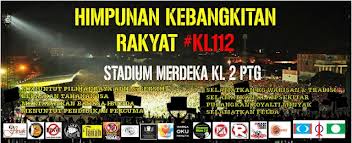
#KL112 Himpunan Kebangkitan Rakyat


Saturday, 12th January 2013 at the Himpunan Kebangkitan Rakyat.


Kuala Lumpur Legal Aid Centre                             
Tingkat 9, Wisma Kraftangan     
No.9, Jalan Tun Perak
50050 Kuala Lumpur         

Tel: 03-2691 3005 / 03-2693 2072
Fax: 03-2693 0527

First Atheist Church Opens In London


By Brad Hirschfield. Published by The Washington Post on 7 January 2013.

The first atheist church has opened in London, and it serves as yet another reminder of three important facts connected to the ongoing cultural struggle between many believers and non-believers. First, principled atheism is as much a faith as is theism; no matter how much many atheists would have us believe otherwise. Second, the human longing for community transcends the often bitter divides about where to find it and how to celebrate it. Third, like most so-called firsts in the world of faith and no-faith, this one is not really new.

Very few, if any, ideas or institutions are truly new. Virtually everything that we celebrate as new has its roots in something else, and that is especially true when it comes to religion. For example, before there was Christmas, there was Hanukkah. And before there was Hanukkah there were yet older celebrations of light in the midst of darkness - some Greco-Roman and others Zoroastrian. Of course, each of these traditions is unique, but none simply fell from the sky as fully formed novelties. Each emerged from a context which included predecessors which they both mirrored and altered, and the same can be said for this “first” atheist church.

While there may be no precedent for this kind of church in England, Americans have been playing with idea of church without God for generations. Perhaps best known, and most durable, among these experiments is the Society for Ethical Culture. Founded in 1877 by Felix Adler, the society did not actively embrace atheism. It simply pursued “deed over creed” and assumed that both theist and atheist beliefs were entirely personal and largely irrelevant.

That the society was founded not only by a Jew, but by the son of noted Reform rabbi Samuel Adler, also fits within a tradition in which arguing against the very right of God to be God goes back to the Genesis story of Abraham. Not to mention the fact that according to recent studies of the American spiritual landscape, Jews are the most highly secularized religious group in the nation. They would eschew the term religious, but functionally, that is what it is. They are part of a community of meaning, values and practice which draws on a shared past and identifies with a collective present and future.

Like their predecessors, the newly founded atheist church of England, seeks to create meaning and offer a sense of belonging for those who lack what one of its founders describes as “the good stuff of religion.” They see no reason why “theological disagreement” should keep people from enjoying that so-called good stuff, and especially in a world where decisions about worship are made increasingly based on what works for the worshipper, not based on some pre-existing theology or creed, that seems like a more than reasonable claim.

In fact, while I am not at all sure that a monthly meeting arranged by a performance artist and a comedian, as is the case in England, will be able to deliver all that they promise, successful spiritual ventures have started with far crazier stories. Not to mention that to recognize the power of no God, is not so different from recognizing the power of some newly identified God or prophet, which is the founding story of pretty much every faith tradition.

And it is for placing itself on the same continuum as theistic systems, that I am most grateful to the founders of this new church. The decision to believe or to disbelieve is just that, a faith claim. Nobody can know for sure when it comes to finite beings making claims about either existence of non-existence of the infinite. But, as this new church reminds us, we can see more of ourselves in each other than we often do.

In recognizing that we all make the decision to believe or not for a variety of reasons, with some going back and forth about exactly where they stand on that issue, we can recognize that both faith and non-faith are personal journeys which seek both communities of affirmation and the possibility of finding greater purpose and meaning in our lives. Perhaps it is because we are so very alike, we believers and non-believers, that some of us fight so hard to distinguish ourselves from each other. Perhaps.

Friday, January 4, 2013

Ten People Punished for Believing in Traditional Marriage


Posted by Peter Saunders at Christian Medical Comment on 20 December 2012.

Freedom to disagree and the right to private conscience are fundamental liberties in any truly open society. Yet, the Government has utterly failed to consider the impact on civil liberty of its plans to redefine marriage (See their proposals here). 

I have already given ten ways in which these new proposals will undermine civil liberties. 

The Coalition for Marriage has just released a new leaflet outlining ten case histories of people who have already been punished in various ways for standing for traditional marriage. 

In it they argue that redefining marriage is sold as a permissive measure, but it will quickly become coercive. In fact, they say, it already has. Too many people have already been punished for expressing their sincere beliefs about marriage. If marriage is redefined, it will get much worse. The ten examples they quote are as follows. In each case I have added links to the relevant news coverage.

1. Adrian Smith (pictured) was demoted and had his salary cut by 40 per cent, all because he said gay weddings in churches would be ‘an equality too far’. He wrote those four words outside work time on his personal Facebook page which was not visible to the general public.

2. Peter and Hazelmary Bull were ordered to pay £3,600 in damages because their B&B had a policy of only allowing married couples to share a double bed.

3. David Burrowes MP received a death threat after he said redefining marriage is unnecessary because civil partnerships already give same-sex couples legal equality with married couples.

4. Archbishop of York, Dr John Sentamu, received hate mail – some of a racist nature – after he spoke out against the Government’s plans to redefine marriage. North Yorkshire Police investigated the correspondence as hate crimes.

5. Rhys & Esther Curnow are young newly-weds who delivered a 500,000-strong petition against redefining marriage to Number 10 Downing Street. They were targeted online with threatening and hate-filled messages, sparking a police investigation.

6. World Congress of Families had a conference about redefining marriage banned by the Law Society and the Queen Elizabeth II Conference Centre because just discussing the subject would be a breach of ‘diversity policies’.

7. Arthur McGeorge is a bus driver who faced disciplinary action by his bosses just because he shared a petition backing traditional marriage at work during his break time.

8. Dr Bill Beales, a respected headmaster, faced calls for his suspension after he said in a school assembly that people were being ‘placed on trial’ for holding traditional beliefs about marriage.

9. Lillian Ladele, a registrar at Islington Council, was pushed out of her job because she asked her managers to accommodate her belief that marriage is the union of one man to one woman.

10. Dr Angela McCaskill is a deaf diversity officer at a university in America. She was suspended because she signed a petition saying voters should decide whether marriage should be redefined.

Link: http://pjsaunders.blogspot.ca/2012/12/ten-people-punished-for-believing-in.html

Thursday, January 3, 2013

Religious Liberty vs Gay Rights


By Erin Cox. Published by The Washington Post on 27 December 2012.

An Annapolis company whose old-fashioned trolleys are iconic in the city’s wedding scene has abandoned the nuptial industry rather than serve same-sex couples. The owner of Discover Annapolis Tours said he decided to walk away from $50,000 in annual revenue instead of compromising his Christian convictions when same-sex marriages become legal in Maryland in less than a week. And he has urged prospective clients to lobby state lawmakers for a religious exemption for wedding vendors.


While most wedding busi­nesses across the country embraced the chance to serve same-sex couples, a small minority has struggled to balance religious beliefs against business interests. Wedding vendors elsewhere who refused to accommodate same-sex couples have faced discrimination lawsuits and lost. Legal experts said Discover Annapolis Tours sidesteps legal trouble by avoiding all weddings.

“If they’re providing services to the public, they can’t discriminate who they provide their services to,” said Glendora Hughes, general counsel for the Maryland Commission on Civil Rights. The commission enforces public accommodation laws that prohibit businesses from discriminating on the basis of race, sexual orientation and other characteristics.

The trolley company’s decision, publicized by a straight groom offended by what he called “repressive bigotry,” offers a snapshot of a local business navigating a new landscape in Maryland’s wedding industry, and leaving it behind for a competitor to swoop in.

The head of the Maryland Wedding Professionals Association said the trolley company is the second vendor to refuse business over the state’s same-sex marriage law, which voters upheld in November. The Maryland clergyman who led opposition to same-sex marriage called the trolley company’s choice to abandon profits on principle “gutsy” and predicted that more businesses would quietly follow suit.

“That’s a bold and noble statement,” said Derek McCoy, executive director of the Maryland Marriage Alliance. “The other option would have been just to become a legal case.”

Frank Schubert, the political strategist who ran campaigns against same-sex marriage in Maryland and three other states this year, said opponents predicted collateral damage from legalizing same-sex unions. “This is exactly what happens,” Schubert said, adding that religious liberty is “right in the crosshairs of this debate. . . . The law doesn’t protect people of faith. It simply doesn’t.” Schubert pointed to a handful of other examples publicized in news reports across the country of wedding vendors sued for refusing to accommodate a same-sex ceremony: a pair of Vermont innkeepers, a New Jersey church group and a New Mexico wedding photographer.

In Maryland, the gay-rights group Equality Maryland said the trolley company’s decision appears to be an isolated case of a business owner exercising his rights. “As long as he doesn’t discriminate against other people, he’s free to do whatever he wants to do, including withdrawing his business from the industry,” executive director Carrie Evans said.

Discover Annapolis Tours owner Matt Grubbs declined repeated requests to discuss the move, beyond acknowledging its economic impact to his business, which also operates historic tours endorsed by the Annapolis and Anne Arundel County Conference and Visitors Bureau.

Grubbs said he expects to post a full explanation on his company’s Web site by Jan. 1, and he confirmed that he sent an e-mail to prospective client Chris Belkot last month that said, “We used to do weddings until recently. But we’re a Christian-owned business, and we are not able to lend support to gay marriages. And as a public accommodation, we cannot discriminate between gay or straight couples, so we had to stop doing all wedding transportation.”

In his message, Grubbs suggested that Maryland residents contact their lawmakers to “request they amend the new marriage law to allow an exemption for religious conviction for the layperson in the pew. The law exempts my minister from doing same-sex weddings, and the Knights of Columbus don’t have to rent out their hall for a gay wedding reception, but somehow my religious convictions don’t count for anything.”

Belkot, 31, forwarded Grubbs’s e-mail to Annapolis news Web sites and fired off a response to Grubbs that read, in part, “It is your right to run your business any way you see fit, but let’s be honest here, you drive a trolley up and down a street. Not exactly God’s work.”

Owners can often face business decisions that conflict with their beliefs, according to a consultant who works with Christian businesses.

“When they’re confronted with something that they feel is against the Bible and against God’s words, our first advice is to think through the process to determine if it really is against your core values,” said Ken Gosnell, president of the C12 Group of Central Maryland, a Christian business consulting group.

Gosnell, who said he has not met Grubbs, added that the trolley company’s decision on same-sex weddings does not necessarily reveal Grubbs’s feelings about gay people or transporting them to other events.

“It could be that it’s not so much that he’s against people, so much as he’s against a policy or law that has been put in place,” Gosnell said. “That is not abnormal for any business owner to take a position about any law that affects them.”

Wednesday, January 2, 2013

The Marginalised And The Elite


By Alyaa Azhar. Published by Free Malaysia Today on 2 January 2013.

Three members of a family in Pengerang, Johor, unable to cope with the loss of their home, committed suicide by inhaling charcoal smoke in an enclosed room yesterday. The family had received a notice informing them their home was being acquired for the controversial RM60 billion Petronas’s Refinery and Petrochemicals Development project.

They were told that they would receive only RM20,000 in compensation as the land on which their house was on was owned by another. Gabungan NGO Pengerang, a grassroots group opposing the oil plant, said the man sought help from the ruling political party, and had informed the party he wished to commit suicide.

The group’s treasurer, Chua Peng Sin, said the man, by name of Pang, suffered financial difficulties as he was earning a living helping out at a restaurant. He was forced to quit his job to care for his wife, who had suffered a stroke, and their child, who was diagnosed to be mentally disabled.


By G Vinod. Published by Free Malaysia Today on 2 January 2013.

PKR director of strategy Rafizi Ramli claimed that Deepak bought 19 types of jewellery, worth about RM13 million for the prime minister's wife. Rafizi also produced several documents, including invoices and bank payment records made to two luxury jewellery companies based in Hong Kong – Dehres Limited and Firestone Corporation Limited.

The payments for the jewellery were made by two companies linked to Deepak – Carpet Raya Sdn Bhd and Carpet Plus Sdn Bhd. Rafizi urged the authorities to investigate, alleging that the matter was nothing short of a corrupt act. He said that it would not be difficult for an agency like the Malaysian Anti-Corruption Commission (MACC) to investigate as each luxury jewellery is unique, with its own reference code. 

“For example, Deepak’s company made payment for the purchase of a diamond ring, code DR 2763, worth US$1.5 million. “So we have its code and the MACC could easily trace this matter if it hauls up Deepak for an investigation,” Rafizi said, adding that it would be difficult for anyone to forge a bank record.

Read more here: