Thursday, October 17, 2013

We should not let the Allah issue be exploited by Umno or its media!


Pakatan Rakyat (PR) today said that it will not support the call for a ban on the use of the word "Allah" if it is used with good intentions, properly and not in a degrading manner. PR de facto head Datuk Seri Anwar Ibrahim said PR and Christians in general had been unreasonably attacked over the matter. "We should not let it (the Allah issue) be exploited by Umno or its media," he told a press conference today.

Although the Court of Appeal ruling on Monday prohibiting the use of the word "Allah" was limited to the Bahasa Malaysia section of the Catholic weekly The Herald, the implications on the grounds are far-reaching with some Malay rights groups calling for the ban to be extended to churches in Sabah and Sarawak.

Anwar said PR had referred the matter to religious experts, including PAS president Datuk Seri Abdul Hadi Awang, even before the ruling, and international Islamic scholars. PR will issue a statement today on the opposition coalition's joint stand on the word.

Meanwhile, Sarawak Dayak Iban Association (Sadia) secretary-general Nicholas Mujah said calls for the ban to be extended to Sabah and Sarawak are uncalled for. "Unlike in Peninsular Malaysia, the Sarawak Muslims are not confused and the Christians are also not confused with the usage of the word," he said when asked to respond to a call by Perkasa to extend the ban to the two states. He said the call is against the spirit of the 1963 Malaysia Agreement and the Cobbold Commission Report on the formation of Malaysia.

Sarawak Dayak National Union (SDNU) issued a statement that any ruling to stop Dayaks from using the word is tantamount to infringing Christians' constitutional rights. Its president, Tan Sri William Mawan Ikom, who is state social development minister, said it is also against the fundamental right to freedom of worship.

Sarawak Dayak Graduates Association (SDGA) president Dr Dusit Jaul said he agreed with state Land Development Minister Tan Sri Dr James Masing's stand that any ban on the use of the word is an infringement of the rights of Christians in Sarawak.

Constitutional lawyer Syahredzan Johan said the Court of Appeal's decision has set a precedent that may be used in the future to ban similar words or publications. He said in The Herald case, the home minister was acting under the Printing Presses and Publications Act 1984 (PPPA). "That is a federal law, which is also in relation to national security. That is why in the future, they may use PPPA to perhaps ban words in the Al-Kitab, the Bahasa Malaysia version of the Bible.

Meanwhile, Malaysian Gurdwara Council president Jagir Singh said the ruling will affect Sikhs in the country who also use the word in their prayers. "Since the (judgment) is wide, it will affect us. If you go by the ruling of the court, there is no exemption for anybody. It is blanket and will affect every publication (which uses the word Allah)," said Jagir.


International media reports:

By Jennifer Pak. Published by BBC News, Kuala Lumpur on 14 October 2013.

The verdict does not come as a surprise to the two million Christians in Malaysia. Many of them believe that the case stems from a tight race between the governing Malay-Muslim party, UMNO, and the opposition Islamic party, PAS.

The Allah ban is seen as an attempt by UMNO to boost its Islamic credentials and win back votes. It's an issue that crops up in the government-linked media ahead of an election and promptly dwindles after the vote.

Christians are so convinced that this issue is about political posturing that most followers say they will continue to use the offending Bibles and use the word Allah in their worship.

Not all Muslims back the ban. But one of the most outspoken supporters is an influential group called Perkasa, which is backed by former prime minister Mahathir Mohamad - a champion of Malay-Muslim rights.


Published by the National Editorial on 14 October 2013.

Like the history of most religions, the history of Islam is complex and much debated. But there are a few elements that are not in dispute, chief among them that the God of the Quran is the same as the God of the Bible and of the Torah before it. The mission of Islam, as expressed in the Quran, is not to bring a new faith, but to update the messages of the monotheistic faiths before it.

It is therefore surprising to see, as The National reports today, that a Malaysian court has ruled that a Christian newspaper may not use the word “Allah” to refer to God. The court overturned a previous decision by a lower court, ruling that “Allah” as a term is not exclusive to Islam. This causes a problem for the country’s substantial Christian minority, who have used the word “Allah” to refer to God for decades.

In a fellow Muslim country with substantial Christian and Hindu populations, this feels like the wrong decision. The UAE is rightly proud of its society that allows people from all over the world to practise their faiths openly and without discrimination. Indeed, that inclusiveness is inherent in Islam. One of the reasons Islam was able to spread so far, so rapidly, was the inclusive nature of the faith: for at least two centuries after the coming of Islam, the Arabs ruled vast regions where the majority were not Muslims. The word “Allah” is never exclusive to Islam – indeed, both Christians and Jews used the word “Allah” to refer to God even before the coming of Islam.

That remains the case today. When Christians across the Middle East pray to God, they use the term “Allah”. Walk into a church in Cairo, Baghdad or Beirut this coming Sunday and you will hear the name of “Allah” invoked. That also applies to the Jews of the Arab world, who for centuries have prayed to “Allah”. The Quran itself is explicit on this subject, declaring, in Surah Al Ankabut, that Muslims should tell People of the Book (Christians and Jews) that “our God and your God is one”.

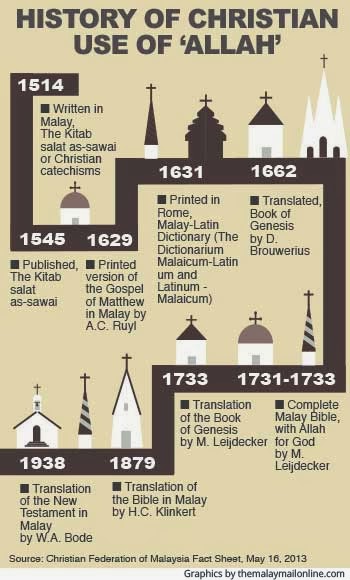
The Malaysian decision overlooks not merely the theology, but also the etymology of the word. The word “Allah” is derived from the Arabic “al-ilah”, the god. It’s found its way across the world and entered Malay from Arabic.

Arabic as a language is a vehicle for faith, be that Christianity, Judaism or Islam. The God of the three monotheistic religions is the same god. It is unsurprising, therefore, that all three faiths in the Arabic-speaking world (and beyond) refer to God as “Allah”. And if they have the same God, they should have the right to call their deity by the same name.

Link:
http://www.thenational.ae/thenationalconversation/editorial/word-allah-is-not-exclusive-to-islam?fb_action_ids=10151976505061974&fb_action_types=og.recommends&fb_source=other_multiline&action_object_map=%7B%2210151976505061974%22%3A1427094640843412%7D&action_type_map=%7B%2210151976505061974%22%3A%22og.recommends%22%7D&action_ref_map=%5B%5D

By Endy M. Bayuni, published by The Jakarta Post on 16 October 2013.

The controversy in Malaysia started when Muslims raised objections to the use of the word Allah by the Roman Catholic Church in its publications. Although the lower court already ruled in favor of the church in 2009, the Malaysian government decided to take up the issue on behalf of Muslims and appealed. Not surprisingly, this week it won the case, ironically on the eve of the Muslim’s Sacrifice Day.

The controversy on the use of the word “Allah” goes beyond semantics, or else it would not have provoked such emotional reactions from all sides concerned.

And it is a debate that sooner or later will come to Indonesia, for the seeds of exclusivity have already been deeply planted among Muslims in the country with the world’s largest Muslim population. Like their Malay Muslim brothers, Indonesian Muslims who share the same Malay root language, translate the phrase Lailaha Illallah to Tiada tuhan selain Allah (in English: No God but Allah), instead of the literal translation “No god but God”.

Something quite fundamental is lost in the translation when Indonesians make a distinction between “God” and “Allah”, two words that essentially mean the same thing. But this erroneous translation may have become the basis that put Muslims in much of Southeast Asia to claim exclusivity to God.

I am no historian, so I do not profess to know the reason for the translation, but since this part of the world was predominantly Hindus and Buddhists before Islam came in the 14th century, the distinction between Allah and God may have been important in helping to convert people who then believed in many deities.

The late Islamist scholar Nurcholish Madjid drew sharp rebukes when he suggested that Indonesians should translate the term to “No god but God”, so the idea was dropped prematurely. Exclusivity to the claim of God is equally strong in Indonesia, if not stronger, than in Malaysia.

Indonesia has had its share of debates on Islam’s claim to exclusivity, including whether non-Muslims should be allowed to say the traditional Islamic greeting assalamu’alaikum (which means peace be upon you) and other popular Islamic expressions such as Alhamdulillah (praise be to God) and Insya Allah (God willing).

It’s only a matter of time before someone takes the cue from Malaysia and starts raising objections to non-Muslims using the word Allah. The problem with religious exclusivism is that it breeds intolerance, which leads to prejudices against the others.

Indonesia and Malaysia may rightfully claim to have developed a more moderate strand of Islam, and history has actually proven that Muslims in this part of the world to be more tolerant when compared to their brothers and sisters in Islam’s place of origin in the Middle East or in South Asia.

But there is only a thin line dividing tolerance and intolerance, so we should not take this moderation for granted. With the rising exclusivism that the Muslim majorities in these two countries are pushing, we may be witnessing the Islam in Malaysia and Indonesia becoming less and less tolerant. In fact, it may already be happening.

Which begs the question: Is there anyone in this country that is pushing for more religious inclusivism? Insya Allah.

Read more here:
http://m.thejakartapost.com/news/2013/10/16/no-one-has-monopoly-claim-god-on-use-allah-malaysia.html

Monday, October 14, 2013

Allah case: Church to fight on


The Herald will appeal the appellate court's decision to set aside the High Court's ruling permitting it to use the term "Allah" in its publication. Saying this, the weekly's editor Father Lawrence Andrew, said the Court of Appeal's decision contradicts government policy.

Referring to the Catholic Church's argument that the Malay-speaking congregation commonly used the term in reference to God, Lawrence said: "We cannot reconcile how on the one hand the Christian community is allowed to freely use, import and distribute the Al-Kitab which uses the word 'Allah' extensively, by virtue of the govt's 10-point solution for their worship and instruction of their prayer."

"It is also a retrograde step in the development of the law into the fundamental liberties of religious minorities in this country," he told reporters outside the Palace of Justice here today. "In our view, the Court of Appeal ought to have interpreted the Federal Constitution in order to uphold rather to diminish the rights of the minorities," he added.

Disappointed that the decision to set aside the earlier High Court judgment which ruled that it was against the Church's constitutional right to discontinue using the term, the priest insisted that evidence submit during the course of the trial had showed that the word "Allah" is not exclusive to Islam. 

"It goes against evidence itself and by the use of the word by the Christians is a danger to public order is not proved yet till today," he said after a three-man bench read out the gist of the judgment this morning. 

Justices Datuk Seri Mohamed Apandi Ali, Datuk Mohd Zawawi Salleh and Datuk Abdul Aziz Abdul Rahim had unanimously ruled that the home minister, in banning The Herald from using Allah in its Malay edition, had made a decision in the interest of safeguarding public order. The judges also state that no constitutional right was infringed in the process and that the word "Allah" is not an integral part of the Christian faith. 

The Church, in its submissions, had stated that the Malay edition of the publication citing excerpts of the Al-Kitab, a translation of the Bible in Bahasa Malaysia. "We have not caused disharmony, for the 18 years of The Herald's publication, we have not caused any inconveniences," asserted Lawrence. "So we feel that this is unrealistic, given that the use of the word 'Allah' by Bahasa Malaysia- speaking congregation and other indigenous groups especially in Sabah and Sarawak for generations," he said.  

"We are not discouraged by this decision. We trust in God, justice will be served. We will appeal," said Lawrence. 

Link:
http://www.fz.com/content/herald-appeal-decision-contradicts-government-policy#ixzz2hgPhR9UK

To what extent will Prime Minister Najib Razak now push the issue remains to be seen. However, there is already deep concern he might seize on the ruling and use the precedent to force Christian groups into surrendering more of their rights whenever it was politically beneficial to him, or whenever he wanted to curry favour with the Muslims.

Some even fear that the Muslim extremists or ultras in Malaysia, flushed by today's victory, might get more demanding. This would set the stage for a collision course with the Christians, especially those from Sabah and Sarawak. The already high racial and religious disunity is bound to rise at least by another notch and this could destabilize Malaysia even more.

Nasharuddin was among those who attended the hearing at the Palace of Justice in Putrajaya this morning. Ibrahim Ali, the head of ultra Malay rights group Perkasa too was present. However, the Muslim NGOs while noisy and emotional failed to gather more than 200 or so protesters. Shouts of Allahu Akbar or God is Great cut through the cool morning breeze outside the grand court complex, while group prayers were also held. When the government's lawyers came to announce the decision, they were greeted like heroes.

Read more here:
http://www.malaysia-chronicle.com/index.php?option=com_k2&view=item&id=174491:catholic-magazine-herald-denied-the-right-to-use-allah-by-malaysias-appeals-court&Itemid=2#axzz2hh7V2U3M

But Khalid said that rather than banning the use of ‘Allah’ by non-Muslims for fear of retaliation by “stupid people”, the government should focus on educating the Muslims on what the Quran said over the issue. “The government should educate Muslims regarding all the verses of the Quran which mentions non-Muslims discussing about Allah with the Prophet Muhammad, and using the word freely without any hindrance whatsoever,” the Shah Alam MP said. “Instead, our government seems to be very proud that we are the only Muslim nation that practices this ban – that we are going beyond even what the Prophet Muhammad had done...”

He rejected Department of Islamic Development’s (Jakim) line of argument that allowing non-Muslims to use ‘Allah’ would threaten the faith of Muslims, saying: “It’s just like how everybody uses the word ‘God’ and ‘Tuhan’. There’s no confusion there.” On the contrary, Khalid insisted that opening up the word ‘Allah’ to other religions would build a common platform among the country’s different believers, and hence encourage interfaith discussions.“The question of pluralism also doesn’t come into play because the Quran says the only religion accepted by Allah is Islam,” he added.

Khalid also maintained that the issue was political rather than religious – he claimed that right wing Malay groups were championing the cause to make Islam exclusive to Malays and erect barriers between themselves and the non-Muslims in the country. “They want to maintain special position, hegemony in the country… they want to distance the Malays from the non-Malays in the country, so that issues such as good-governance, which is supported by non-Malays, does not become a matter of interest for the Malays,” said Khalid.

Read more here:
http://www.freemalaysiatoday.com/category/nation/2013/10/14/we-respect-allah-ruling-but%E2%80%A6/

Sarawak will continue to allow the use of the word Allah in Bahasa Malaysia and native language Bibles and church publications, said State Land Development Minister Tan Sri Dr James Masing, following the Court of Appeal's ruling today not to allow Catholic weekly The Herald to use the term.

Masing described the ruling as “not genuine”, saying the use of the word Allah predated Islam. “We (Christians in Sabah and Sarawak) have been using the word Allah for over 100 years. Why suddenly we are now told we cannot use it?" he asked, adding that the court's decision would have a negative impact on non-Muslims beyond Sabah and Sarawak. “Did they have a dream that Allah said they (the Christians) can't use the word Allah?” he asked, referring to the opposition by some Muslim groups in West Malaysia on the usage of the word in Christian texts.

Referring to Muslims in Sabah and Sarawak as "brothers", Masing said they had no qualms about Christians using the word. Masing reminded Christians in the state that Sarawak Chief Minister Tan Sri Abdul Taib Mahmud had in the past weighed in on the issue by giving assurance that he would not stop them from using the word Allah.

PKR Sarawak chief Baru Bian, saying he was stunned by the decision, said churches and Christians in Sabah and Sarawak would continue using the word Allah. “I am stunned by the decision.

We have produced very clear facts that we were promised a guarantee by our forefathers when Sabah and Sarawak helped form Malaysia. The ruling appears to go against the fundamental rights that were promised," said Baru, adding that the decision goes against the Malaysia agreement.

Baru, a church elder of the Kuching Evangelical Church for over a decade until he joined politics, said the ruling went against Article 11 of the Federal Constitution which allows people to profess and propagate their religious beliefs.

Read more here:
http://www.themalaysianinsider.com/malaysia/article/its-worship-as-usual-sarawak-christians-will-continue-use-allah-state-minis

Reverend Dr Herman Shastri, general secretary of the Council of Churches Malaysia (CCM), who was also present in court, expressed disappointment with the ruling, saying that he did not agree with the argument that the word "Allah" was not integral to Christianity.

"The learned judges obviously did not take into consideration that the Christians in Sabah and Sarawak and Malay-speaking Christians in Peninsular Malaysia have been using the word even before Independence," he argued.

He explained that Christians in the Middle East and Indonesia have been using the word "Allah", adding that the word predates Islam. "Even in the Quran it is mentioned that the Christians and Jews believe in Allah, which explains why PAS had also said that Christians can use the word. "But here, the judges made a ruling without calling expert evidence. This is very disappointing," added Shastri.

He said the CCM could not understand the "public order" argument accepted by the court. "The people in East Malaysia have been using the word and they have been living in peace, so what public order are they talking about? Just because a few extremists are making a big issue of this does not make it a national security issue," he said. Shastri noted that Putrajaya's 10-point solution to Christians in Sabah and Sarawak had not affected public order.

Read more here:

Whatever the High Court rules on the “Allah” issue today, churches in Sarawak like this one that conduct their services in the native languages have no plans to change the way they worship, with many saying that “Allah” will continue to be used in their prayers.

At this church in Kampung Tabuan yesterday, which caters to the largely Iban villagers in the surrounding areas, the service was conducted in Iban. The liturgy alone – the booklet that sets out the fixed set of Eucharistic rites and words to be used in worship – contained no fewer than 80 of the words “Allah Taala”, which means God Almighty in Iban. The word was also used in the hymns and in the sermon of Reverend Nelson Sinken.

The secretary of the Parochial Council of Churches, Maxwell Landong, told The Malaysian Insider after the service, “Since I started going to church, the words Allah Taala have been used by the church to refer to God. It’s our language and there are no other words I know that were used to refer to God.”

He added, “We have been using Allah in our liturgy, our Iban-language Bibles, publications, prayers and sermons for as long as I can remember. The Muslims in Sarawak have accepted that. So what is the fuss? Why now?” He pointed out that if the court ruled against the Catholic Church’s use of the word, it would be difficult to enforce the ruling here. He said that on a personal basis he would still pray to Allah Taala and read Bibles that use the word Allah to refer to God “no matter what the court says”.

For his part, Reverend Sinken was sanguine on today’s highly anticipated Court of Appeals decision on the dispute between Christians and certain Malaysian Muslim authorities over the use of the word. “I'm not worried,” Reverend Sinken said. He did not offer prayers for divine intervention or speak on the subject in his sermon. Echoing the exact sentiments of Landong, Reverend Sinken said of the Christians, “We in Sarawak have been using the word Allah for years without problem. It’s also our language. I'm sure the court will take all those into consideration.”

Like the majority of the churchgoers here yesterday, Dorothy Gregory is optimistic that the court will decide in the favour of “what is fair and just”. There are many similar words in the Iban and Malay languages. For example, “hutan” (jungle) in Malay is “utan” in Iban. “Jalan” (walk) in Malay is “jalai” in Iban and “makan” (eat) in Malay is “makai” in Iban.

When asked what could happen if the court ruled that Christians cannot use the word “Allah”, both Landong and Reverend Sinken said it would be up to the Archbishop to determine what they should do next.

Datuk Bolly Lapok is the Anglican Archbishop for Sarawak and Brunei.

Earlier, Bishop Lapok, as chairman of the Association of Churches in Sarawak, said the association “finds it unacceptable that practice of the Christians in Sabah and Sarawak who for generations had used Allah in worship, long before the very idea of Malaysia was conceived, is now held as unlawful by the government”.

He said that to stop saying Allah in the practice of their faith would be tantamount to a block on religious freedom. He added, “This is abhorrent, wholly unacceptable and a flagrant betrayal of the Malaysia Agreement, which guaranteed the inalienable rights of non-Muslims in Sarawak and Sabah to religious freedom.Lapok said the churches expect the federal government to abide by the Federal Constitution, which guaranteed religious freedom. He said the native churches will continue to use Bibles with the word Allah as it was “their fundamental right”.

He reminded the government that people in Sabah and Sarawak were promised the right to practise their religion when Sabah and Sarawak were courted to join the Malay states of Malaya to form Malaysia. He said the government must respect and abide by that promise.

Read more here:
http://www.themalaysianinsider.com/malaysia/article/inside-a-church-a-hundred-times-the-sound-of-allah

The Court of Appeal’s ruling on the “Allah” issue exposes the rights of Malaysia’s religious minorities to oppression under the guise of appeasing the majority, lawyers said today.

In expressing its disappointment at the appellate court’s ruling, the Catholic Lawyers’ Society said the voices of moderation appeared to be “drowned out” by the religiously intolerant, stressing that the minorities’ rights in Malaysia must be protected.

“To find that the minority must yield to the majority also sends a frightening message that the minorities’ rights are subject to the whims and fancies of the majority.

The minorities rights to freedom of religion are enshrined in the Federal Constitution and must be upheld at all times and not oppressed by the majority,” the Catholic Lawyers’ Society wrote in a press statement signed off by its president, Viola De Cruz Silva.

Read more here:
http://www.themalaymailonline.com/malaysia/article/lawyers-allah-appeal-opens-door-to-oppression-of-religious-minorities

Tuesday, September 24, 2013

Church Members Mistreat Homeless Man in Church Unaware It Is Their Pastor in Disguise


Seeded by The WOPR on 18 September 2013.


Pastor Jeremiah Steepek transformed himself into a homeless person and went to the 10,000 member church that he was to be introduced as the head pastor at that morning.

He walked around his soon to be church for 30 minutes while it was filling with people for service, only 3 people out of the 7-10,000 people said hello to him.

He asked people for change to buy food – no one in the church gave him change.

He went into the sanctuary to sit down in the front of the church and was asked by the ushers if he would please sit in the back.

He greeted people to be greeted back with stares and dirty looks, with people looking down on him and judging him.

As he sat in the back of the church, he listened to the church announcements and such.

When all that was done, the elders went up and were excited to introduce the new pastor of the church to the congregation.

“We would like to introduce to you Pastor Jeremiah Steepek.” The congregation looked around clapping with joy and anticipation.

The homeless man sitting in the back stood up and started walking down the aisle. The clapping stopped with all eyes on him.

He walked up the altar and took the microphone from the elders (who were in on this) and paused for a moment then he recited,

“Then the King will say to those on his right, ‘Come, you who are blessed by my Father; take your inheritance, the kingdom prepared for you since the creation of the world.

“For I was hungry and you gave me something to eat, I was thirsty and you gave me something to drink, I was a stranger and you invited me in, I needed clothes and you clothed me, I was sick and you looked after me, I was in prison and you came to visit me.’

“Then the righteous will answer him, ‘Lord, when did we see you hungry and feed you, or thirsty and give you something to drink? When did we see you a stranger and invite you in, or needing clothes and clothe you? When did we see you sick or in prison and go to visit you?’

‘The King will reply, ‘Truly I tell you, whatever you did for one of the least of these brothers and sisters of mine, you did for me.’ [Matthew 25: 34-45]

After he recited this, he looked towards the congregation and told them all what he had experienced that morning. Many began to cry and many heads were bowed in shame.

He then said, “Today I see a gathering of people, not a church of Jesus Christ. The world has enough people, but not enough disciples. When will YOU decide to become disciples?”

He then dismissed service until next week.

Following in the footsteps of Jesus Christ should be more than just talk. It ought to be a lifestyle that others around you can love about you and share in.

Malaysian Government's Request For RM14 Billion Seen As Untimely


By Pauline Ng. Published by The Business Times Singapore on 24 September 2013.
THE Malaysian government's commitment to budgetary reforms and the consolidation of its fiscal deficit was thrown into doubt yesterday when it sought a further RM14.12 billion (S$5.6 billion) for its operating expenses. Economists say the large amount, coming a month before the tabling of the 2014 Budget, could undermine the government's credibility and lead to a further weakening of the ringgit if does not meet consolidation targets and is punished by international investors.
In Parliament yesterday, Deputy Finance Minister Ahmad Maslan tabled the Supplementary Supply Bill 2013 seeking the extra funds, the bulk or nearly RM12 billion sought for Treasury services. Given that Mr Ahmad had in July already asked for RM12.17 billion under the same Bill, the latest request is sure to raise concerns as to whether Malaysia can pare its fiscal deficit to 4 per cent of gross domestic product (GDP) from 4.5 per cent last year.
The government should not hide behind fictitious economy projections but rather come to terms with reality; as it is unnecessary to have Supplementary Bill annually, says Lembah Pantai MP Nurul Izzah Anwar. Pakatan Rakyat views with great concern the first Supplementary Bill on operating expenditure for 2013 worth RM15 billion, comprising of RM14.13 billion for ‘perbelanjaan bekal’ and RM 888.46 for ‘perbelanjaan tanggungan’ which was tabled in parliament yesterday.
According to Nurul, the supplementary budget will adversely affect the nation’s public finances in general and the pace of fiscal consolidation process in the immediate to medium term. The PKR leader also forecast that if no changes happen in revenue, development expenditure, loan recovery and the GDP, the additional operating expenditure will cause the ratio of budget deficit against GDP for 2013 to jump to 5.5% Nurul stressed that 5.5% ratio will be above the 4% projection target tabled in Budget 2013 on 28 September 2012...
“The BN government has failed to achieve their own deficit to GDP targets whilst asking Malaysians to tighten their purses for the sake of a more sustainable future,” says Nurul. She cited the consequences faced in 2012 where by the government failed to achieve the 4.5% target for deficit to GDP ratio.

“It ballooned to 4.9% after taking into account all supplementary bills amounting to RM 28.5 billion,” added Nurul

Nurul also added that the government failed to display meaningful progress towards achieving a self imposed commitments to bring down the budget deficit-to-GDP ratio to 3% by 2015 and maintain a public debt ceiling below 55% at all times.

Read more here: 

The Permata Negara project, under the patronage of the prime minister's wife, had received allocations of RM150 million in 2013, RM111 million in 2012 and RM100 million in 2011.

Manivanan described the manner in which the allocation was spent as "quite peculiar". "Out of the RM 150 million, RM 20 million was returned back to the government, RM 77 million was given to Kemas by Permata to upgrade 313 pre-schools throughout the country," he said.

He said RM 16 million was channelled to the Terengganu Family Development Foundation and another RM9 million was given to the Sarawak state government to manage the state's second Permata programme.

"So Permata is the body that provides government funding?" he asked. "What is it's hallmark achievement in education?"

Read more here:

Wednesday, September 11, 2013

Ministers Who Are Unhappy With Rakyat, Please Resign


Those who cannot accept Malaysia's first-past-the-post system should emigrate to practise their political beliefs elsewhere, newly appointed Home Minister Datuk Seri Zahid Hamidi said today. In his column in Utusan Malaysia, Zahid said the Pakatan Rakyat's claims of having won the 13th general election by popular vote were claims based on its interpretation of the list system, or single transferable vote. "These methods, as interpreted by the Opposition, are only used in countries where the head of state and ruling party are chosen in a proportionate representation electoral system where seats are won based on the number of votes received," he said. He added that Malaysia had inherited its first-past-the-post system from the UK. "Those who do not want to follow it can emigrate elsewhere to practise the list system, or single transferable vote system, used in republican nations. "If they are truly loyal citizens, they will accept the political and electoral system as enshrined in our Federal Constitution. They also have to admit the truth of defeat in the first-past-the-post system," he said.

Read more here: http://www.malaysia-chronicle.com/index.php?option=com_k2&view=item&id=101172:those-not-happy-with-ge13-results-can-leave-the-country-zahid&Itemid=2#axzz2eYQIeLVV


Federal Territories Minister Datuk Seri Tengku Adnan Tengku Mansor wants Malaysians to stop complaining over the skyrocketing price of properties. "If houses are expensive, then don't buy from the developer or else, don't grumble too much," he said, adding that everyone is bound by the simple rule of "willing buyer and willing seller". "If the houses developers are selling is expensive, then don't buy."

Those who have no confidence in the country’s education system as outlined in the National Education Blueprint can send their children to study abroad, said Education Minister II Datuk Seri Idris Jusoh. “If some people feel the system is not good and want to send their children overseas to study, the government cannot stop them. But the Ministry will work towards improving the country’s education system," said Idris after a forum in Shah Alam today. “We cannot please everyone. We have our own objectives and we will continue to implement them. It is not my own decision before we came up with this blueprint.

Saturday, September 7, 2013

Freedom: Another Casualty of the Gay Agenda


By Frank Turek. Posted on 28 August 2013 by The Christian Post.

If you think that same sex marriage and "non-discrimination" laws are all about love and tolerance, you couldn't be more wrong. A decision out of the New Mexico Supreme Court last week clearly shows why. The decision is itself intolerant and discriminatory.

According to the Court, Christian photographer Elane Huguenin violated New Mexico's "non-discrimination" law by politely declining to photograph a same-sex commitment ceremony. Although the lesbian couple that brought the complaint easily found another photographer, Elane Photography now must pay nearly $7,000 in court costs for merely exercising her First Amendment rights.

The First Amendment of the U.S. Constitution was put in place to prevent exactly what the New Mexico Supreme Court has done: using the strong arm of government to force citizens to advocate (not just tolerate) ideas and behaviors that contradict their religious or moral convictions. Forcing people to support same sex weddings or commitment ceremonies is forcing them to advocate same sex behavior.

The First Amendment protects not only the right to free speech, but also the right not to be coerced into speech. Former Chief Justice of the U.S. Supreme Court, Warren Burger wrote, "The right of freedom of thought protected by the First Amendment against state action includes both the right to speak freely and the right to refrain from speaking at all. . . . A system which secures the right to proselytize religious, political, and ideological causes must also guarantee the concomitant right to decline to foster such concepts." Wooley v. Maynard, 430 U.S. 705, 714 (1977). Even the U.N. Human Rights Committee recognizes a universal human right not to be coerced into advocating any idea. (You know our country is stuck on stupid when our courts are getting human rights lessons from the U.N.!)

Now, if you justify this decision because you disagree with Elane Photography's religious or moral position, you're not thinking like an American (or a U.N. person). Imagine a homosexual videographer being forced to video a speech that a conservative makes against homosexual behavior and same sex marriage. Should that homosexual videographer be forced to do so? Of course not! Then why Elane Photography?

It is important to understand that Elane Photography was not refusing service because of the "sexual orientation" or sexual attractions of the couple. In fact, Elane Photography was happy to work with lesbian clients on other projects that did not involve advocating homosexual behavior (for example, taking professional head shots). In this case however, she declined service because she did not want to use her artistic talents to advocate sexual actions that went against her moral and religious beliefs.

But isn't this just like a white photographer refusing to photograph a black wedding? I know it's very fashionable to compare homosexuality to race, but the comparison is completely fallacious. And as Chesterton said, "Fallacies do not cease becoming fallacies when they become fashions."

First, homosexuality, unlike race, is a behavior, and statistically a harmful behavior. As a result, people have good moral reasons-even beyond religious beliefs-for opposing or not wanting to advocate homosexual behavior. But since race hurts no one, there is no moral justification for refusing to serve someone merely due to race.

Second, people are born into their race but not their sexual behavior. Sexual behavior is always a choice, race never is. You will find many former homosexuals, but you will never find a former African American. (I know whom you're thinking about. Let him rest in peace!).

Now, some believe there is a gay gene for homosexual attractions. But there's not only no evidence for a gay gene, identical twin studies suggest it doesn't exist. Yet even if we one day find some kind of genetic component to homosexual attractions, that would not mean that homosexual actions must be advocated by anyone. Being born with certain tendencies doesn't necessarily justify acting on those tendencies. If it did, Elane Huguenin could have justified her actions by simply claiming that she was born with the anti-gay gene!

New Mexico Justice Richard C. Bosson justified his actions this way: "The Huguenins are free to think, to say, to believe, as they wish; they may pray to the God of their choice and follow those commandments in their personal lives wherever they lead. The Constitution protects the Huguenins in that respect and much more. But there is a price, one that we all have to pay somewhere in our civic life."

I have a newsflash for Justice Bosson: People in North Korea and Iran are free to think, believe and pray to the God of their choice too! But that's not freedom of religion. The "free exercise" of religion means that you can actually live according to your religious beliefs. Justice Bosson and his misguided colleagues are essentially saying, "You can be a Christian as long as you don't act like a Christian. It's fine if your pastor or the Bible tells you to do something, as long as you don't actually do it." So we can't obey God anymore? Is that the "price" we have to pay, Justice Bosson? Looks like the time for peaceful civil disobedience is here. Jail anyone?

Despite his inane ruling, Justice Bosson does seem to recognize the chilling implications of his decision. He wrote: "…the Huguenins… now are compelled by law to compromise the very religious beliefs that inspire their lives. Though the rule of law requires it, the result is sobering. It will no doubt leave a tangible mark on the Huguenins and others of similar views."

This is only one of many "tangible marks" that the mainstream media continues to ignore as they cheer on intolerance disguised as "gay rights." There is a long and growing list of marks tattooed on people of faith and people of conscience who are being discriminated against beyond just the Huguenins. This is not tolerance or "non-discrimination." It is exactly the opposite. It is totalitarianism-do what we say, or else!

Our country has a choice to make: either maintain the value of freedom enshrined in our Constitution, or usurp the value of freedom by mandating conformity to the gay agenda. Unless the church and other freedom-loving people begin to speak up and get involved – and by that I mean in politics, education, the media, and law-we will lose the very freedoms our founders spilled their blood to secure.

Yes, there is a price to pay. But the price isn't giving up your Constitutional rights as the New Mexico Supreme Court mandates. The price is getting involved to protect those rights.

P.S. Click here https://itunes.apple.com/podcast/cross-examined/id337782458 and go to the top of the list to hear my in-depth interview with Jordan Lorence, the Alliance Defending Freedom (ADF) attorney who argued the case for Elane Photography. You can also see Jordan interviewed by Shannon Bream here. ADF is considering an appeal to the United States Supreme Court.

Thursday, September 5, 2013

Wrongful Conversion: Who's Responsible?


In a heated online television discussion yesterday, three Muslim scholars were still agreed on one thing: that the use of the word “Allah” to describe gods of different religions – including the Christian god – is an issue only in Malaysia and nowhere else in the world.
But it still was an issue to two of the scholars as they argued there was an agenda behind Christians using Allah to refer to their god in Malay bibles.
"Christianity is said to be over 2,000 years old. They should have a big vocabulary bank to choose from to refer to God. The fact that they chose Allah was evidence that they have an agenda," argued Dr Khalif Muammar Harris, associate professor of the Center for Advanced Studies on Islam, Science and Civilization at Universiti Teknologi Malaysia.
Agreeing with him, another panellist echoed the refrain of some that Christians had used the word to mislead East Malaysians to convert them to Christianity. Making this point was Dr Yusri Mohamad, chairman of the Coalition of Supporters of Islam (Pembela), who wanted the word "Allah" banned in Malay bibles.
"It is a Christian virus in the country. They cannot be faulted for having their own missionaries, but they are propagating the virus of pluralism, that all religions are the same," he said.
Read more here:
An illiterate Hindu woman has been converted to Islam without her knowledge and only found out through the National Registration Department (NRD).
Madinah Kanniammah Abdullah, 54, who lives in a rundown longhouse settlement in Kampung Bunga Raya, Subang, said she had never been a Muslim.
The mother of five told FMT that her problems started when she got into a relationship with an Indian national when she was a teen.
“I was 19 then and was in love with a man from India. He told me that he was Hindu and even prays in temples.
“We lived together for a week and that was when I found out he was a Muslim,” she said.
Madinah said her boyfriend took her identification card on the pretext of opening a bank account for her.
“But when he returned the IC I noticed that my name had been changed. When I asked him he said it was the correct spelling of my name in Malay,” she said.
Madinah found out later that her new IC indicated her as a Muslim, after a check with the NRD.
“I can’t read and write. So how could I possibly have signed any documents?” she asked.
She said she used thumbprints and could not recall signing any marriage documents with the Muslim man.
Years later, Madinah married a local Hindu in a customary wedding and started having problems when her first child was born.
Read more here:

Many objected strongly when the government tabled the Administration of the Religion of Islam (Federal Territories) Bill 2013 late last month. The Bill allowed for the unilateral conversion to Islam of a child by one parent, presumably after that parent converts himself or herself to Islam. We are glad that these strong objections have caused the Bill to be withdrawn, for now.

Many have emphasised too that withdrawing the bill does not address the problem as existing state religious laws and the Bahasa Malaysia version of the Federal Constitution must be amended to ensure that the consent of both parents is necessary for a child’s conversion.

But unilateral conversion of the child is not the only issue to worry about when one spouse converts to Islam. In WAO’s direct experience with women whose husbands convert opportunistically, other rights of the non-converted women have been eroded.

If one spouse converts to Islam, the non-converted spouse and other non-Muslim next-of-kin are not entitled to inherit from the converted spouse. The Distribution Act 1958 does not apply to the estate of any person professing Islam, and non-Muslims are generally not allowed to inherit under faraid principles of asset distribution.

Non-Muslim family members can only receive at most one-third of the converted person’s estate, if the converted person chooses to bequeath anything at all. The Distribution Act 1958 should be amended to safeguard the right of the deceased’s non-Muslim next-of-kin to inherit.

Read more here:

The High Court here has ruled as “null and void” the conversion of three Hindu children of kindergarten teacher, M.Indira Ghandi to become Muslims. Judicial Commissioner Lee Swee Seng also ruled that the father of the children, Mohd Ridzuan Abdullah, had not followed the rules in converting his children, Tevi Darsiny, 16; Karan Dinish, 15; and Prasana Diksa, five, to Islam.

“Under the Perak Islamic Administration Enactment, the three children must have the intention to embrace Islam without force. In this case, the three children cannot be proved to have recited the syahadah (affirmation of faith) and they, as well as their mother, were not present at the Islamic Religious Office for the conversion purposes,” he said when delivering his judgment which lasted one hour and 40 minutes.

Lee said the conversion was null and void as the children were not present to recite the syahadah before the religious officer. He said the decision was made not to ensure victory for any quarter, but more to maintain racial harmony in the country.

Read more here: