Showing posts with label Freedom of Assembly. Show all posts
Wednesday, August 26, 2015
#Bersih4
Key Words:
1MDB,
BERSIH 4,
corruption,
democracy,
economy,
election,
Election Commission,
exploitation,
Federal Constitution,
Freedom of Assembly,
government,
Human Rights,
justice,
Najib Razak,
politics
Tuesday, January 7, 2014
Malaysians Seen Curbing Spending as Living Costs Surge: Economy
By Chong Pooi Koon. Published by Bloomberg News on 7 January 2014.
Millions of middle-class Malaysians are grappling with the biggest increase in state controlled electricity and gasoline costs since 2008, threatening consumer spending growth and reasserting the country’s reliance on exports this year.
Since winning a May election, Prime Minister Najib Razak has unleashed a series of price increases to cut subsidies and improve state finances, crimping scope for companies to boost wages while spurring inflation. The moves, from a 14 percent jump in sugar costs in October to an 11 percent increase for gasoline in September and an average 15 percent to 16.9 percent climb for electricity this month, could slow private consumption growth by 0.9 percentage point in 2014, according to Alliance Financial Group Bhd. and Malaysian Rating Corp.
“Definitely it’s difficult,” Ng Wei Keong, a project engineer with two children aged 5 and 3, said in an interview at a December protest against another strain on his living cost -- an increase in the annual property assessment rate in Kuala Lumpur. “My kids will be without toys, no more vacation, no new cars and we must be very wise on spending money.”
Malaysia’s middle class, forged during the economic boom of the early 1990s, is bearing the brunt of the fiscal trimming as they grapple with a cocktail of record-high property prices, elevated household borrowings, and slower pay increases than lower-income earners. Rebounding exports are set to counter the spending squeeze, giving Najib scope to put consumers through the immediate pain of surging living costs as he shifts the economy toward market-based prices for commodities and energy.
‘Some Pain’
“There will be some pain in moving towards market-based pricing of the currently subsidized-costs of essential food items, fuel and energy,” said Suhaimi Ilias, chief economist at Maybank Investment Bank, part of the country’s largest lender. “Over the long term the economy will gain from a generally more efficient economy.”
Underscoring the threat to the domestic demand that held up growth in the past two years as exports faltered, consumer confidence in the third quarter fell to the weakest since 2009, according to a Malaysian Institute of Economic Research measure. An index of consumer stocks barely rose in the second half of 2013, gaining 0.02 percent compared with the benchmark’s 5.2 percent climb.
The “headwinds to domestic demand in the near term” would make Malaysia’s economic growth increasingly dependent on an export recovery, Citigroup Inc. said in a November report. The banking group predicts a 5 percent expansion in 2014, at the lower end of the government’s forecast range, as it anticipates more fuel price increases that will cut discretionary incomes by a net 2 billion ringgit ($608 million), or 0.2 percentage point of nominal gross domestic product.
Sandwich Class
Those in the middle-income group, who make as little as 3,000 ringgit a month, don’t benefit as much as other segments from planned government handouts or income tax cuts, said Wan Saiful Wan Jan, chief executive officer at the Institute for Democracy and Economic Affairs, a Kuala Lumpur-based think tank.
Malaysian families who earn 3,000 ringgit to 4,999 ringgit a month made up 27.8 percent of households in the population of about 30 million, according to government data for 2012, up from 4 percent in 1989. About 39 percent of households fall below that bracket, while the remainder of the middle class and the highest income groups -- those earning 5,000 ringgit and above - - account for 33.6 percent.
Inflation Pressure
“The bottom 40 percent is helped by the various welfare programs, while the top 5 percent will benefit from the trend to reduce income tax and they are generally better off in a liberalizing economy,” Wan Saiful said in an interview. “For the middle income group, nothing has been done to help them but there are so many things that they can’t afford anymore.”
Inflation in Southeast Asia’s No. 3 economy may accelerate to 2.9 percent this year and a seven-year high of 3.3 percent in 2015, when Najib plans to introduce a new consumption tax, according to Bloomberg surveys. In contrast, the Malaysian Employers Federation estimates lower salary increases and bonuses in 2014 in the private sector as business costs rise.
“The faster inflation rate amid slower income rise erodes purchasing power, which will impact the consumer spending part of GDP,” said Maybank’s Suhaimi. He predicts the central bank will keep interest rates unchanged even as inflation reaches 3.5 percent in 2014, to avoid further deflating consumer sentiment. “The risk to growth is pretty much coming from consumers.”
Pay Increases
Executives will get a 5.63 percent average increase in salaries, down from 6.31 percent in 2013, and non-executives will get a 5.65 percent raise from 6.7 last year, according to an MEF survey of 257 companies. Lower-paid workers will fare better -- in addition to benefiting from a minimum wage, non-executives will get a bigger bonus this year while executives will get a smaller payout.
Government data show that the most well educated people in the workforce got the smallest wage increase in the two years through 2012.
“What we earn cannot cope with the rising cost of living,” said Selena Tay, a freelance writer in her 40s who lives with and supports her elderly parents. She plans to cut out purchases of clothes, shoes, bags to save money for food. “The government is strangling us. We are now scared to read the daily newspaper because every day, the price of something is going up.”
Political Gamble
Najib is making a political gamble as he starts to dismantle decades of subsidies to address fiscal risks identified by Fitch Ratings, which cut Malaysia’s credit outlook in July. Within months of the May election that returned his ruling Barisan Nasional coalition to power without winning the popular vote for the first time, he scrapped the sugar subsidy and unveiled plans for a goods and services tax at the risk of further alienating the urban voters who turned against him.
The next election is due by about mid-2018. Najib’s predecessor Abdullah Ahmad Badawi, who introduced even bigger increases in electricity and fuel prices after the 2008 general election, stepped down to make way for Najib mid-term in early 2009.
Forty-nine percent of respondents in a survey released in December say the country is heading in the wrong direction, with rising living costs and unfavorable economic conditions cited as the main reasons, according to the Merdeka Center for Opinion Research.
Some Malaysians have already taken to public protests against the price increases. In December, hundreds gathered in front of the city council office in Kuala Lumpur to rally against an increase in property taxes. On New Year’s Eve, about 4,000 people joined an illegal protest in the capital to demand lower living costs, disrupting a countdown concert, Bernama reported.
“My biggest worry is, financial difficulty will lead to ethnic tension,” said Wan Saiful. “You go to a Malay area in Kuala Lumpur, Kampung Baru or Sentul, you already get the sentiment that they are accusing the Chinese of taking away all their economic wealth. If you go to poorer Chinese area in Cheras, Balakong, the sentiment you’ll get is the ethnic Chinese will say of course they are poor, because the ethnic Malays are the ones being helped by the government.”
To contact the reporter on this story: Chong Pooi Koon in Kuala Lumpur at pchong17@bloomberg.net
To contact the editor responsible for this story: Stephanie Phang at sphang@bloomberg.net
Key Words:
#GE13,
1Malaysia,
Abdullah Ahmad Badawi,
Anything But BN,
corruption,
cronyism,
economy,
election,
family,
Freedom of Assembly,
government,
Himpunan #Turun,
Najib Razak,
politics,
poverty
Wednesday, January 1, 2014
Berkhidmat Untuk Umno Atau Rakyat?
Ini diharamkan:
Dewan Bandaraya Kuala Lumpur (DBKL) akan berbincang dengan pihak polis bagi menentukan tindakan susulan terhadap penganjur perhimpunan haram di Dataran Merdeka malam tadi. Datuk Bandar Kuala Lumpur Datuk Seri Ahmad Phesal Talib berkata pihaknya akan memutuskan tindakan lanjut terhadap penganjur perhimpunan itu setelah satu mesyuarat khas diadakan.
“Setakat ini DBKL belum mengenal pasti apa tindakan yang akan diambil…sama ada tindakan saman kepada penganjur atau tindakan-tindakan lain yang sesuai,” katanya kepada Bernama di sini hari ini.
Perhimpunan haram itu yang dianjurkan badan bukan kerajaan (NGO), dihadiri kira-kira 4,000 peserta telah merencatkan konsert Ambang Tahun Baharu anjuran DBKL yang terpaksa dihentikan setengah jam sebelum detik jam 12 malam ekoran peserta perhimpunan menyerbu masuk ke Dataran Merdeka.
Polis menamakan empat NGO sebagai terlibat dalam penganjuran perhimpunan haram berkenaan iaitu Gerakan Turun Kos Sara Hidup, Solidariti Mahasiswa Malaysia (SMM), Jingga 13 dan Solidariti Anak Muda Malaysia (SAMM).
Mengulas mengenai jumlah kerugian, Ahmad Phesal berkata DBKL setakat ini belum menerima apa-apa laporan kerugian peralatan atau harta benda susulan perhimpunan haram itu.
Link:
Pengerusi Gerakan Turun Kos sara Hidup (TURUN) Azan Safar mengisytiharkan perhimpunan malam tadi sebagai satu kejayaan ekoran kehadiran seramai 10,000 ribu orang membanjiri Dataran Merdeka untuk membantah kenaikan kos sara hidup.
Azan berkata kehadiran ramai peserta pada malam tadi menandakan sokongan dan reaksi mereka terhadap semua kenaikan tersebut, walaupun pihak berkuasa mengancam mengambil tindakan dan melaber acara tersebut sebagai perhimpunan haram.
"Tahniah Rakyat. Himpunan TURUN berjaya. Terima kasih buat seluruh rakyat Malaysia, dari orang kenamaan sehingga rakyat marhaen yang telah berhimpun secara aman dan bersurai sebaik tamat sambutan Tahun baru 2014.
"Tahniah kepada rakyat yang berjaya menganjurkan himpunan buat rakyat pada malam ini," katanya melalui sistem pesanan WahtsApp kepada Malaysiakini.
Beliau turut merakam penghargaan kepada pihak berkuasa yang memberikan kerjasama terbaik dalam memastikan himpunan malam ini berlangsung dengan aman. Berdasarkan laporan, polis tidak membuat sebarang penahanan ke atas mana-mana peserta perhimpunan tersebut.
Tetapi ini dibenarkan:
Seramai 70 anggota dan pemimpin Pertubuhan Pribumi Perkasa Malaysia (Perkasa) Selangor, yang diketuai Yang Dipertuanya, Abu Bakar Yahya, membuat bantahan secara aman di depan Ibu Pejabat Polis Daerah di Shah Alam hari ini.
Tunjuk perasaan itu berlangsung selepas Perkasa Selangor membuat laporan polis pada 2.30 petang terhadap Pengarang mingguan Katolik Herald Paderi Lawrence Andrew berhubung satu kenyataan yang dikeluarkannya dalam The Malaysian Insider Jumaat lepas.
Link:
http://www.themalaysianinsider.com/bahasa/article/perkasa-selangor-bantah-kenyataan-pengarang-herald
Key Words:
#GE13,
1Malaysia,
alkitab,
Allah,
Anything But BN,
Christianity,
democracy,
Freedom of Assembly,
injustice,
Perkasa,
persecution,
police,
politics,
rakyat,
religious freedom
Wednesday, June 5, 2013
The Baling spirit lives on
Published by Malaysiakini on 3 June 2013.
Thirty-nine years ago, a little-known incident in Baling caused a seismic shift in Malaysian politics, but very few Malaysians are aware of the incident or realise its significance and the impact it created. If the full details of this incident had been divulged in 1974, the government might have fallen...
The Baling event referred to is not the historic meeting in 1955 of Tunku Abdul Rahman, who was the head of the Malayan government and Chin Peng, the leader of the Communist Party of Malaya (CPM).
Nor was it the Memali Incident of 1985, the shameful massacre of a defenceless community by forces loyal to Dr Mahathir Mohamad’s government.
The Baling Incident (BI) which occurred in 1974 was shrouded in secrecy. It was a series of many small expressions of the bottled-up feelings of anger, betrayal, fear and resentment, of the rural poor.
In present-day Malaysia, the rakyat participated in democracy marches and rallies against oppression, injustice and the dictatorial rule of Najib and the BN government. In 1974, it was Abdul Razak, Najib’s father, who faced similar marches against social injustices.
Bizarrely, in 1974 Abdul Razak announced in Parliament that the civil servants’ allowance would be increased by 50 percent, from RM1,000 to RM1,500.
When news broke of the deaths of a few children from eating ubi gadong, a type of poisonous wild yam, to stave off hunger pangs, the social unrest reached a tipping point. At its peak, around 25,000 of the rural poor took to the streets.
Like father, like son; both Abdul Razak and Najib unleashed the might of the FRU and the police on peaceful protesters. Najib is a politician without imagination, but he knew that brutal action had served his father well.
A dark chapter in our history
In 2013 Najib merely employed his father’s tried and tested methods of retaliation. The consequences of 1974 opened a dark chapter in our history.
Then, like now, information was heavily censored. Abdul Razak did not want the rakyat to know that an uprising had occurred in Kedah. Five years earlier, the country had been overwhelmed by the May 13 clashes. The Chinese were convenient scapegoats.
Abdul Razak was in a quandary. The district of Baling was mainly populated by Malays. The significance of the BI had to be suppressed.
In the BI there was no Chinese element, or communist subversives at work. BI was social unrest - a revolt by Malay smallholders and farmers. Peaceful hunger marches throughout Baling spread outwards from Baling town, Kulim and Sik.
News travelled fast and despite media censorship in 1974, students at Universiti Malaya, Universiti Kebangsaan Malaysia and Kolej Mara, as well as the universities’ teaching fraternity expressed their support for the uprising. They organised a series of meetings and urged the government to address the plight of the poor.
Syed Husin Ali, then an associate professor at Universiti Malaya, said: “At first they (the students) demonstrated within their campus. The police fired tear gas but some cannisters landed on the nearby squatter settlement, injuring some children.
“The students joined forces and gathered in the centre of KL. When the police acted against them, they took refuge in the National Mosque. Over 1,000 students were arrested and detained for a few days. Some squatters joined some students to ‘run riot’ at the highway, putting up blockades and smashing traffic lights.”
The education minister then was Mahathir. He and Ungku Aziz, the vice-chancellor of UM at the time, produced the Universities and University Colleges Act (UUCA).
In 2013, history repeated itself and the nightmare which descended on Najib’s father is now his own. Today, Najib has warned that he would get tough with students Adam Adli Abdul Halim and Safwan Anang as well as other dissenters. The ISA has been repealed, so what has Najib up his sleeve?
Let this column warn both Najib and Mahathir, the joint rulers of Malaysia that their efforts to subjugate the rakyat will not succeed. Baling was not an isolated incident.
Prior to BI, there were unreported acts of unrest against the BN government. In Tasik Utara, Johor Baru, poor urban Malays camped in front the residence of then MB Osman Saat to voice their disgust at being cheated of housing and land.
The wounds which Abdul Razak, Mahathir and Najib opened are still festering. Our awareness of their crimes and of their despotic rule are more acute.
Their policies have cast long shadows and there will be more Baling incidents until Najib and the illegitimate BN government step down.
MARIAM MOKHTAR is a non-conformist traditionalist from Perak, a bucket chemist and an armchair eco-warrior. In ‘real-speak', this translates into that she comes from Ipoh, values change but respects culture, is a petroleum chemist and also an environmental pollution-control scientist.
Read more here: http://www.malaysiakini.com/columns/231865
Key Words:
Anwar Ibrahim,
Baling 1974,
education,
Freedom of Assembly,
history,
Mahathir Mohammad,
Memali 1985,
Najib Razak,
police,
politics,
poverty,
social justice
Monday, May 27, 2013
French gay marriage opponents stage big Paris march
Published by Free Malaysia Today on 27 May 2013.
Several hundred thousand opponents of same-sex marriage marched in central Paris on Sunday against a reform the unpopular French government passed last month at the price of deepening political polarization. Large park grounds around Les Invalides monument were full of protesters waving pink and blue flags, while far-right activists hung a banner on the ruling Socialist Party headquarters urging President Francois Hollande to quit.
The protests, which began as a grass roots campaign strongly backed by the Roman Catholic Church, have morphed into a wider movement with opposition politicians and far-right militants airing their discontent with Hollande. Although they have failed to block gay marriage, the protesters hope their renewed show of force will help stop or slow down further laws some Socialists want allowing assisted procreation and surrogate motherhood for gay couples.
Jean-Francois Cope, leader of the opposition UMP party, marched in the demonstration and urged young protesters to join his party to keep up pressure on the left-wing government. “The next rendez-vous should be at the ballot boxes for the municipal elections,” he said, referring to local polls due next year where conservatives hope to profit from the protest movement’s unexpectedly strong mobilization.
While the rally was peaceful throughout much of the day, police said they arrested 96 hardline opponents to the gay marriage law later on for refusing to disperse or occupying private property. Once the bulk of protesters had gone home, clashes erupted between hardliners wielding sticks and riot police, filling the Invalides Esplanade with tear gas. The violence was less severe than at the end of previous demonstrations, however. Police said 150,000 marched yesterday while protest organizers said a million people took part.
Warnings of violence ignored
Interior Minister Manuel Valls warned protesters on Saturday not to bring children along because of violence he feared after far-right militants clashed with police at recent rallies. He mobilized 4,500 police to secure the event.
Many parents ignored his warnings and some picnicked with children on the lawn at the rally. “Look, it’s perfectly safe here,” said Elisabeth Huet from Orleans, who marched along with her adult daughter and three small grandchildren.
A survey published on Sunday showed 53 percent of those polled support gay marriage and adoption, indicating a slide of about 10 points since the protests began last November. It said 72 percent thought the protests should stop now.
Plagued by economic recession, unemployment at more than 10 percent and pressure to reduce the public deficit, Hollande got some respite on Sunday from another poll showing his record low popularity had inched up four points to 29 percent this month.
While leaders of Hollande’s Socialist Party denounced the protest against a law already passed in parliament and validated by the Constitutional Council, the conservative UMP party was split over whether to continue the rallies. There were fewer Catholic priests than at earlier demonstrations. Several bishops joined previous marches, but distanced themselves as protests became more openly political.
France’s first gay wedding is due to take place on Wednesday in Montpellier, France’s self-proclaimed capital of gay culture. France, a traditionally Catholic country, followed 13 others including Canada, Denmark, Sweden and most recently Uruguay and New Zealand in allowing gay and lesbian couples to wed.
In the United States, Washington D.C. and 12 states have legalized same-sex marriage.
- Reuters
Link:
Key Words:
Bible,
Christianity,
family,
Freedom of Assembly,
homosexuality,
Human Rights,
law,
marriage,
Religion,
religious freedom
Tuesday, May 21, 2013
Jangan Mempolitikkan Pelaksanaan Undang-undang
PUTRAJAYA, 20 Mei (Bernama) — Menteri Dalam Negeri Datuk Seri Dr Ahmad Zahid Hamidi mengingatkan pemimpin pembangkang supaya tidak mempolitikkan segala pelaksanaan dan tindakan pihak berkuasa dalam usaha memelihara keamanan dan kesejahteraan negara.
Pihak berkenaan boleh menghadapi risiko besar sekiranya terus berbuat demikian, katanya pada sidang media selepas memulakan tugas hari pertama sebagai menteri dalam negeri.
“(Penasihat DAP) Lim Kit Siang dan (Setiausaha Agung DAP) Lim Guan Eng harus membezakan antara objektif politik, langkah politik dengan pelaksanaan undang-undang. Jangan mempolitikkan segala pelaksanaan undang-undang yang dilaksanakan oleh IGP (ketua polis negara) atau lain-lain agensi yang berada di bawah KDN,” katanya.
Ahmad Zahid berkata ketua polis negara, ketua-ketua jabatan dan agensi di bawah KDN, diberi kuasa sepenuhnya bagi melaksanakan tugas dan tanggungjawab mereka mengikut bidang kuasa masing-masing, tanpa campur tangan politik.
Sebarang tindakan yang dilakukan di bawah KDN tidak boleh dianggap sebagai tindakan bermotifkan politik, tetapi berlandaskan kepada asas-asas perundangan yang sedia ada, katanya.
Beliau mengingatkan bahawa kerajaan tidak lagi memberi amaran, sebaliknya akan mengambil tindakan tegas terhadap mana-mana pihak yang bertindak di luar batasan menjejaskan ketenteraman awam negara.
“Kami tidak akan berkompromi untuk mengambil tindakan sebagaimana yang termaktub dalam undang-undang, akta dan enakmen yang sedia ada, katanya.
Menyentuh kenyataan pemimpin-pemimpin pembangkang berhubung beberapa perkara berkaitan kenyataan beliau baru-baru ini, soal perundangan, pilihan raya dan sebagainya, Ahmad Zahid berkata perkara itu boleh dipertikai di Parlimen.
“Sebagai orang politik, kita berjumpa di gelanggang politik, gelanggangnya bukan di jalanan, bukan di padang terbuka, tetapi di Dewan Rakyat. Jangan gunakan forum di tempat lain,” jelas beliau.
Ahmad Zahid turut membidas Ketua Umum PKR Datuk Seri Anwar Ibrahim yang meminta beliau supaya tidak menjadikan negara ini seperti milik keluarganya
“Negeri ini pun bukan negeri bapa dia punya. Memang bukan (milik) bapa saya. Ini (pun) bukan negeri bapa dia,” katanya.
Anggota Parlimen Bagan Datoh itu dibidas kerana membuat kenyataan menggesa mereka yang tidak berpuas hati dengan keputusan pilihan raya di Malaysia supaya berhijrah ke negara di mana mereka boleh mempraktikkan kepercayaan politik mereka.
Ahmad Zahid juga berkata bagi memastikan pelaksanaan KDN berjalan lancar, cadangan, pandangan dan kerjasama padu daripada semua pihak dialu-alukan, selain kritikan dan teguran.
“Kami perlukan sokongan dan dukungan daripada masyarakat keseluruhannya, ini termasuk pemimpin-pemimpin politik, sama ada dalam kerajaan mahupun di luar kerajaan, NGO, individu dan institusi.
“Bukan sekadar memberikan maklum balas, aduan atau rungutan tetapi memberikan cadangan dan kerjasama kepada apa yang sedia ada dalam perundangan,, peruntukan yang digaris pandukan. Ia bukan untuk kepentingan politik kami,” katanya...
Asal berita :
Key Words:
1Malaysia,
Anything But BN,
education,
Freedom of Assembly,
Freedom of Expression,
Home Ministry,
injustice,
Malaysia Boleh,
police,
rule of law,
separation of powers,
social justice,
youths
Tuesday, May 14, 2013
Himpunan Blackout Johor Bahru: Change of Venue
Key Words:
#GE13,
Anwar Ibrahim,
Anything But BN,
democracy,
election,
Election Commission,
Freedom of Assembly,
Johore,
PKR,
rakyat
IGP’s got it wrong, rally is legal
By K Pragalath. Published by Free Malaysia Today on 8 May 2013.
The Inspector General of Police is working with a wrong understanding of the law relating to protest rallies, said a lawyer today. IGP Ismail Omar’s declaration that a rally tonight by Pakatan Rakyat is illegal shows he is still working with the mindset of section 27 of the Police Act.
“Section 27 of the Police Act has been replaced with the Peaceful Assembly Act 2012. There is no such thing as permits under the PAA,” said civil liberties lawyer, Syahredzan Johan. He said this in response to Ismail’s declaration that the rally led by Opposition Leader Anwar Ibrahim tonight in Kelana Jaya Stadium is illegal.
“The organiser must comply with the PAA. Marching without a permit, aimed at arousing anger, is wrong according to the law,” declared the IGP. “Comply with the law and use the correct channel to apply for a permit from the district police chief,” national news agency Bernama quoted Ismail Omar as saying yesterday. Ismail added that those who took part in the rally tonight will be arrested.
Police cannot declare rally illegal
Anwar called for the rally following allegations that the 13th general election that took place on Sunday was fraught with cheating and irregularities.
Syahredzan also explained the limitations of the police under the PAA. Among others, he said the police cannot declare a rally illegal. “No rallies can be declared illegal under the PAA. The organisers can only be charged for not notifying the OCPD of the rally.” The act states that rally organisers are required to notify the police 10 days prior to the rally. “Rally participants cannot be charged for attending the rally. They are not committing an offence unless they bring their underaged children."
Link:
Key Words:
#GE13,
Anything But BN,
children,
election,
Election Commission,
Freedom of Assembly,
law,
lawyer,
PKR,
police,
politics
Monday, May 13, 2013
Himpunan Blackout 505 coming to JB!
Key Words:
#GE13,
Anwar Ibrahim,
Anything But BN,
Blackout 505,
election,
Election Commission,
Freedom of Assembly,
Human Rights,
Johore,
politics,
rakyat
#GE13 More clarity needed on Public Order Act: Voices
From Edwin Dai. Published by Singapore Law Watch on 8 May 2013.
Last month, it was reported that six Malaysians were investigated by the police for holding a public assembly without a permit and were warned that “foreigners should refrain from importing their domestic political activities into Singapore” (“Police investigating voting drive”, April 16).
On May 2, only days before the Malaysian general election, Mr Abdul Ghani Othman, who was contesting the parliamentary seat of Gelang Patah, travelled to Singapore, and his trip received much media coverage.
It is in the interest of the public for the police to clarify the ambit of the Public Order Act.
The definition of “assembly” under the Public Order Act, Section 2(1), refers to a gathering or meeting of persons for the purpose (or one of the purposes) of demonstrating support for or opposition to the views or actions of any person, group of persons or any government; publicising a cause or campaign; or marking or commemorating any event. It also includes a demonstration by a person alone for any such purposes.
There appears to be inconsistency in the way the two situations were handled. A plea for Malaysians to perform a national duty was deemed to constitute an illegal assembly.
On the other hand, a trip by a (now former) Barisan Nasional (BN) Member of Parliament to Singapore, where he aired his thoughts on the coming election, was given media coverage. The purpose of his visit may be reasonably construed by some as an attempt to canvass support for BN from Malaysians residing in Singapore.
There is a need for the authorities to clarify the Public Order Act and its enforcement. Specifically, it is unclear whether Mr Abdul Ghani’s visit flouted the Public Order Act or, at the very least, was in direct opposition to the police’s position on “foreigners” and their “domestic political activities”.
Link:
Key Words:
#GE13,
1Malaysia,
Anything But BN,
BERSIH 2.0,
BERSIH 3.0,
democracy,
election,
Freedom of Assembly,
Human Rights,
injustice,
Johore,
police,
rakyat,
Singapore
Tuesday, January 8, 2013
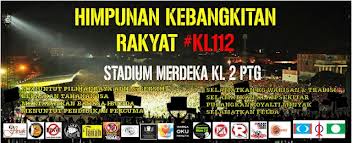
#KL112 Himpunan Kebangkitan Rakyat
Key Words:
Anything But BN,
education,
election,
Election Commission,
exploitation,
Freedom of Assembly,
frustration,
government,
Himpunan Hijau,
Human Rights,
indigenous people,
injustice,
rakyat,
Save Malaysia Stop Lynas
Thursday, December 27, 2012
Hunger Protest 100: Hazardous projects hunger strike 27 Dec 2012
By K Pragalath. Published by Free Malaysia Today on 27 December 2012.
A pro-environment group called Malaysian Youth Against Public Hazards (MYAP) is organising a hunger strike tonight at Dataran Merdeka to raise awareness against hazardous projects. The group had identified five projects – Lynas Rare Earth Plant, Bukit Koman Cyanide Gold Mining, Pengerang Oil Refinery, Sarawak Mega Dams project and the Rawang High Tension Cable. However, MYAP’s two immediate demands were focused on Lynas.
They are demanding for an end to Lynas’ temporary operating license (TOL) since there is data to show risk to public health and environment whereas their second demand is for a proper Detailed Environment Impact Assessment (DEIA) to be done and made public before a TOL is issued.
The hunger strike is called Hunger Protest 100. The 100 refers to the number of hours that the hunger strike would be held. The protest, which begins at 8pm, would end on the stroke of midnight on Jan 1, 2013. MYAP spokesperson and team leader Tan Woen Tien told FMT that at the time of writing 18 participants had confirmed their participation.
Student activist Adam Adli and PKR affiliated NGO Solidariti Anak Muda Malaysia would be participating as well. “Hospital Kuala Lumpur has been notified. In addition, a St John’s Ambulance will be stationed nearby,” said Tan.
According to MYAP’s Facebook page, non-Muslim participants would only consume water throughout the fasting period whereas Muslim participants would be fasting from dawn to sunset. During the strike, several speakers were scheduled to deliver speeches. Bersih steering committee member Wong Chin Huat is expected to start the ball rolling tonight with a talk entitled, “Would it be possible for Mat Kilau to accept Lynas?”
Parti Sosialis Malaysia (PSM) secretary-general S Arutchelvan would be giving a talk tomorrow. Meanwhile, Tan said another environment group Himpunan Hijau leader, Wong Tack, would be organising the “people’s congress to allow the people to decide the type of development that they want."
Link:
Key Words:
Anything But BN,
climate change,
Constitution,
corruption,
election,
environment protection,
Environmental Quality Act,
exploitation,
Freedom of Assembly,
government,
Human Rights,
Malaysia Boleh,
youths
Sunday, November 25, 2012
Green Walk ends near Dataran amid blockade
By Leven Woon. Published by Free Malaysia Today on 25 November 2012.
Thousands of Green Walk marchers today gathered along Jalan Raja after their route to Dataran Merdeka were blocked off by the authorities. The marchers then decided to sit down by the road, facing a police barricade that stopped them from entering Dataran Merdeka which has been cordoned off since yesterday.
The police have also informed the marchers that no action would be taken as long as the police barricade remained unbreached. At the same time, the marchers also formed a volunteer team to form a human chain to keep the other marchers from breaching the police barricade. The marchers were been joined by some Pakatan leaders.
Earlier, the organisers said the marchers had gathered at the Sentul market at about 1pm today before embarking on the last leg of the 300km march from Kuantan which started 13 days ago. The march started on Nov 12 by Himpunan Hijau chairman Wong Tack to campaign against the controversial Lynas rare earth plant in Gebeng as well as to highlight other environmental issues.
The crowd later broke into jubilation when Wong Tack arrived at the scene at 5.30pm. “The people have risen, the choice is in our hand,” he said while addressing the crowd. He said the marchers travelled through 15 townships during their trek, in which he saw more and more people coming forward to “defend the future of the country”. “We are not the last generation of this country, we will take responsibility, we will make the country better,” he told the cheering crowd.
The crowd, which at one point rose to about 10,000, then dispersed soon after, leaving only about 300 marchers behind as at 6pm... These marchers are planning to follow through with their original plan of camping at Dataran Merdeka for the night. Wong Tack said the marchers would follow instructions from the authorities but would not disperse.
“Tonight I decided to set foot here, I will talk to the nature. Tomorrow I’ll be here to witness the sunlight,” he said. However, Wong’s energetic speech was followed by Dang Wangi police chief Zainuddin Ahmad’s announcement that Wong would be investigated under Section 9(5) of the Peaceful Assembly Act 2012.
He said Wong as the organiser has failed to apply for an assembly permit as required under Section 9(1) of the same act. Additionally, the Kuala Lumpur City Hall (DBKL) also said that the marchers were prohibited to step into Dataran Merdeka because it was undergoing renovation.
In reply, Wong argued that he was not the organiser of the march because “everyone came on their own initiative”. He also mocked the authorities for their “hospitality”. “Along the way, every schools, businesses, villages and mosques opened their doors for us. But now that we have arrived at Dataran, after 55 years of independence, we are not allowed to set foot inside and rest,” he said.
Wong also urged everyone to gather at the spot tomorrow for the “People’s Assembly” to decide the next move. Traffic along Jalan Raja too returned to normal at about 6.30pm.
Meanwhile, Deputy Inspector-General of Police Khalid Abu Bakar said the group had breached the Peaceful Assembly Act 2011 as it was a street gathering and some of the participants have brought their children along. There were also no presence of police water cannon trucks or the Federal Reserve Units at Dataran Merdeka today.
Link:
Key Words:
1Malaysia,
Anything But BN,
election,
environment protection,
Freedom of Assembly,
government,
health,
Himpunan Hijau,
Human Rights,
law,
police,
rakyat,
Save Malaysia Stop Lynas
Monday, November 19, 2012
Prime Minister signed ASEAN’s first human rights declaration (AHRD) in Cambodia
By Clara Chooi. Published by The Malaysian Insider on 18 November 2012.
Today’s signing, which took place during the 21st ASEAN Summit at the Peace Palace in the capital city of Phnom Penh, comes at an opportune time for Malaysia and the Barisan Nasional (BN) government led by Najib, which has come under close international scrutiny for its alleged mishandling of several recent human rights issues.
“ASEAN shall pursue the protection and promotion of human rights in the region in our own way and also try to maintain the highest standard as expressed in various declarations and instruments of the international community,” ASEAN secretary-general Surin Pitsuwan was quoted as saying in The Star Online.
According to media reports, the AHRD has a total of 40 clauses and covers areas like civil and political rights, economic, social ad cultural rights, developmental processes and peace enhancement. The declaration also states that the rights of women, children, elderly and disabled persons and migrant workers are integral and indivisible part of human rights and fundamental freedom, The Star reported.
Najib has found himself in the international spotlight on numerous occasions, taking the hit for his administration’s alleged heavy-handedness in dealing with matters concerning civil freedom, individual rights to freedom of expression, assembly and association.
Some key examples include the widespread crackdown on two pro-democracy rallies held by electoral reform movement Bersih 2.0 — one on July 9, 2011, and another on April 28 this year — which resulted in scene of chaos and violence on the streets of this usually peaceful capital city.
To dull the uproar, however, Najib has taken great pains to improve civil liberties in Malaysia, even agreeing to repeal the controversial Internal Security Act (ISA) and the Sedition Act, enacting a new law to regulate public gatherings, agreeing to allow student participation in politics and relaxing provisions in laws governing press freedom.
But after the last protest on April 28, foreign media reports predicted that the government’s handling of the event would likely undermine Najib’s image as a reformist and force the prime minister to delay the next general election.
Several newswires, picked up by major newspapers globally, also took the same stance, with Reuters reporting that police action raised “the risk of a political backlash that could delay national polls which had been expected as early as June.”
Agence France-Presse also said that “the rally poses a dilemma for Najib, who since last year’s crackdown has sought to portray himself as a reformer, launching a campaign to repeal authoritarian laws in a bid to create what he called ‘the greatest democracy’.”
Several reports pointed to the first Bersih rally held just months before the March 2008 elections, which saw BN record its worst electoral performance ever, ceding its customary two-thirds supermajority in Parliament and five state governments.
Najib took over from Tun Abdullah Badawi a year later, ostensibly to improve on the results and some observers say only a return to two-thirds majority will guarantee he remains Umno president.
Widespread condemnation from the international press of Putrajaya’s crack down on last July’s Bersih rally saw Najib announce a raft of reforms including a parliamentary select committee on electoral reforms and the Peaceful Assembly Act, a major concession to win back an alienated middle-class.
But the findings of a bipartisan panel have been criticised as cosmetic by civil society and the opposition and yesterday’s planned sit-in was the first major test of the new law regulating demonstrations the BN chief says abides by “international norms”.
The foreign press had at the time also widely carried global civil liberties watchdog Human Rights Watch’s criticism of the government, saying it showed “contempt for its people’s basic rights and freedoms.”
“Despite all the talk of ‘reform’ over the past year, we’re seeing a repeat of repressive actions by a government that does not hesitate to use force when it feels its prerogatives are challenged,” said Phil Robertson, its deputy Asia director.
Apart from Bersih, the BN administration has also earned itself international condemnation for bringing charges of sexual misconduct and sodomy against Opposition Leader Datuk Seri Anwar Ibrahim numerous occasions, a move that the leader’s supporters have claimed was merely to stifle his campaign to topple the ruling pact.
Several cases of deaths in custody over the past few years had also cast the government in the spotlight for alleged human rights abuses. One example is the death of DAP political aide Teoh Beng Hock, whose death, which occurred while he was under the care of anti-graft officials, has continued to haunt the government since 2009.
Link:
Deeply flawed ASEAN Human Rights Declaration must be postponed
In a letter sent today to ASEAN Heads of State, the ICJ and other leading international human rights organizations called for the postponement of the adoption of the ASEAN Human Rights Declaration. The groups are pointing out that in its current form, the Declaration falls short of existing international human rights standards and risks creating a sub-standard level of human rights protection in the region.
Of particular concern are the General Principles in the Declaration. Under General Principles 6,7, and 8 of the current draft, enjoyment of rights is to be “balanced with the performance of duties”, subjected to “national and regional contexts” and to considerations of “different cultural, religious and historical backgrounds.” Also, all the rights in the Declaration may be restricted on a wide array of grounds including “national security” and “public morality”.
Key Words:
1Malaysia,
Abdullah Ahmad Badawi,
AHRD,
Anything But BN,
ASEAN,
BERSIH 3.0,
election,
Freedom of Assembly,
government,
Human Rights,
law,
liberty
Wednesday, October 10, 2012
Guatemalan peasants protesting rights abuses killed, UN dispatched
By Deborah Dupre, author, columnist and rights defender. Published by examiner.com on 6 October 2012.
Thousands of indigenous Guatemalans shouted in anger Friday and the United Nations human rights officers have been dispatched to the Department of Totonicapan in western Guatemala where the military and police brutalized and killed six indigenous people protesting energy and education rights abuses Thursday.
“We have received alarming information that six indigenous peasants were killed and at least 30 injured,” a spokesperson for the Office of the UN High Commissioner for Human Rights (OHCHR), Rupert Colville, told reporters in Geneva.
"We were protesting right next to them when they opened fire on us," said Rolando Carrillo, a 25-year-old protester with a bandaged arm and lacerated face he said was from being hit during the clash. Six of the seven dead peasants were buried Friday afternoon in Totonicapan, where thousands gathered as the coffins of local people shot to death passed through the town's central square.
Hundreds shouted "Justice! Justice!" while dozens of mourners hurled themselves toward the coffins in grief.
The Associated Press reports,"Thousands of indigenous Guatemalans shouted in anger Friday about the deaths that occurred during a protest over electricity prices and educational reform in a poor rural area. According to reports, a large number of indigenous people placed several roadblocks in protest against increased electrical tariffs and other basic service provisions.
Mr. Colville noted conflicting reports about the location of the incident. “Details remain unclear and our office in Guatemala is shortly sending two teams of human rights observers – one to Sololá Department and one to Totonicapan – to verify the facts and follow up on the incidents,” he said.
USA Today reports that the protesters were blockading a highway near Totonicapan, about 90 miles west of Guatemala City. President Otto Perez Molina has now acknowledged that government forces opened fire during the protest Thursday. Molina has said earlier that police and troops on the scene were unarmed and that protesters provoked the clash.
The UN High Commissioner for Human Rights, Navi Pillay, visited Totonicapan during her mission to Guatemala in March. She met with traditional indigenous authorities to discuss a range of human rights concerns. Ms. Pillay had noted that, although indigenous peoples constitute the majority of the nation's population, they continue to be subject to exclusion and denial of their human rights.
Guatemala was among the first signatories of the UN Declaration on the Rights of Indigenous Peoples, that underscores indigenous peoples have the right to self-determination, that is, to participate in decision-making in matters which would affect their rights.
In a May protest, approximately 200 people armed with machetes and guns briefly seized an army outpost in a province bordering Mexico to demand justice for the killing of a man who opposed constructing a hydroelectric plant. In response, Molina declared a state of siege in the area and granted the army emergency powers.
Key Words:
economy,
education,
environment protection,
exploitation,
Freedom of Assembly,
Guatemala,
Human Rights,
indigenous people,
injustice,
UNDRIP,
United Nations
Monday, October 1, 2012
Ancestors ‘join’ thousands in Pengerang rally
By Leven Woon. Published by Free Malaysia Today on 30 September 2012.
More than 3,000 people gathered at Pengerang, Johor today for the Himpunan Hijau Lestari Pengerang rally against a massive petro-chemical plant, with some local residents bringing ancestral photographs to the scene. Clad in green, the protesters started to gather at Dataran Sungai Rengit since early morning, to the backdrop of a huge lobster statue at the square entrance.
By the time the rally began at 10am, the squre was packed with protesters holding placards that read, among others, “Don’t wait until our villages are pawned”, “Taiwan treats it as rubbish, we take it as treasure”, “Defend sustainable Pengerang”.
Empty chairs were also placed in front of the stage where 10 local residents later placed their ancestors photographs on the chairs in a symbolic move to oppose the proposed grave relocation. “The authorities always say there are only a few people protesting against this project, but today not only the entire village has come out, we even invited our ancestors to come,” said Gabungan NGO Pengerang vice chairman Sim Seng San.
The residents also carried the photographs to the stage, while some performed brief prayers to their ancestors later. Sim told FMT that it was the residents’ idea to bring the photographs to the rally. “Unlike urban people buying property, the local folks have laid their roots and foundation in Pengerang for generations. “Our ancestors built it for decades, but it vanishes now on an order from the authorities,” he said.
The Johor edition of Himpunan Hijau rally was held today following residents’ opposition to the RM60 billion Petronas’ Refinery and Petro-chemical Integrated Project (Rapid). Besides posing potential health hazards, the residents are also upset over the massive land acquisition plan which will see more than eight villages and 8,094ha of lands being taken up.
A slew of activists such as Himpunan Hijau chairman Wong Tack, Bersih steering committee member Wong Chin Huat, and politicians such as Johor DAP chairman Boo Cheng Hau, PAS vice president Salahuddin Ayub, Johor PAS commissioner Mahfodz Mohamed, central committee member Mazlan Aliman and Johor PKR chairman Chua Jui Meng attended the rally. They led the crowd to break into occasional chants of “Hidup Rakyat”, “No to Rapid”, “Bersih” throughout the two-hour protest.
Meanwhile, Kg Sungai Kapal resident Kasran Dollah, whose home has been earmarked for acquisition, told the crowd that the compensation given was too little as compared to the losses incurred. “They only offered RM2.8 per square feet for agricultural land. If I have one acre of land, I would only be given RM120,000, which is not even enough to buy a house that costs RM150,000,” he said.
He added that the residents would also lose their source of income once their agricultural lands are taken. Johor PKR chairman and party vice president Chua said that Pakatan would close down the Petronas plant if it comes to power in the next general election. The rally ended peacefully at noon, with emcee Hishammuddin Rais leading the crowd to recite Earth Charter, a pledge to conserve the environment.
Read more here: http://www.freemalaysiatoday.com/category/nation/2012/09/30/ancestors-join-thousands-in-pengerang-rally/
Related reports:
Speaking to FMT later, Chua said the decision was made in PKR’s political bureau meeting chaired by de facto leader Anwar recently. He said Rapid will be scrapped alongside with the Lynas Advanced Materials Plant in Gebeng, Pahang.
“I want to warn companies who wish to invest in the Rapid project, even if (Prime Minister) Najib (Tun Razak) gives them license, we will revoke it once we come into power,” he said. He added that Pakatan was willing to incur extra costs to compensate investors’ losses.
http://thestar.com.my/news/story.asp?file=%2F2012%2F9%2F30%2Fnation%2F20120930145347&sec=nation&utm_source=dlvr.it&utm_medium=twitter
Pengerang MP Datuk Seri Azalina Othman Said said the opposition was using the project as a political move to instil hatred towards the government. She added that the opposition had been twisting facts about the project to gain votes. She blasted the protest organisers for saying that she was invited to attend the event. "I did not received any invitation from them. This is the way Opposition works which is lying to the people," she said.
PAS vice-president Salahuddin Ayub told reporters at the rally that the party never opposed the project but reminded the Government of the welfare of the people in Pengerang.
Key Words:
1Malaysia,
Anwar Ibrahim,
Anything But BN,
Earth Day,
economy,
election,
environment protection,
exploitation,
Freedom of Assembly,
Himpunan Hijau,
Human Rights,
PKR,
politics,
Save Malaysia Stop Lynas
Subscribe to:
Posts (Atom)